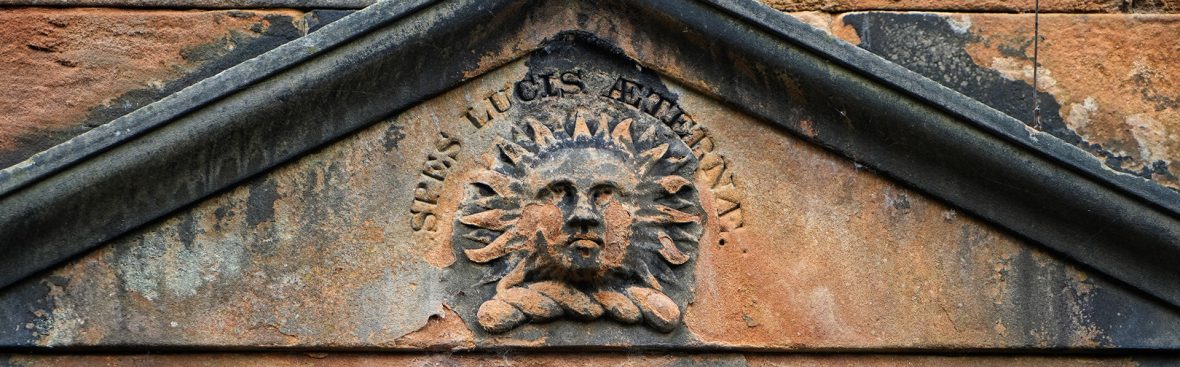
Saturday September 26th and Sunday September 27th are our annual doors open days at Greyfriars Kirkyard in Edinburgh. The Covenanters’ Prison area (which is normally closed to the general public) will be open from 10am to 4pm on these days.
Greyfriars has so much Covenanter history, with many key Covenanter events of the 17th century happening here and many key Covenanter people buried here. The National Covenant was first signed here in 1638, the men who wrote it (Archibald Johnston and Alexander Henderson) are buried here, the Covenanters’ Prison was where 1,200 combatants from the Battle of Bothwell Bridge were held in 1679 and the Martyrs Monument to the men and women who suffered between 1661 and 1688 stands here, in front of the place where many of those executed in Edinburgh are buried. And of course Bluidy Mackenzies tomb is here too.
Come along between 10am and 4pm on the 26th or 27th, the visit is entirely free of charge. We will be available to answer questions about the Kirkyard. Look for us in our green tabards, we love to talk about this place!
A few weeks ago, Friends of Greyfriars Kirkyard trustees Chris Cooper (Treasurer) and Mark Hatton (Chair) gave two fascinating talks at an evening lecture put on by Edinburgh World Heritage. Chris shed further light on the man (and woman!) behind the enigmatic Bayne monument while Mark made a compelling case for why the George Heriot marker can be considered a trendsetter for monument designs in the years that followed. Both talks can now be viewed on YouTube.
There is no doubt in my mind that the Foulis Memorial and the Bannatyne are the two most outstanding examples of monumental architecture in Greyfriars Kirkyard. Each stands alone as soaring celebrations of the symbolism of death, resurrection and status. Each is a sermon in stone that speak volumes about the people they were raised to memorialise and the time in which they died. But do they somehow speak to each other ?
The Foulis was commissioned by George Foulis, the son of the deceased and it was created by the finest Master Mason of the period, William Ayton, in 1633/34. The Bannatyne was commissioned by Janet McMath, the young wife of the deceased and also created by William Ayton in 1635. Whilst each monument has much in common, they are different in some obvious and perhaps quite subtle ways.
The Foulis is designed to be a “look at us” monument, with the portraits of the deceased loving power couple taking centre stage. They look down on viewers from their lofty stance, where they are dressed to impress in their grand, perhaps rather haughty, clothing. Despite the inscription describing them as “humble”, there is nothing remotely modest or reserved about this memorial. One can’t help but think the Kardashians would approve.
The Foulis Memorial
The Bannatyne on the other hand is designed around the theme of Vanity and the need to avoid it. “Vanitas” is the use of symbolism to convey the meaning that life on earth is but a passing phase in which ambition, and worldly desires are futile, a mere vanity. Vanitas artwork developed and became very popular in Holland in the 16th & 17th centuries, where many Scottish people went to study, trade or escape. They were influenced by this art and inevitably brought it back to Scotland. This genre is depicted on the Bannatyne with symbols showing a Cherub blowing bubbles, amongst flowers and smoke, with the words “Nothing evades Death” and “What is Man’s Life ? A shade, a smoke, a flower ; short to the good, to the bad doth long endure” and “know the vanity of transitory things”.
Perhaps this theme on the Bannatyne serves deliberately to contrast with the excessive flamboyant pretentious pomposity of the Foulis ? So could Janet McMath be speaking to George Foulis, saying “I disapprove of your vanity” in a rather subtle & dignified manner ?
The Bannatyne Memorial
That either Monument was tolerated by a strictly Protestant society in 17th Century Scotland is something of a surprise. Although perhaps Charles I’s attempts to reintroduce colour, style and ceremony in the 1630’s was almost encouraging such elaborate works.
This enclosure was raised by Rachel Balfour, the widow of William Forrester, a Writer to the King’s Signet who died in 1701. The inscription over the entrance speaks about William’s Mother & Father, of whom he was clearly very proud. William’s mother was Christine MacNeil, who had 8 sons and 3 daughters in 50 years of marriage to his father, Reverend Alexander Forrester. Alexander (born in 1611) was a committed Presbyterian and Covenanter who signed the National Covenant in 1638, served with the Covenanter Army in the 1640’s and steadfastly resisted Charles II’s attempts to impose an Episcopalian Church structure in the 1660’s. Alexander was Minister at St Mungo’s in Dumfriesshire, but refused to conform with Charles II’s “innovations” and so was expelled and subsequently arrested for holding an illegal conventicle. He then spent years imprisoned, firstly on Bass Rock and secondly in solitary confinement in the Edinburgh Tolbooth. He died in 1686 aged 75 and was buried at Greyfriars. His wife, Christine died in 1694 and was also buried at Greyfriars.
William was their 4th son who had a successful career as a Writer to the Signet. When William died in 1701 he left instructions to his Widow to erect this burial lair. When built this lair would have stood alone (like a detached house), with its elaborate external side walls, bearing many mortality symbols, fully visible. In subsequent years further burial lairs were built adjacent to the Forrester, effectively turning it in to a terraced house, with its side walls now less visible, but well worth seeking out. The Forrester Lair became a “Den” for youngsters (quite possibly pupils from Heriot’s School), who between 1710 and 1727, carved some fascinating graffiti on the inner walls, also well worth seeking out.
There is no doubt in my mind that the Foulis Memorial and the Bannatyne are the two most outstanding examples of monumental architecture in Greyfriars Kirkyard. Each stands alone as soaring celebrations of the symbolism of death, resurrection and status. Each is a sermon in stone that speak volumes about the people they were raised to memorialise and the time in which they died. But do they somehow speak to each other ?
The Foulis was commissioned by George Foulis, the son of the deceased and it was created by the finest Master Mason of the period, William Ayton, in 1633/34. The Bannatyne was commissioned by Janet McMath, the young wife of the deceased and also created by William Ayton in 1635. Whilst each monument has much in common, they are different in some obvious and perhaps quite subtle ways.
The Foulis is designed to be a “look at us” monument, with the portraits of the deceased loving power couple taking centre stage. They look down on viewers from their lofty stance, where they are dressed to impress in their grand, perhaps rather haughty, clothing. Despite the inscription describing them as “humble”, there is nothing remotely modest or reserved about this memorial. One can’t help but think the Kardashians would approve.
Here are three examples of Father Time shown on 17th century mural monuments at Greyfriars. This character plays a fascinating role. Often mistaken for the Grim Reaper, he is actually a far more benign and welcome symbol.
His origins are literally lost in the mists of time, but most think he developed from the Greek God Chronos. To the 17th century mind he symbolises that our time on earth is short and uncertain, such that at any moment our time may run out. So be prepared at all times, by being a good Christian, follow biblical teachings and repent of your sins.
Father Time is there as our guide on the journey from life, to death and onwards to heaven. He is always shown as an elderly bearded male, often with wings, telling us he is an angelic figure, sent by God. His hourglass is there to symbolise time and remind us how precious and finite it is. But what of his scythe ? This is the tool he uses to severe the ties that bind our mortal body to our immortal soul. Once these ties are severed our Soul is released, free to ascend to heaven, where we receive our reward for a good Christian life.
Have you ever noticed that the Cherub in the centre of the top panel on the Foulis Memorial has its eyes closed ? By contrast, the equivalent Cherub on the Bannatyne Memorial has its eyes wide open. Why ?
Whilst here, we should pause to consider just how much is going on on these panels. Being rather high up and difficult to see, it would be easy to miss just how much detail there is on these panels, rich in symbolism and its associated messages. I have added a description on each photo.
You are welcome to challenge or contradict my interpretation of the symbolism. It is a subject that deserves debate.
This scene is flanked by what appears to be pregnant caryatids, perhaps symbolising the promise of new life in heaven. The masked Greenman along the bottom also symbolises new life after death, as does the flowers, foliage, arrangements of fruits and stalks of wheat. The pair of small cherubs in each top corner are blowing trumpets, summoning the dead to arise. The hour glass symbolises that we need to be ready for our time to die, whilst the flaming lamp on top of the hourglass symbolises life going on. The small skull and cross bones, bound with ropes either side bottom corner symbolise what becomes of our mortal remains, which are affixed to the earth. The large Cherub leans rather casually on a skull, showing us to not be fearful of death, but we do need to be ready for it. Ready for it being having repented in time and having been faithful Christians, so deserving of resurrection to heaven. Perhaps the Cherub’s eyes are closed to show how relaxed they are, or how deep in contemplative thought ?
The Chubby Cherub symbolises a healthy new life.
The Cherub on the Bannatyne here has its eyes wide open and staring into the distance. It is surrounded by very similar symbolism to the Foulis, with several added extras. We have the skull and bones beneath the Cherub (we are not fearing death, we are beating it). We have the hourglass (be thee ready for when the time to die comes) and the foliage and wheat (new life). We have a vase full of flower to the left, then a Cityscape of buildings and towers. There is a skull peeking out of one of the windows. A tree grows out of the top of one of the towers (left) whilst the other has a huge lamp on top, from which emits a massive plume of smoke. Another large tree grows behind the Cherub. I suggest this distinctive style is showing us a Cedar of Lebanon, a tree which has held profound significance for millennia. The tree features in the Hebrew Bible, according to which the tree was used in the construction of the Jerusalem Temple by Solomon. To the right of the tree is a cluster of buildings, with what appears to be a large Church in the middle. This could be modelled on St Giles High Kirk in Edinburgh. The Bannatyne Memorial has a Vanitas theme, copying some Dutch artists of a few decades earlier. The symbolism here is clearly heavily influenced by that.
On the Foulis Mural Monument ….. did Justice & Faith ever have heads ?
So two possible answers. Maybe they were modelled on classical Greek or Roman sculptures which often don’t have heads. So maybe they never had heads when first created.
Or, they did originally have heads but these were knocked off at some stage in the past…..possibly during the time Oliver Cromwell troops garrisoned Greyfriars Kirk.
How will we ever know the answer to this question ? It is a question I often get asked and would love to be able to give a definitive answer.
Today this memorial is mounted on the north wall of the Kirk, but it wasn’t originally in this position. When Thomas Robertson died in 1686 “his most mournful wife and children erected this monument”. The memorial was created by Robert Mylne, the most famed & skill Master Mason to the Crown. They had it affixed to the West Wall of the original (Old) Greyfriars Kirk, in a prominent position for all to admire. When the New Greyfriars Kirk was added to the west end of the old Kirk, this memorial found itself hidden from view in the internal space between the old and new structures. This space was subsequently used as the coal cellar, meaning this marvellous memorial suffered the indignity of being hidden and covered in coal dust. When the dividing walls between the Old & New Kirk were finally removed in the 20th century, this monument was liberated and mounted in its current position where everyone can see it again. The inscription ends with the motto “Virtue survives the Grave”. Perhaps a footnote might be added saying “This Monument survived the Coal Cellar”.
A classic Robert Mylne design in which the central panel is made up of drapes, held up in the mouth of a beast.This small foliate face (aka Green Man) is on the monument.A winged spirit underneathFlanking the left side of the monument is a large Angel holding a skull on their knee (Angels have no gender).On the right side the flanking Angel holds the scales of judgement. Note the all seeing eye of god depicted in the centre of the swirl to the left.
The upper section of the Foulis Memorial is so high above ground level that it is difficult to fully see and appreciate the intricate artistry and symbolism that resides here. A few unusual elements that must have been a stern test of the stonemasons’ skills include :
The cherub’s arms & hands are holding the frame of the scene below.
A pair of winged cherubs are blowing trumpets of resurrection. They symbolise that the dead will arise.
Pregnant female figures (in the form of caryatids) stand either side, naked from the waist up. They symbolise that the dead will be reborn.
The skull & cross bones are tethered by ornate ropes which are threaded through the frame. This must have been exceedingly difficult to carve. These symbolise that we all will die and our mortal remains and possessions will remain on earth whilst our soul ascends to heaven.
The large central cherub is shown in a relaxed contemplative pose, surrounded by symbols of death (skull & hour glass) and resurrection (flowers, foliage & crops)
The large flower symbolises the beauty and vulnerability of life, as well as the power to be reborn after death.
A “green man” hides in plain sight on the lower border. The face is covered in foliage, symbolising new life growing after and out of death.
The winged heads symbolise the soul of the deceased ascending to heaven. The whole Foulis memorial is a tour de force of the art of the stonemasons. No expense has been spared, no corners cut and no technical challenge was regarded as too great. The Foulis family did not achieve fame by playing an enduring role in the big social, political, military, religious, economic or scientific events of their day. They simply earned a fortune, mostly from money lending. Yet this memorial has earned them an enduring fame as we still discuss them today. The cost of this memorial must surely make it one of the most expensive of any we find in burial grounds in the whole of Scotland dating to the 17th or 18th centuries. But we can confidently conclude that the Foulis family received good value for money as by spending big, their name lives on, which is what a memorial seeks to achieve. George Heriot, another major money lender of the same period and a relative of the Foulis family, achieved the same result. But not by financing a big memorial above his burial place (which is at St Martin-in-the-Fields in London) but by leaving much of his fortune to establish Heriots School and Heriot Watt University. Those endowments amounted to over £25,000 (equivalent to £25 million today). The Foulis family will have spent a fraction of that amount on this memorial, but I estimate it will have cost up to £500 (or £500,000 in today’s terms).
1 Winged cherub framing scene
This is the winged cherub whose arms appear to be holding the whole upper central scene. It is a most unusual pose, that must have been difficult to carve and could easily be overlooked. But once you see it, it is a detail that adds interest and impresses us further. The facial features are brilliantly carved giving the figure a personality & warm quality.
Winged cherub framing scene
2 Winged cherubs with trumpets
This is one of the pair of winged cherubs (angels) blowing trumpets of resurrection, pointing down towards the ground in which the dead are buried. They, like all of the Cherubs on this monument, have a very life like appearance, with a particularly well carved mouth, nose & eyes. They seem to display a deliberately warm & friendly character. The floral, fruity display behind them is further reinforcing the resurrection/ new life after death message.
Winged cherubs with trumpets
3 Caryatids
The pregnant & naked female figures forming the columns either side of this upper panel. These are Caryatids, a classical architectural device found on Ancient Greek buildings. This is a deliberate effort to evoke classical art, demonstrating the sophistication and education of the family. The figures are here to symbolise the power to bring forward new life. They are supporting their heads by holding their necks.
Caryatids
4 Skull & crossbones
The skull & cross bones is the most prevalent mortality symbol, serving to remind viewers to prepare for their inevitable death by living a good Christian lifestyle. The message is often reinforced by tethering the symbol with a rope or ribbon, symbolising that earthly assets and matters are of no value to us after death. A big effort has been made here to show the tether which is shown threaded through the structure to emphasis how securely bound it is. At the ends of the tether are decorative tassels that add weight.
Skull & crossbones
5 Central cherub
The central Cherub is shown, eyes closed to empathise its contemplative nature. It rests casually on a large skull, beside a brilliantly carved hourglass which has a flaming torch on top. The message is to contemplate death, the time of which will inevitably arrive, without any suggestion that these people fear death. This is designed to tell us that they are fully confident of their resurrection and admission to heaven so death holds no concerns, indeed death is the gateway to a new blissful life in heaven.
Central cherub
6 Flower
The large flower with leafy stem symbolises the frail, temporary beauty of life and the ability for life to go on after death (like flowers can die back in the autumn but grow up again in the spring). The carving of this element is less pronounced than the rest of the scene so sadly it has faded somewhat, compared to the still vibrant carvings that surround it.
The Museum of Edinburgh at Huntly House on Cannongate has a gravestone which they believe was originally at Greyfriars Kirkyard. The gravestone records the names, ages and years of death as Helen Alexander, who died in 1729 aged 75 years & her husband, James Currie, who died in 1736 aged 80 years. The museum notice accompanying this gravestone provides a few inaccurate statements about it. It says this gravestone was believed to have originally been raised at Greyfriars and that James Currie was a Stonemason who carved the Covenanters Martyrs Monument at Greyfriars and that the gravestone features tools of a Stonemason. Non of these statements appear to be correct.
James was not a Stonemason, but a successful Merchant and together with his Wife, Helen, they collected a large number of testaments from Covenanters facing the death penalty in Edinburgh. This collection included sermons, speeches, writings and comments by many Covenanters dating from the 1650’s through to the 1690’s. James published this collection in a book that ran to over 780 pages.
James & Helen were primarily responsible for raising the first Martyrs Monument at Greyfriars. They came up with the idea, petitioned the Council, raised the funding and quite possibly drafted the inscription.
They died at the grand ages of 75 & 80 respectively and were buried in their Parish at Old Pentland. Their gravestone is an impressive example of the type produced in the 1730’s, carved on all 4 faces. Such headstones were not allowed at Greyfriars in that period as only mural (wall mounted) monuments and burial lairs were allowed arranged around the perimeter of the burial ground, with no freestanding headstones allowed on the grass until around 1750. This was because the volume of burials at Greyfriars was so great, headstones would have got in the way. The headstone symbols on James & Helen’s stones are the standard Memento Mori, skull, cross bones, scythe, with the gravedigger’s tools of spade, turf cutter & pick axe. The museum appears to have mistaken these for the tools of a Stonemason.
Attached are photos of each face of the headstone, plus the information panel. A photo of the book James & Helen published together with a newspaper article that recounts their story.
The Museum of Edinburgh, at Huntly House on Cannongate, EdinburghThe Museum of Edinburgh, at Huntly House on Cannongate, EdinburghThe Museum of Edinburgh, at Huntly House on Cannongate, EdinburghThe Museum of Edinburgh, at Huntly House on Cannongate, EdinburghThe Museum of Edinburgh, at Huntly House on Cannongate, EdinburghThe Museum of Edinburgh, at Huntly House on Cannongate, EdinburghThe Museum of Edinburgh, at Huntly House on Cannongate, Edinburgh