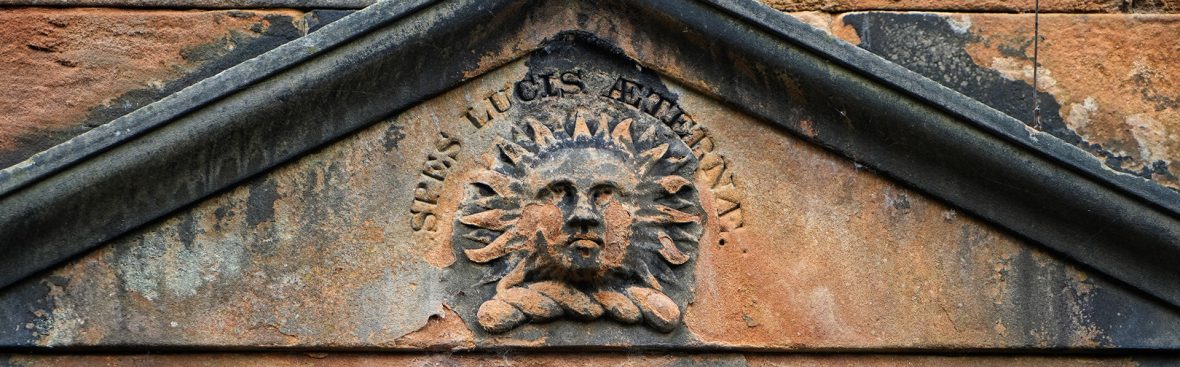
Saturday September 26th and Sunday September 27th are our annual doors open days at Greyfriars Kirkyard in Edinburgh. The Covenanters’ Prison area (which is normally closed to the general public) will be open from 10am to 4pm on these days.
Greyfriars has so much Covenanter history, with many key Covenanter events of the 17th century happening here and many key Covenanter people buried here. The National Covenant was first signed here in 1638, the men who wrote it (Archibald Johnston and Alexander Henderson) are buried here, the Covenanters’ Prison was where 1,200 combatants from the Battle of Bothwell Bridge were held in 1679 and the Martyrs Monument to the men and women who suffered between 1661 and 1688 stands here, in front of the place where many of those executed in Edinburgh are buried. And of course Bluidy Mackenzies tomb is here too.
Come along between 10am and 4pm on the 26th or 27th, the visit is entirely free of charge. We will be available to answer questions about the Kirkyard. Look for us in our green tabards, we love to talk about this place!
This enclosure was raised by Rachel Balfour, the widow of William Forrester, a Writer to the King’s Signet who died in 1701. The inscription over the entrance speaks about William’s Mother & Father, of whom he was clearly very proud. William’s mother was Christine MacNeil, who had 8 sons and 3 daughters in 50 years of marriage to his father, Reverend Alexander Forrester. Alexander (born in 1611) was a committed Presbyterian and Covenanter who signed the National Covenant in 1638, served with the Covenanter Army in the 1640’s and steadfastly resisted Charles II’s attempts to impose an Episcopalian Church structure in the 1660’s. Alexander was Minister at St Mungo’s in Dumfriesshire, but refused to conform with Charles II’s “innovations” and so was expelled and subsequently arrested for holding an illegal conventicle. He then spent years imprisoned, firstly on Bass Rock and secondly in solitary confinement in the Edinburgh Tolbooth. He died in 1686 aged 75 and was buried at Greyfriars. His wife, Christine died in 1694 and was also buried at Greyfriars.
William was their 4th son who had a successful career as a Writer to the Signet. When William died in 1701 he left instructions to his Widow to erect this burial lair. When built this lair would have stood alone (like a detached house), with its elaborate external side walls, bearing many mortality symbols, fully visible. In subsequent years further burial lairs were built adjacent to the Forrester, effectively turning it in to a terraced house, with its side walls now less visible, but well worth seeking out. The Forrester Lair became a “Den” for youngsters (quite possibly pupils from Heriot’s School), who between 1710 and 1727, carved some fascinating graffiti on the inner walls, also well worth seeking out.
There is no doubt in my mind that the Foulis Memorial and the Bannatyne are the two most outstanding examples of monumental architecture in Greyfriars Kirkyard. Each stands alone as soaring celebrations of the symbolism of death, resurrection and status. Each is a sermon in stone that speak volumes about the people they were raised to memorialise and the time in which they died. But do they somehow speak to each other ?
The Foulis was commissioned by George Foulis, the son of the deceased and it was created by the finest Master Mason of the period, William Ayton, in 1633/34. The Bannatyne was commissioned by Janet McMath, the young wife of the deceased and also created by William Ayton in 1635. Whilst each monument has much in common, they are different in some obvious and perhaps quite subtle ways.
The Foulis is designed to be a “look at us” monument, with the portraits of the deceased loving power couple taking centre stage. They look down on viewers from their lofty stance, where they are dressed to impress in their grand, perhaps rather haughty, clothing. Despite the inscription describing them as “humble”, there is nothing remotely modest or reserved about this memorial. One can’t help but think the Kardashians would approve.
The Museum of Edinburgh at Huntly House on Cannongate has a gravestone which they believe was originally at Greyfriars Kirkyard. The gravestone records the names, ages and years of death as Helen Alexander, who died in 1729 aged 75 years & her husband, James Currie, who died in 1736 aged 80 years. The museum notice accompanying this gravestone provides a few inaccurate statements about it. It says this gravestone was believed to have originally been raised at Greyfriars and that James Currie was a Stonemason who carved the Covenanters Martyrs Monument at Greyfriars and that the gravestone features tools of a Stonemason. Non of these statements appear to be correct.
James was not a Stonemason, but a successful Merchant and together with his Wife, Helen, they collected a large number of testaments from Covenanters facing the death penalty in Edinburgh. This collection included sermons, speeches, writings and comments by many Covenanters dating from the 1650’s through to the 1690’s. James published this collection in a book that ran to over 780 pages.
James & Helen were primarily responsible for raising the first Martyrs Monument at Greyfriars. They came up with the idea, petitioned the Council, raised the funding and quite possibly drafted the inscription.
They died at the grand ages of 75 & 80 respectively and were buried in their Parish at Old Pentland. Their gravestone is an impressive example of the type produced in the 1730’s, carved on all 4 faces. Such headstones were not allowed at Greyfriars in that period as only mural (wall mounted) monuments and burial lairs were allowed arranged around the perimeter of the burial ground, with no freestanding headstones allowed on the grass until around 1750. This was because the volume of burials at Greyfriars was so great, headstones would have got in the way. The headstone symbols on James & Helen’s stones are the standard Memento Mori, skull, cross bones, scythe, with the gravedigger’s tools of spade, turf cutter & pick axe. The museum appears to have mistaken these for the tools of a Stonemason.
Attached are photos of each face of the headstone, plus the information panel. A photo of the book James & Helen published together with a newspaper article that recounts their story.
The Museum of Edinburgh, at Huntly House on Cannongate, EdinburghThe Museum of Edinburgh, at Huntly House on Cannongate, EdinburghThe Museum of Edinburgh, at Huntly House on Cannongate, EdinburghThe Museum of Edinburgh, at Huntly House on Cannongate, EdinburghThe Museum of Edinburgh, at Huntly House on Cannongate, EdinburghThe Museum of Edinburgh, at Huntly House on Cannongate, EdinburghThe Museum of Edinburgh, at Huntly House on Cannongate, Edinburgh