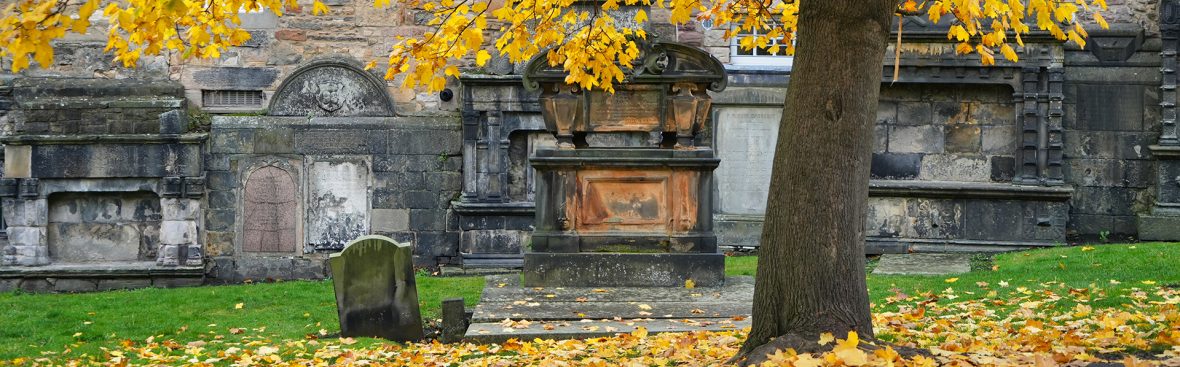

This enclosure was raised by Rachel Balfour, the widow of William Forrester, a Writer to the King’s Signet who died in 1701. The inscription over the entrance speaks about William’s Mother & Father, of whom he was clearly very proud. William’s mother was Christine MacNeil, who had 8 sons and 3 daughters in 50 years of marriage to his father, Reverend Alexander Forrester. Alexander (born in 1611) was a committed Presbyterian and Covenanter who signed the National Covenant in 1638, served with the Covenanter Army in the 1640’s and steadfastly resisted Charles II’s attempts to impose an Episcopalian Church structure in the 1660’s. Alexander was Minister at St Mungo’s in Dumfriesshire, but refused to conform with Charles II’s “innovations” and so was expelled and subsequently arrested for holding an illegal conventicle. He then spent years imprisoned, firstly on Bass Rock and secondly in solitary confinement in the Edinburgh Tolbooth. He died in 1686 aged 75 and was buried at Greyfriars. His wife, Christine died in 1694 and was also buried at Greyfriars.
William was their 4th son who had a successful career as a Writer to the Signet. When William died in 1701 he left instructions to his Widow to erect this burial lair. When built this lair would have stood alone (like a detached house), with its elaborate external side walls, bearing many mortality symbols, fully visible. In subsequent years further burial lairs were built adjacent to the Forrester, effectively turning it in to a terraced house, with its side walls now less visible, but well worth seeking out. The Forrester Lair became a “Den” for youngsters (quite possibly pupils from Heriot’s School), who between 1710 and 1727, carved some fascinating graffiti on the inner walls, also well worth seeking out.
There is no doubt in my mind that the Foulis Memorial and the Bannatyne are the two most outstanding examples of monumental architecture in Greyfriars Kirkyard. Each stands alone as soaring celebrations of the symbolism of death, resurrection and status. Each is a sermon in stone that speak volumes about the people they were raised to memorialise and the time in which they died. But do they somehow speak to each other ?
The Foulis was commissioned by George Foulis, the son of the deceased and it was created by the finest Master Mason of the period, William Ayton, in 1633/34. The Bannatyne was commissioned by Janet McMath, the young wife of the deceased and also created by William Ayton in 1635. Whilst each monument has much in common, they are different in some obvious and perhaps quite subtle ways.
The Foulis is designed to be a “look at us” monument, with the portraits of the deceased loving power couple taking centre stage. They look down on viewers from their lofty stance, where they are dressed to impress in their grand, perhaps rather haughty, clothing. Despite the inscription describing them as “humble”, there is nothing remotely modest or reserved about this memorial. One can’t help but think the Kardashians would approve.


