A good turnout today saw us Litter Picking, Gravel Gathering, Fence Fixing, Sign Shining, Buddleia Bashing, Seat Washing & Mud Larking. With the gravel washed away by the August Monsoon returned to its proper location, the muddy soil that had spread on to the path returned to the flower bed, the bird poop washed off the seats & signs, the Buddleia removed from the south wall, the fence posts along the edge of McGonagal restored to an upright position and all remaining litter picked and put in the bins. The result is a nice and tidy, clean, welcoming & happy kirkyard. Many thanks to all of the old and new members who came along to help today !
The Summer surge is now in full swing, with the Kirkyard looking like crowds attending a football match at times today. This volume of visitors brings a tsunami of litter with it. So it was a particularly good start to the day today with a mammoth load of litter, rubbish and assorted nasties leaving the Kirkyard after a big clean up effort over the last 24 hours. Paul Cunningham was definitely the star for the shear volume and weight of rubbish he lifted today.
In slightly less positive news the downpour of rain midweek washed a lot of mud & gravel down the Yard, which has once again clogged the gutter above the bottom steps and coated the Grassmarket steps in mud, particularly foul smelling mud at the bottom where the drain is still blocked. Tom was once again the star man for cleaning up the bottom section and the steps, but non of us could face clearing the gutter again. One bit of progress has been the complete clearance of buddleia and ivy from the George Heriot tomb, aided by a resident of Candlemaker Row who has leant out of their window to cut back the ivy that we couldn’t reach.
We had another good turnout today, but in all of the work I forgot to take a group photo. Our next First Sunday is on the 6th September.
Crowds in the Kirkyard this morning.The lorry load of rubbish ready for departure. It took a big effort to collect all of this rubbish over the last 24 hours and Paul C did most of it. Fantastic job !Tom looking rather downcast because all of his work to keep this gutter clear in recent weeks was thwarted by the midweek downpour. That washed mud and gravel down to once again block this gutter.This is what the gutter looked like before the downpour. Sadly the drainage in the Kirkyard simply can’t cope with heavy rain.By contrast, this is what George Heriot looked like a couple of weeks ago. Lots of buddleia and ivy covering the monument. We had cleared it from the face of the monument but not from the top.By contrast, this is what George Heriot looked like a couple of weeks ago. Lots of buddleia and ivy covering the monument. We had cleared it from the face of the monument but not from the top.
The recent drought is revealing where the walls around the burial lairs used to be. As the grass dehydrates and the ground shrinks back, the areas with shallow soil above buried hidden old stone walls brown off earlier than the rest of the grass. This reveals the ghosts of the old walls. Once the rain returns the grass will green, the earth will swell and these marks will disappear again, until the next drought.
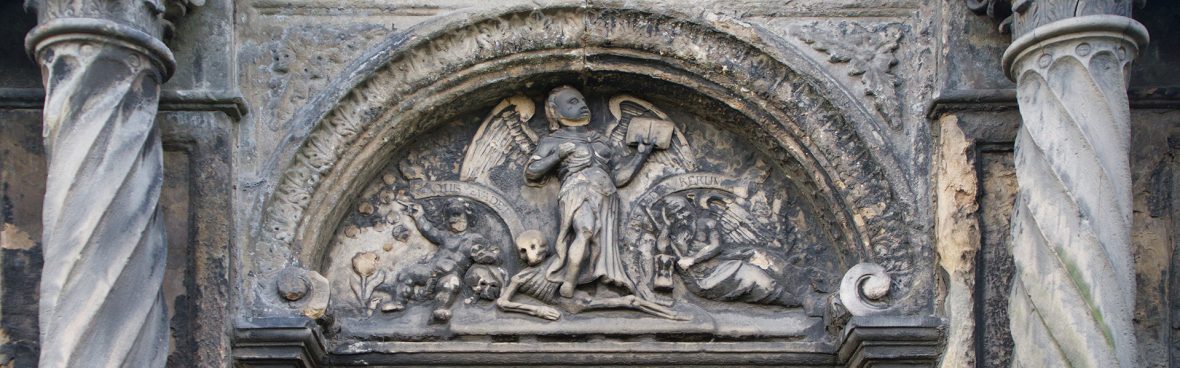
The cracks that were threatening the integrity and symbolism of the Bannatyne Monument have been repaired. Nic Boyes, a highly skilled and experienced stone conservator, set about the task by injecting a paraloid in to the cracks, then applying resin. This will hopefully ensure that this wondrous example of 17th century symbolism is preserved for future generations to admire and marvel at.
Stone Conservation Students watched on to learn the techniques being used. Mark & Kev from the Edinburgh Bereavement Services erected the platform and took the opportunity to remove the buddleia and privet that was growing on the monument. Thanks to Susan at Edinburgh World Heritage for organising and funding the conservation work. It is fantastic to see this monument cherished like this.
Before.After.Work in progress.Stone Conservation Students from Edinburgh University watching and learning the specialist techniques required for a project of this nature.Mark & Kev erected and dismantled the platform.The vegetation that had been growing (bottom left) was cut back, giving us an unobstructed view of the top section of the monument.A view of the image on the monument that I believe depicts Thomas Bannatyne looking out from a burial shroud. This had been obscured by vegetation but is now visible. Need to find a way to treat that root stock to prevent regrowth.
So today we shifted a huge amount of Buddleia from the tops of the west walls around the Kirkyard. The priority was to remove the flower heads before they set seed and further spread this very invasive plant into every nook & cranny. Whilst Buddleia might look pretty, it causes a lot of damage to the stonework and obscures the view of the monuments. We find that extendable loppers are a safe and effective way to cut back the buddleia without the danger of using chemicals, the risk of using ladders or the cost of using a cherry picker. It isn’t perfect, but it certainly is better than letting the buddleia take over. Thanks to Paul, Paul, Paul and Tom for putting in a hell of a shift today.
Snipping away at this very determined and fast growing plant.One clump of buddleia pushing the stonework apart before we set about it.30 minutes later, this buddleia is down and bagged, ready to be loaded on to the trailer and taken off site.A trailer full of buddleia from all around the Kirkyard. Many dumpy bag loads each weighing 10 stone or more.
Great to see some new youthful faces at today’s First Sunday (despite the damp weather). We had a good go at removing the Buddleia from the monuments along the East Wall and picked up all of the fallen branches from the recent high winds. Plus a thorough litterpick. We then had a Geek session looking at Marriage related stories around the Kirkyard, in preparation for a wedding party tour soon. A very productive and enjoyable afternoon, many thanks to everyone who came along and grafted today.
One of the enduring mysteries of Greyfriars Kirkyard is we still don’t know where the original Grey Friars buildings were. When the Grey Friars established a Friary in Edinburgh in the early 15th century James I granted them the land that now forms the Kirkyard. Over the years they were based in Edinburgh they will have developed a friary church, a cloister, refectory, and dormitory. This complex would not necessarily have been particularly large, as there were likely no more than a couple of dozen Friars based here. The rest of their land was used for growing food and herbs used to feed the hungry and treat the sick of Edinburgh. But during the Reformation the Friars were banished and their buildings demolished. No one today knows what buildings they had or precisely where they were. Most historians appear to have concluded that these buildings were in the North end of the current burial ground, on the edge of the Grassmarket. But others (me included) speculate that Greyfriars Kirk built between 1610 & 1620 was founded on the footprint of the old Friary, incorporating where convenient the stonework of the much earlier buildings.
There are several things that corroborate this theory. Firstly this is a flat section of ground, that sits in the middle of the land, so a better position to locate the Friary than on the slope near the Grassmarket. Secondly if we look closely we can see evidence of an older building lying underneath the current Kirk. These photos illustrate where the walls, pillars and buttressing of the Kirk appear to have been built off earlier foundations.
Thanks to Jamie Moffat at the Kirk for identifying and allowing access to these old areas of stonework.
One of the original buttresses stands on top of stonework that looks like an earlier structure, incorporating a rounded profile. Are these stones remnants of the original Friary?In the South East corner of the Kirk, hidden by boxing in, we can see the remains of a structure that is much wider than the Kirk’s walls that have been built on top. Are these the remains of the earlier Friary building?Some of the original internal pillars of the Kirk have been built on bases that don’t match the shape of the pillar. Were these bases part of the earlier Friary building?
In time for the James Hutton memorial concert in Greyfriars Kirk on Saturday, the Hutton lair in the Covenanters has had a makeover. The drain was taken out by Edinburgh University, Edinburgh Bereavement Services then made good the wall, we thoroughly weeded the lair and today 2 tons of nice new gravel was put in and levelled out. It now looks fly !
That drain was washing the gravel away.The drain was removed by Edinburgh University.Edinburgh Bereavement Services made good the wall.And today 2 tons of new gravel has been applied to make the lair look its best.
There is one particularly gruesome and disconcerting tomb in Greyfriars Kirkyard, which is on the West Wall. This is the family tomb for the Chiesley’s. It features a spatchcocked skeleton, wearing a crown whilst floating in a skull soup, looking as if it has just given birth to a basketball. One may well ask “why” would the Chiesley Family choose such imagery for their family memorial. Well this is a rather “colourful” family, which had some rather unusual lifestyles and stories. Let’s just consider three members of this family, Robert Chiesley, his brother John and John’s daughter, Rachel.
Robert Chiesley was a successful Merchant, who lost a fortune in the Darien Scheme and then lost his mind, ending his days as a resident in Bedlam, just a few yards from Greyfriars Kirkyard.
John Chiesley abandoned his wife after they had 10 children together. When Judge Lockhart ordered John to pay alimony to his wife he was so offended that he followed the Judge home and shot him dead in the street. He never denied the Murder, simply saying he was judging the Judge for his outrageous verdict. John was tortured, then taken to the gallows, where his right hand was cut off and he was then hung in chains with his gun tied around his neck. Ever since his ghost has been named Johnny One Arm.
But it was John’s Daughter, Rachel, who perhaps had the maddest life. Rachel was only ten years old when her Father was executed and she grew up to be quite a “wild lady”. It is said that she fell pregnant by James Erskine, aka Lord Grange, then forced him to marry her by holding a gun to his head. She went on to have 9 children with Erskine.
When she discovered he had a mistress she variously threatened to commit suicide, or to run naked through the streets of Edinburgh, or to expose Erskine for his Jacobite sympathies, something that could have got him in to a heap of trouble. So Erskine arranged for Rachel to be kidnapped. He made up a story that she had died and he arranged a funeral at Greyfriars to prove it. Meanwhile Rachel was taken to a tiny, barely habited island off North Uist called Husker, where she lived in very basic conditions for two years, before being moved to a tiny stone hut on St Kilda (called a Cleit) where she was held in even worse conditions for 6 years. She wrote that “I was in great miserie in the Husker but I’m ten times worse and worse here”.
At the age of 61 rumours that she was being held on St Kilda caused a rescue party to set sail to find her, but she had been moved, eventually ending up on Skye. She was initially housed in a cave, before a humble cottage became her secret home for the final few years of her life. Initially she was buried under the cover of darkness at Waternish. When her existence and death became known, another well attended funeral was held for her, in which the coffin was apparently filled with stones. Her story became very popular and features in many songs, poems, novels and even a play.
So next time you are in Greyfriars Kirkyard, take a look at the gruesome Chiesley Tomb and reflect on what a Mad, Bad, Dangerous & Tormented family they were.
As the 300th anniversary of the birth of James Hutton approaches (3rd June) we are getting more geologists wanting to visit his memorial. The respect and affection these visitors have for James Hutton serves to remind us just how great an impact this man had and continues to have on people who understand his genius, have studied his work and followed in his footsteps by becoming geologists.
Every one of the people buried at Greyfriars Kirkyard have individual stories, deserve to be remembered and respected for the lives they lived. But very few still command the esteem and reverence of James Hutton.
A Group from the Geological Society of America in Edinburgh this week to celebrate James Hutton’s anniversary’s
An American Couple who have long admired James Hutton and flew in to Edinburgh so they could lay a wreath at his grave.