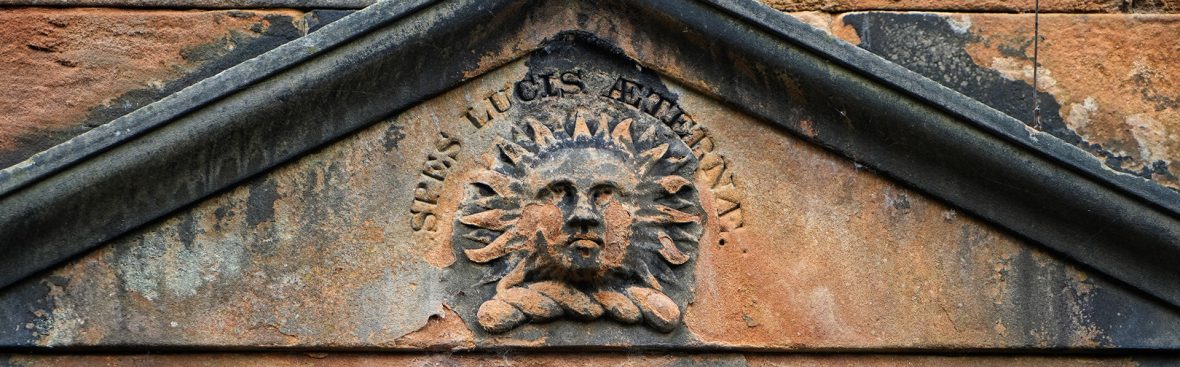
The cracks that were threatening the integrity and symbolism of the Bannatyne Monument have been repaired. Nic Boyes, a highly skilled and experienced stone conservator, set about the task by injecting a paraloid in to the cracks, then applying resin. This will hopefully ensure that this wondrous example of 17th century symbolism is preserved for future generations to admire and marvel at.
Stone Conservation Students watched on to learn the techniques being used. Mark & Kev from the Edinburgh Bereavement Services erected the platform and took the opportunity to remove the buddleia and privet that was growing on the monument. Thanks to Susan at Edinburgh World Heritage for organising and funding the conservation work. It is fantastic to see this monument cherished like this.
Before.After.Work in progress.Stone Conservation Students from Edinburgh University watching and learning the specialist techniques required for a project of this nature.Mark & Kev erected and dismantled the platform.The vegetation that had been growing (bottom left) was cut back, giving us an unobstructed view of the top section of the monument.A view of the image on the monument that I believe depicts Thomas Bannatyne looking out from a burial shroud. This had been obscured by vegetation but is now visible. Need to find a way to treat that root stock to prevent regrowth.
There is no doubt in my mind that the Foulis Memorial and the Bannatyne are the two most outstanding examples of monumental architecture in Greyfriars Kirkyard. Each stands alone as soaring celebrations of the symbolism of death, resurrection and status. Each is a sermon in stone that speak volumes about the people they were raised to memorialise and the time in which they died. But do they somehow speak to each other ?
The Foulis was commissioned by George Foulis, the son of the deceased and it was created by the finest Master Mason of the period, William Ayton, in 1633/34. The Bannatyne was commissioned by Janet McMath, the young wife of the deceased and also created by William Ayton in 1635. Whilst each monument has much in common, they are different in some obvious and perhaps quite subtle ways.
The Foulis is designed to be a “look at us” monument, with the portraits of the deceased loving power couple taking centre stage. They look down on viewers from their lofty stance, where they are dressed to impress in their grand, perhaps rather haughty, clothing. Despite the inscription describing them as “humble”, there is nothing remotely modest or reserved about this memorial. One can’t help but think the Kardashians would approve.
The Foulis Memorial
The Bannatyne on the other hand is designed around the theme of Vanity and the need to avoid it. “Vanitas” is the use of symbolism to convey the meaning that life on earth is but a passing phase in which ambition, and worldly desires are futile, a mere vanity. Vanitas artwork developed and became very popular in Holland in the 16th & 17th centuries, where many Scottish people went to study, trade or escape. They were influenced by this art and inevitably brought it back to Scotland. This genre is depicted on the Bannatyne with symbols showing a Cherub blowing bubbles, amongst flowers and smoke, with the words “Nothing evades Death” and “What is Man’s Life ? A shade, a smoke, a flower ; short to the good, to the bad doth long endure” and “know the vanity of transitory things”.
Perhaps this theme on the Bannatyne serves deliberately to contrast with the excessive flamboyant pretentious pomposity of the Foulis ? So could Janet McMath be speaking to George Foulis, saying “I disapprove of your vanity” in a rather subtle & dignified manner ?
The Bannatyne Memorial
That either Monument was tolerated by a strictly Protestant society in 17th Century Scotland is something of a surprise. Although perhaps Charles I’s attempts to reintroduce colour, style and ceremony in the 1630’s was almost encouraging such elaborate works.
Have you ever noticed that the Cherub in the centre of the top panel on the Foulis Memorial has its eyes closed ? By contrast, the equivalent Cherub on the Bannatyne Memorial has its eyes wide open. Why ?
Whilst here, we should pause to consider just how much is going on on these panels. Being rather high up and difficult to see, it would be easy to miss just how much detail there is on these panels, rich in symbolism and its associated messages. I have added a description on each photo.
You are welcome to challenge or contradict my interpretation of the symbolism. It is a subject that deserves debate.
This scene is flanked by what appears to be pregnant caryatids, perhaps symbolising the promise of new life in heaven. The masked Greenman along the bottom also symbolises new life after death, as does the flowers, foliage, arrangements of fruits and stalks of wheat. The pair of small cherubs in each top corner are blowing trumpets, summoning the dead to arise. The hour glass symbolises that we need to be ready for our time to die, whilst the flaming lamp on top of the hourglass symbolises life going on. The small skull and cross bones, bound with ropes either side bottom corner symbolise what becomes of our mortal remains, which are affixed to the earth. The large Cherub leans rather casually on a skull, showing us to not be fearful of death, but we do need to be ready for it. Ready for it being having repented in time and having been faithful Christians, so deserving of resurrection to heaven. Perhaps the Cherub’s eyes are closed to show how relaxed they are, or how deep in contemplative thought ?
The Chubby Cherub symbolises a healthy new life.
The Cherub on the Bannatyne here has its eyes wide open and staring into the distance. It is surrounded by very similar symbolism to the Foulis, with several added extras. We have the skull and bones beneath the Cherub (we are not fearing death, we are beating it). We have the hourglass (be thee ready for when the time to die comes) and the foliage and wheat (new life). We have a vase full of flower to the left, then a Cityscape of buildings and towers. There is a skull peeking out of one of the windows. A tree grows out of the top of one of the towers (left) whilst the other has a huge lamp on top, from which emits a massive plume of smoke. Another large tree grows behind the Cherub. I suggest this distinctive style is showing us a Cedar of Lebanon, a tree which has held profound significance for millennia. The tree features in the Hebrew Bible, according to which the tree was used in the construction of the Jerusalem Temple by Solomon. To the right of the tree is a cluster of buildings, with what appears to be a large Church in the middle. This could be modelled on St Giles High Kirk in Edinburgh. The Bannatyne Memorial has a Vanitas theme, copying some Dutch artists of a few decades earlier. The symbolism here is clearly heavily influenced by that.