A few weeks ago, Friends of Greyfriars Kirkyard trustees Chris Cooper (Treasurer) and Mark Hatton (Chair) gave two fascinating talks at an evening lecture put on by Edinburgh World Heritage. Chris shed further light on the man (and woman!) behind the enigmatic Bayne monument while Mark made a compelling case for why the George Heriot marker can be considered a trendsetter for monument designs in the years that followed. Both talks can now be viewed on YouTube.
There is one particularly gruesome and disconcerting tomb in Greyfriars Kirkyard, which is on the West Wall. This is the family tomb for the Chiesley’s. It features a spatchcocked skeleton, wearing a crown whilst floating in a skull soup, looking as if it has just given birth to a basketball. One may well ask “why” would the Chiesley Family choose such imagery for their family memorial. Well this is a rather “colourful” family, which had some rather unusual lifestyles and stories. Let’s just consider three members of this family, Robert Chiesley, his brother John and John’s daughter, Rachel.
Robert Chiesley was a successful Merchant, who lost a fortune in the Darien Scheme and then lost his mind, ending his days as a resident in Bedlam, just a few yards from Greyfriars Kirkyard.
John Chiesley abandoned his wife after they had 10 children together. When Judge Lockhart ordered John to pay alimony to his wife he was so offended that he followed the Judge home and shot him dead in the street. He never denied the Murder, simply saying he was judging the Judge for his outrageous verdict. John was tortured, then taken to the gallows, where his right hand was cut off and he was then hung in chains with his gun tied around his neck. Ever since his ghost has been named Johnny One Arm.
But it was John’s Daughter, Rachel, who perhaps had the maddest life. Rachel was only ten years old when her Father was executed and she grew up to be quite a “wild lady”. It is said that she fell pregnant by James Erskine, aka Lord Grange, then forced him to marry her by holding a gun to his head. She went on to have 9 children with Erskine.
When she discovered he had a mistress she variously threatened to commit suicide, or to run naked through the streets of Edinburgh, or to expose Erskine for his Jacobite sympathies, something that could have got him in to a heap of trouble. So Erskine arranged for Rachel to be kidnapped. He made up a story that she had died and he arranged a funeral at Greyfriars to prove it. Meanwhile Rachel was taken to a tiny, barely habited island off North Uist called Husker, where she lived in very basic conditions for two years, before being moved to a tiny stone hut on St Kilda (called a Cleit) where she was held in even worse conditions for 6 years. She wrote that “I was in great miserie in the Husker but I’m ten times worse and worse here”.
At the age of 61 rumours that she was being held on St Kilda caused a rescue party to set sail to find her, but she had been moved, eventually ending up on Skye. She was initially housed in a cave, before a humble cottage became her secret home for the final few years of her life. Initially she was buried under the cover of darkness at Waternish. When her existence and death became known, another well attended funeral was held for her, in which the coffin was apparently filled with stones. Her story became very popular and features in many songs, poems, novels and even a play.
So next time you are in Greyfriars Kirkyard, take a look at the gruesome Chiesley Tomb and reflect on what a Mad, Bad, Dangerous & Tormented family they were.
This is a slightly odd one for several reasons. Firstly it is inside the Greyfriars Kirk rather than outside. Secondly, it spent the first 290 years of its life elsewhere and was only moved here in 1938.
This is the memorial for Lady Yester (1572-1647). Margaret, Lady Yester donated funds to complete the Tron Kirk on the High Street in 1641 and further funds to build a new Kirk on Infirmary Street in 1644. This new Kirk bore her name. Lady Yester was buried in an aisle at that Kirk when she died aged 75 in 1647 and this elaborate memorial plaque was raised above her grave.
The original Lady Yester Kirk building was replaced in 1805 (with Lady Yester’s memorial retained) and in 1938 that Kirk building was sold to Edinburgh University to be used as their Estates Office (a role it still serves) and the congregation merged with Greyfriars. At that time Lady Yester’s memorial was itself moved to Greyfriars Kirk and now occupies the South East corner of the Kirk (known as Lady Yester’s Aisle).
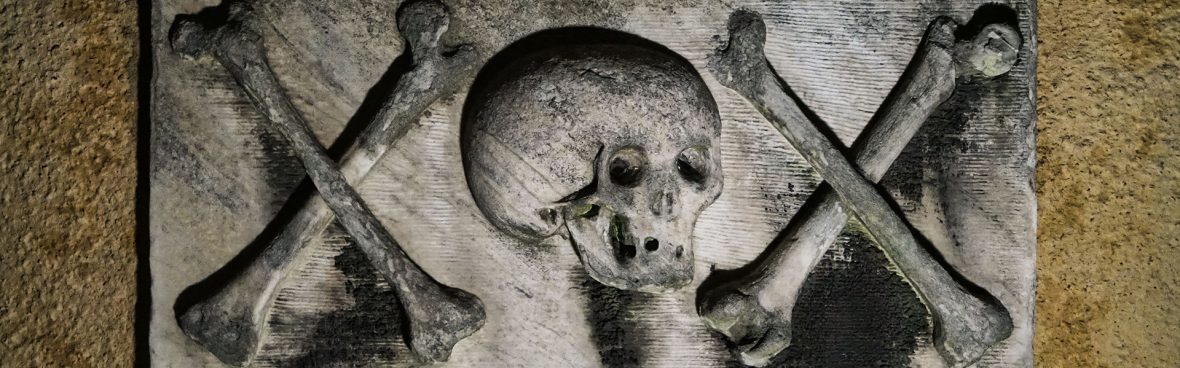
Lady Yester’s memorial is very ornate with gold gilding and inlays that make it stand out. At the bottom of the plaque is a skull and crossbones on a swag. At the top is the family’s Crest consisting of a radiant sun beneath the family motto “LUX VENIT AB ALTO” (“light comes from on high”). The central panel is framed by pillars between which is another skull and crossbones topped by an hourglass, wings, and blades of corn. This is surrounded by the mottoes “MORS PATET HORA LATET” (“death is sure, the hour unsure”) and “SPES ALTERA VITÆ” (“hope for another life”). The inscription (with its quirky spelling) reads :
IT’S NEIDLES TO ERECT A MARBLE TOMBE THE DAYLIE BREAD THAT FOR THE HUNGRY WOMBE AND BREAD OF LYF THY BOUNTIE HATH PROVYDED FOR HUNGRIE SOULES ALL TYMES TO BE DIVYDED WORLD LASTING MONIMENTIS SHALL REARE THAT SHAL ENDURE TIL CHRIST HIMSELF APPEARE POS’D WAS THY LYF PREPAR’D THY HAPPIE END NOTHING IN EITHER WAS WITHOUT COMMEND LET IT BE THE CAIR OF AL THAT LIVE THEREFTER TO LIVE & DIE LIKE MARGARET LADY YESTER WHO DIED 15 MARCH 1647 HER AGE 75