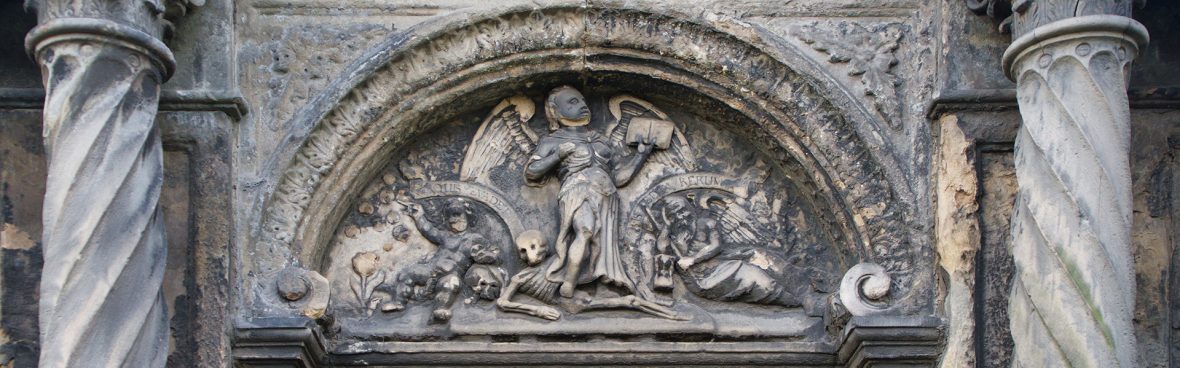
The burial lairs inside the Southern Greyfriars Yard (aka The Covenanters Prison) often have pairs of Death Heads facing each other on either side. These generally have a bone below and a banner above with messages in Latin that translate to sayings such as “Today me, tomorrow you”, “Live remembering death”, “Hope for the next life” and “Remember you will die”. Here are 9 pairs.
Saturday 12th September 2026 was James Anderson Day — and what a day it was.
Just 340 years ago, a craftsman, James Anderson was owed £80 for “painting, colouring and gilding” the newly built John Baine of Pitcairlie mausoleum. We know remarkably little about the people who actually built 17th-century Edinburgh, and here, at last, is one of their names.
To mark the occasion, Dr Louisa Campbell, University of Glasgow, an expert in polychromy, the study of paintwork on old sculptures and buildings opened the day with a fascinating talk on how researchers investigate and analyse historic paint. Armed with this new knowledge, members of Friends of Greyfriars Kirkyard and Edinburgh World Heritage spent two hours giving the John Baine statue a close examination, searching for original paintwork.
We’re waiting eagerly on the laboratory results before we can say whether any paint samples were found. But if they have been, this could be the first step towards contributing to a national database of painted monuments.
The day turned up two genuine discoveries. Close inspection revealed that John Baine is holding a pen — or quill — in his right hand, reinforcing the idea that this mausoleum is a tribute to a celebrated writer to the signet. And for the first time, carved lettering was spotted beneath the skull and crossbones on the monument’s front face. Both promise to deepen our understanding of a mausoleum commissioned by Eupham Aikman in memory of her husband, John Baine.
None of this would be possible without the generous support of Edinburgh World Heritage and the National Lottery — thank you.
To find out more about the Legacies in Stone Project, or to get involved, contact Friends of Greyfriars Kirkyard (fogk.org) or Edinburgh World Heritage (ewh.org).
On the 12th September, as part of the Legacies in Stone Project, Edinburgh World Heritage and the Friends of Greyfriars Kirkyard organised a polychromatic survey of the 1684 John Bayne of Pitcairlie Mausoleum to look for traces of any original paint pigments on the stone. This gave us the opportunity to have a closer look inside the mausoleum at some of the historic graffiti and marks which are normally hidden to the public. There’s the usual attempts at scrawling names into the stonework. However, we also found some intriguing symbols some of which may have characteristics of Christograms or apotropaic marks.
We don’t know the full story of carvings like these and numerous theories abound. The general consensus is that they are (somewhat secretive) Christian symbols, often based on the early Greek alphabet, and were thought to give some protection from evil. They are sometimes referred to as witch marks but counter witch marks would be more precise. In buildings, where such marks have been found, they are often carved around doorways, arches or windows suggesting they are to prevent something malevolent entering through those spaces. But I’ve also seen them in a cave in Derbyshire and even on a prehistoric standing stone in Yorkshire.
One of the most common Christograms is the I, usually carved with a bar through the middle. This is generally thought to be the Greek letter Iota and which is the first letter of Iesous, the Greek name for Jesus.1
Another frequently seen symbol is the double VV, sometimes referred to as a Marian mark as it’s thought to represent The Virgin Mary.2
Then we have the A, I’m going to speculate (wildly) this is Alpha. Being the first letter of the Greek alphabet it is thought to represent the beginning and is often seen on Christograms with its counterpart the last letter Omega. Proclaiming Christ is at the beginning and the end.3
There’s another interesting symbol which appears to be a circle with a cross in it. I wonder if this is the Greek character Theta which is thought to symbolise death4?
So, were these esoteric mason’s marks intentionally written with hidden religious symbols, made when the reformed church took a dim view of openly displaying such decoration. Or were they carved by local cunning folk offering their service to protect from ill will? Or simply meaningless trade initials perhaps of someone’s name? We’ll probably never know – but isn’t life more interesting sprinkled with a little mystery?
The John Bayne Mausoleum, Greyfriars Kirkyard, Edinburgh. The majority of the marks are behind the pillar in the foreground.I (Iota) and A (Alpha)?Double VV (Marian Mark)?Θ (Theta)?Similar I (Iota) and Double VV (Marian Marks), Lincoln Cathedral.Similar I (Iota) and Double VV (Marian Marks), Creswell Crags Cave Derbyshire.Similar I (Iota) and Double VV (Marian Mark), Rudston Monolith, Yorkshire.
Legacies in Stone is a three-year community heritage project funded by the National Lottery Heritage Fund, running from January 2026 to January 2029.
The recent drought is revealing where the walls around the burial lairs used to be. As the grass dehydrates and the ground shrinks back, the areas with shallow soil above buried hidden old stone walls brown off earlier than the rest of the grass. This reveals the ghosts of the old walls. Once the rain returns the grass will green, the earth will swell and these marks will disappear again, until the next drought.
One of the enduring mysteries of Greyfriars Kirkyard is we still don’t know where the original Grey Friars buildings were. When the Grey Friars established a Friary in Edinburgh in the early 15th century James I granted them the land that now forms the Kirkyard. Over the years they were based in Edinburgh they will have developed a friary church, a cloister, refectory, and dormitory. This complex would not necessarily have been particularly large, as there were likely no more than a couple of dozen Friars based here. The rest of their land was used for growing food and herbs used to feed the hungry and treat the sick of Edinburgh. But during the Reformation the Friars were banished and their buildings demolished. No one today knows what buildings they had or precisely where they were. Most historians appear to have concluded that these buildings were in the North end of the current burial ground, on the edge of the Grassmarket. But others (me included) speculate that Greyfriars Kirk built between 1610 & 1620 was founded on the footprint of the old Friary, incorporating where convenient the stonework of the much earlier buildings.
There are several things that corroborate this theory. Firstly this is a flat section of ground, that sits in the middle of the land, so a better position to locate the Friary than on the slope near the Grassmarket. Secondly if we look closely we can see evidence of an older building lying underneath the current Kirk. These photos illustrate where the walls, pillars and buttressing of the Kirk appear to have been built off earlier foundations.
Thanks to Jamie Moffat at the Kirk for identifying and allowing access to these old areas of stonework.
One of the original buttresses stands on top of stonework that looks like an earlier structure, incorporating a rounded profile. Are these stones remnants of the original Friary?In the South East corner of the Kirk, hidden by boxing in, we can see the remains of a structure that is much wider than the Kirk’s walls that have been built on top. Are these the remains of the earlier Friary building?Some of the original internal pillars of the Kirk have been built on bases that don’t match the shape of the pillar. Were these bases part of the earlier Friary building?