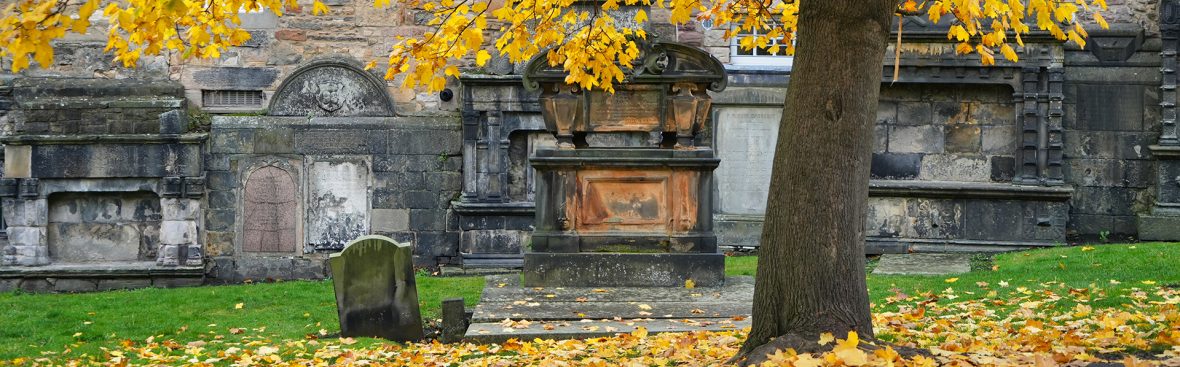
The area of the Kirkyard known as The Covenanters Prison holds the burial place of many of Edinburgh’s most accomplished 18th century scientists, physicians and polymaths. Robert Whytt certainly deserves to be recognised as one of this elite enlightenment group, who advanced human knowledge in many & varied ways.
Whytt studied at St Andrews, Edinburgh, London, Paris, Leiden & Reims, before becoming a physician in Edinburgh in 1738. In 1747 Whytt was appointed professor of the theory of medicine at Edinburgh University. He carried out a great deal of research on the Central Nervous System, disproving many conventional theories and establishing a new understanding of how nerves work to operate muscles. Whytt became one of the most accomplished neurophysiologists of his time. In his research, he outlined the significance of the central nervous system on movement, drew distinctions between voluntary and involuntary actions and clarified the components of the light reflex within the eye.
In 1761 Whytt was made first physician to King George III in Scotland—a post specially created for him—and on 1 December 1763 he was elected president of the Royal College of Physicians of Edinburgh; he held the presidency until his death at Edinburgh on 15 April 1766 at the age of just 52.
Robert Whytt is buried in his family lair in the south west end of the Covenanters Prison.
Today we got closer to learning “What secrets lie beneath John Bayne’s feet?”
It was our day to investigate one of Greyfriars Kirkyard’s most famous — yet puzzling – monuments and learn how we hope to save it for the future.The Mystery of the Bayne Ledger Stone From a bow-maker’s workshop to the King’s inner legal circle, John Bayne’s rise to ‘Writer to the Signet’ was a 17th-century success story. But did his ambition extend below ground?
The ledger stone of John Bayne’s tomb is broken. In repairing it, we have a unique opportunity to look deeper. We are investigating whether this gravestone serves as the ‘lid’ to a hidden burial vault.
This event is brought to you by Edinburgh World Heritage, the Friends of Greyfriars Kirkyard, and the City of Edinburgh Council as part of the Legacies in Stone project. Funded by the National Lottery Heritage Fund, thanks to National Lottery players.
Here are some of the best photos I captured from the event. I’ll let one of the other committee members share what we found, and what is still to be determined (ground-penetrating radar is up next!)
Twice Lord Provost of Edinburgh, but best known for his work as a publisher, including the poems of Robert Burns. William lived and worked in the Luckenbooths beside St Giles. Here he ran his printing, publishing and book selling business as well as holding his famous parties. These social events brought together the brightest intellects & characters of the time and played no little part in the enlightenment period in Edinburgh. As William’s business and political influence grew he moved to the New Town where he lived at 5 George Street until his death in 1815. William, like many other major figures in the enlightenment, never married. He is buried in the West Yard at Greyfriars.
This burial lair at Greyfriars has no memorials within, just an inscription above the doorway saying “Wiliam Inglis Surgeon 1792”. William Inglis was a prominent Scottish surgeon, serving as Deacon of the Incorporation of Surgeons and twice as President of the Royal College of Surgeons of the City of Edinburgh. As such he was a key figure in late 18th-century Edinburgh medicine, a period in which Edinburgh served as the global leader in medical research, education and practice.
He is also well known for his role as an early captain of the Honourable Company of Edinburgh Golfers, the oldest golf club in the world, famously painted by David Allan in 1787. Allan, a member of the same golf club, shows Inglis, wearing the red colours of the club, with his caddy on Leith Links, where the club was then located (it’s now based at Muirfield in East Lothian). Behind Inglis, the annual trophy presented by the City – a golf club with silver balls attached – is being paraded across the Links. Golf was a popular pastime among Edinburgh’s surgeons and other high ranking professionals, during the peak enlightenment years. This artwork holds historical significance as one of the earliest images of organized golf in Scotland, capturing the sport’s evolution from informal recreation to a structured gentlemanly pursuit on natural links courses like Leith, which featured undulating turf, dunes, and coastal hazards. Golf historians recognise this period in Edinburgh as laying the foundations for the huge growth in popularity of rules based golf played at clubs all over the country and beyond.
William Inglis died in 1792, leaving a legacy that bridged surgical excellence and the foundational years of organized golf.
Major General & Commander of The Bath (*), distinguished for his service in The Peninsula, Belgium & Ava. Fought at the battles of Roleija, Vimiera, Lugo, Corunna, Oporto, Talavera, Melloon & Waterloo. Severely wounded twice, he received many medals, some of which are carved on his memorial in his family lair at Greyfriars.
(*) The Order of the Bath is a British order of Chivalry founded by George I in 1725. Recipients are usually senior military officers. The name derives from the medieval ceremony of ritual bathing before being knighted.
One of the most visited memorials in Greyfriars Kirkyard is that of William McGonagall. This is in the West Yard, beside the gates to Heriot’s School. Everyday crowds of folk peer up at this modern shiny black memorial. Most come here because of the association with the Professor of Transfiguration character in Harry Potter, who bears the name Minerva McGonagall (brilliantly played by Maggie Smith in the movies).
Other visitors come here to celebrate the man who proudly bears the title of “Scotland’s Worst Poet”, or who liked to style himself later in his life as “Sir William Topaz McGonagall, Knight of the White Elephant of Burmah”. Well before Harry Potter was written, William McGonagall had legions of adoring fans, many with a rich sense of humour. These fans thought that their poetic hero should be memorialised in both Dundee (where he spent most of his life) and in Edinburgh (where he spent his final years).
He was finally recognised by the people of Dundee in 1997, who said of McGonagall that he was, “So giftedly bad, he backed unwittingly into genius” and then in 1999 they finally achieved their wish for a memorial in Edinburgh, when the shiny black plaque was installed at Greyfriars.
But why is it in this place telling the world that William McGonagall is buried “near this spot”. Let us consider how likely it is that William McGonagall is actually buried anywhere near here at all.
William’s date and place of birth is uncertain (but Ireland in 1825 seems most likely), but we know for a fact that it was in Edinburgh where he died penniless and largely forgotten at 5 South College Street in 1902. The death was duly recorded by the City as being at 4pm on 29th September 1902 as a result of a cerebral haemorrhage. However a search of the City records for details of his burial turns up nothing. Perhaps the least likely place he would have been buried in Edinburgh was the West Yard in Greyfriars. The reason being that the West Yard never had any “common burials” (being burials of the poor in unmarked graves). Furthermore, post 1870 there were no further common burials anywhere in Greyfriars. After that date the only burials here were of individual Family members of those who had long standing burial rights to use their family burial lairs. Such people were the well heeled, not the penniless poets. Non of Edinburgh’s cemeteries have a burial record for William McGonagall. It is possible he was taken to be buried in Dundee, or perhaps he was buried in a Roman Catholic cemetery, possibly Mount Vernon, Edinburgh’s Catholic Cemetery that opened in 1895.
So whilst we don’t know where William McGonagall was actually buried, it seems the most unlikely place of all would be in the West Yard at Greyfriars. So, unless you know differently, I think that modern shiny black plaque is telling us a story. But hey, we all like a good story (or poem), don’t we ?
We are often rather negative about Bankers, thinking of them as unproductive fat cats who get wealthy on the backs of others. But that caricature is not applicable to Sir William Forbes. Brought up in rather humble circumstances after his father died when William was just 4, William worked his way up from a being a lowly bank clerk at Coutts to becoming one of Scotland’s greatest bankers and philanthropists of the 18th century.
Brought up by his mother in a small 2 roomed house in Forrester’s Wynd in Edinburgh, his banking apprenticeship lasted four years. William impressed everyone he worked with, becoming head of Coutts Edinburgh Office in 1761. In 1763 William set up a new Banking Partnership called Forbes, Blair & Herries, Bankers which within a decade became one of the most trusted and successful banks in Scotland.
In 1770 William married Elizabeth, daughter of Sir James Hay of Hayston, M.D., with whom he had nine sons and seven daughters.
William was a co-founder of the Royal Society of Edinburgh and was involved in many philanthropic projects in Edinburgh including the new High School, the Merchant Company, the Morningside Lunatic Asylum, and the Blind Asylum.
Elizabeth died in 1802 and William died in 1806 at 39 George Street in Edinburgh. William had acquired a burial vault at Greyfriars Kirkyard along the South Wall (near Mackenzie’s Mausoleum), where he and many generations of his family were buried during the 19th century.
It is rare to find a family portrait in such an informal pose, but here we have just such for a Family whose burial lair is at Greyfriars Kirkyard.
Sir James Hunter Blair, (1741 – 1787) was a Scottish banker, landowner and politician, who served as Member of Parliament for Edinburgh from 1780 to 1784 and Lord Provost of Edinburgh from 1784 to 1786. As Lord Provost he is best known for commencing the construction of South Bridge, over the Cowgate, which transformed the south side of Edinburgh. Two of the new areas just off South Bridge carry his name, being Hunter Square (around the Tron Kirk) and Blair Street (running down to the Cowgate).
Born in Ayr in 1741, the son of a merchant, in 1756 he was apprenticed to Messrs Coutts, bankers in Edinburgh and in 1763 became a partner in the banking company of Sir William Forbes. After marrying Jean Blair, the daughter and heiress of John Blair of Dunskey in Wigtownshire in 1770, the family name became Hunter Blair when she inherited her father’s estate in 1777. They had 14 children. James died aged just 46 in 1787 after contracting typhus.
Sir James Hunter Blair was a founder member of the Royal Society of Edinburgh and welcomed Robert Burns when the poet first arrived in Edinburgh. On his death, Burns composed an elegy, beginning: “he lamp of day, with ill-presaging glare”, and which goes on to extol in a rather ponderous fashion Blair’s public virtues. Burns himself thought it was a rather mediocre piece, but other critics described it in rather more negative terms. The whole elegy is here.
Some inscriptions on memorials at Greyfriars reference forgotten wars, in remote foreign lands, involving terrible suffering. This memorial to Adam Davie, Major in His Majesty’s Service, who died a prisoner of war in the City of Candy, the Island of Ceylon, in July 1812, after 9 years captivity there, is a case in point.
Candy (or Kandy) was a Kingdom within Ceylon (now called Sri Lanka) that remained Independent by resisting British Colonial rule until 1815. There was a series of wars between 1796 and 1815 in which the British Army sought to gain control of the highlands in the centre of Ceylon. Major Adam Morries, the only son of John Davie & Mary Flint, was captured by enemy forces during one of these wars, with his soldiers being massacred after Major Adam Davie ordered them to surrender.
Major Adam Davie is known to have survived as a special prisoner of the King of Candy for at least nine years. Still wearing his tattered Major’s jacket throughout his captivity, but barefooted, he apparently never made any attempt to escape Candy and all requests to the King of Candy from the British Army for the Major’s release were refused. Davie had apparently married a Candy woman during his captivity and had children. So quite possibly he didn’t want to leave Candy, fearful of possible retributions for his actions preceding his capture. He died of a stroke in 1812.
The full rather incredible and bloody story of the wars & the events leading up to his capture are told here.
The independence of the Kandyan kingdom came to an end in 1815
Just to the left of the gates to the Covenanters Prison are this pair of memorials to a family of Theatre impresarios, Henry Siddon on the right and his brother in law, William Henry Murray on the left. Henry was an actor who first found fame on the stage in London, before relocating to Edinburgh to take over management of The Theatre Royal at the east end of Princes Street (now the General Post office buildings). His brother in law, William, took over running the Theatre Royal after Henry died in 1815, and did an excellent job.
Both men were close to Walter Scott who brought George IV to Edinburgh in 1822. William created the settings at various venues, contrived the “revived ancient dresses” and arranged the “traditional” pageants for which George IV’s visit is much remembered to this day. William was particularly acclaimed for his success in transforming the Assembly Rooms in George Street into a theatrical palace for the Peers’ Grand Ball, an event that was pivotal in making the tartan kilt, which had until then been thought of by Edinburgh Gentry as the primitive dress of the rougher sorts in the lawless Highlands, into the national dress of the whole of Scotland. The King’s last and least formal public appearance during his visit to Edinburgh was at a theatre performance of Scott’s Rob Roy adapted and produced by Murray.