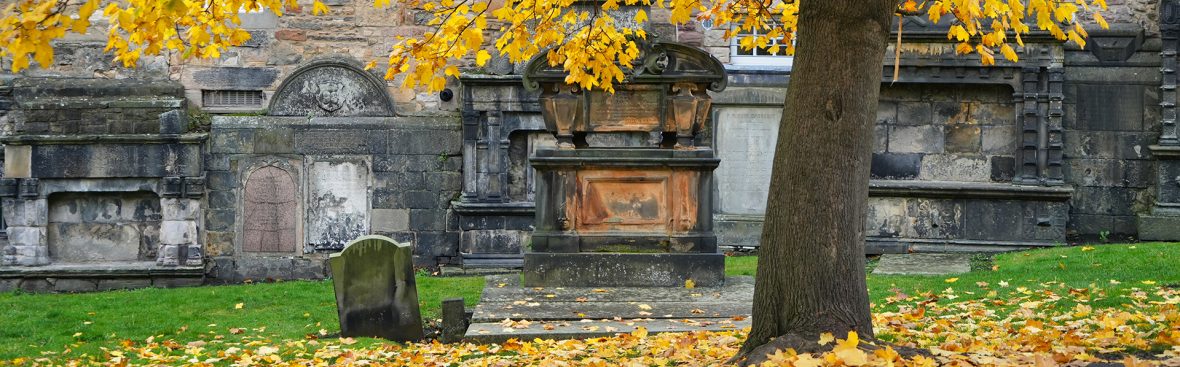
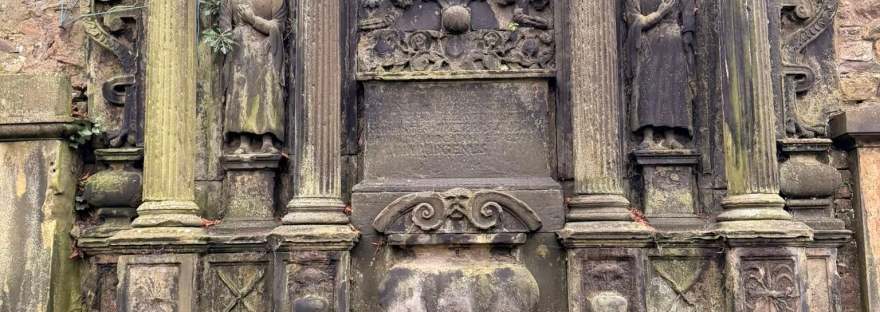
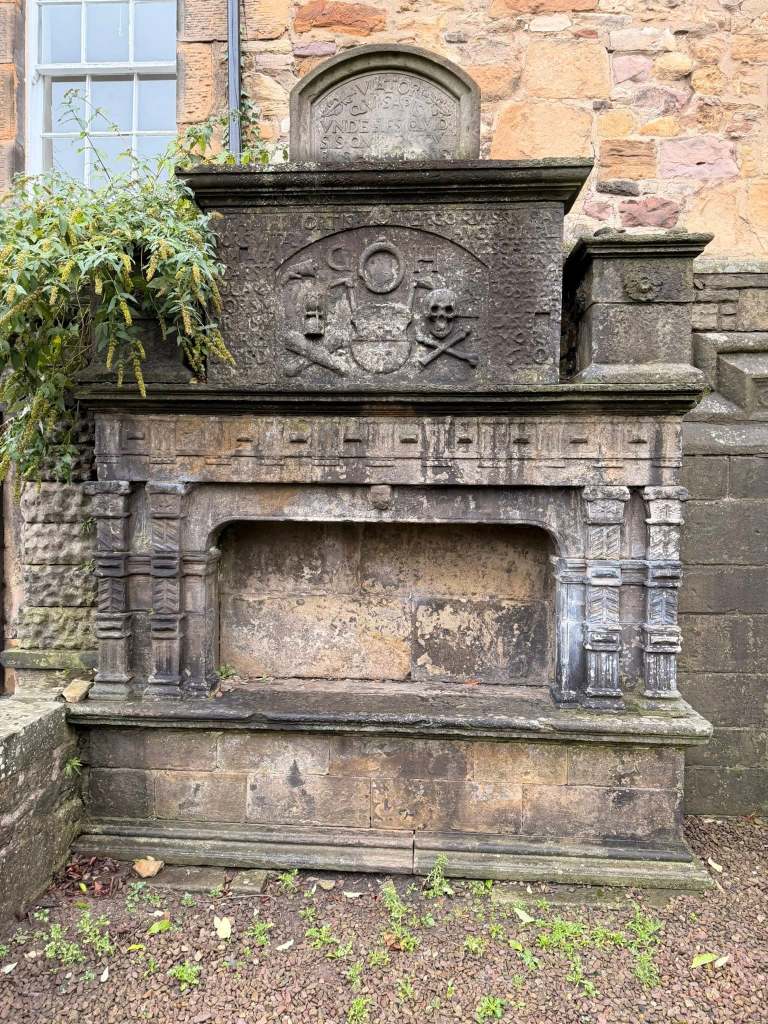
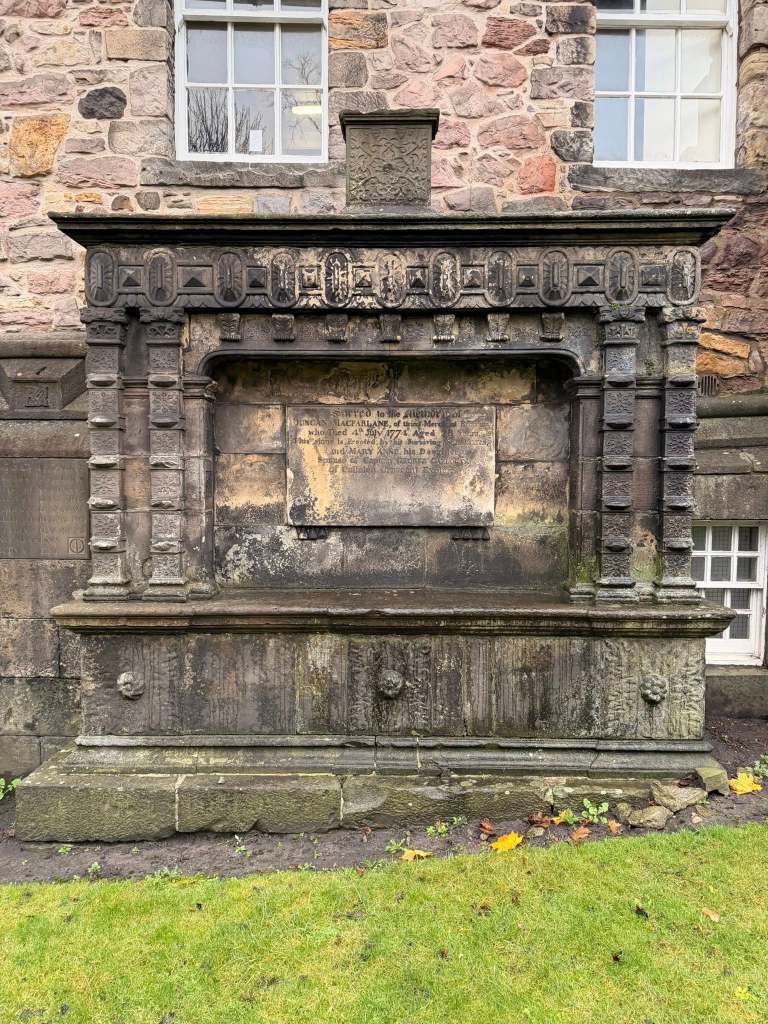
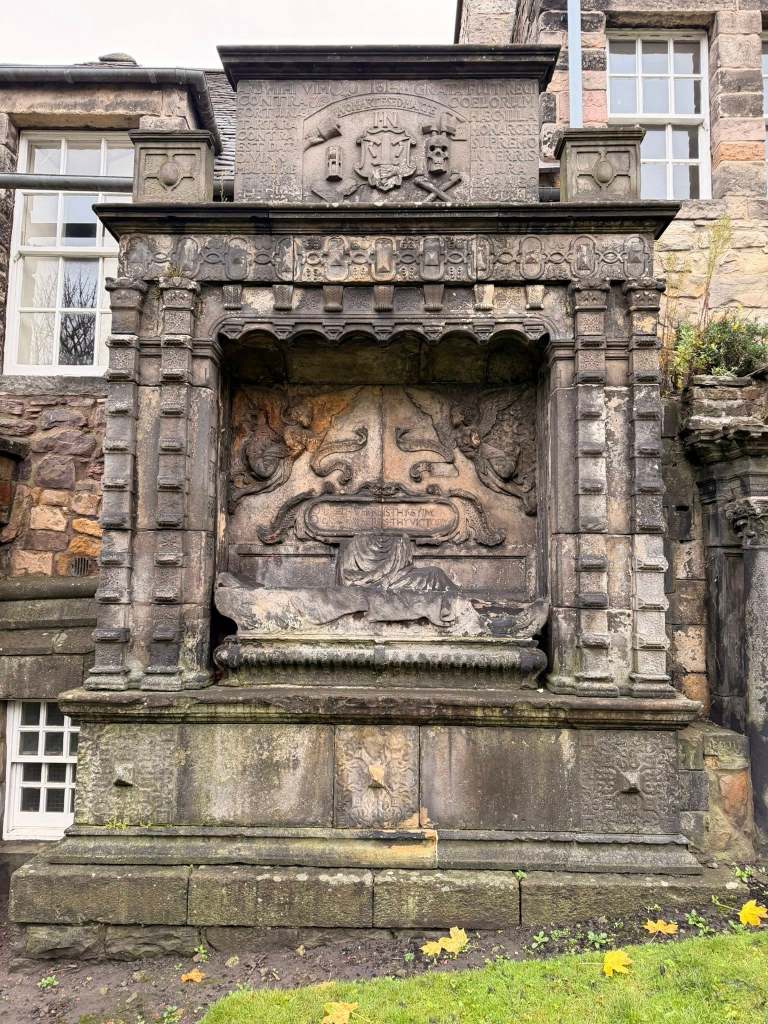
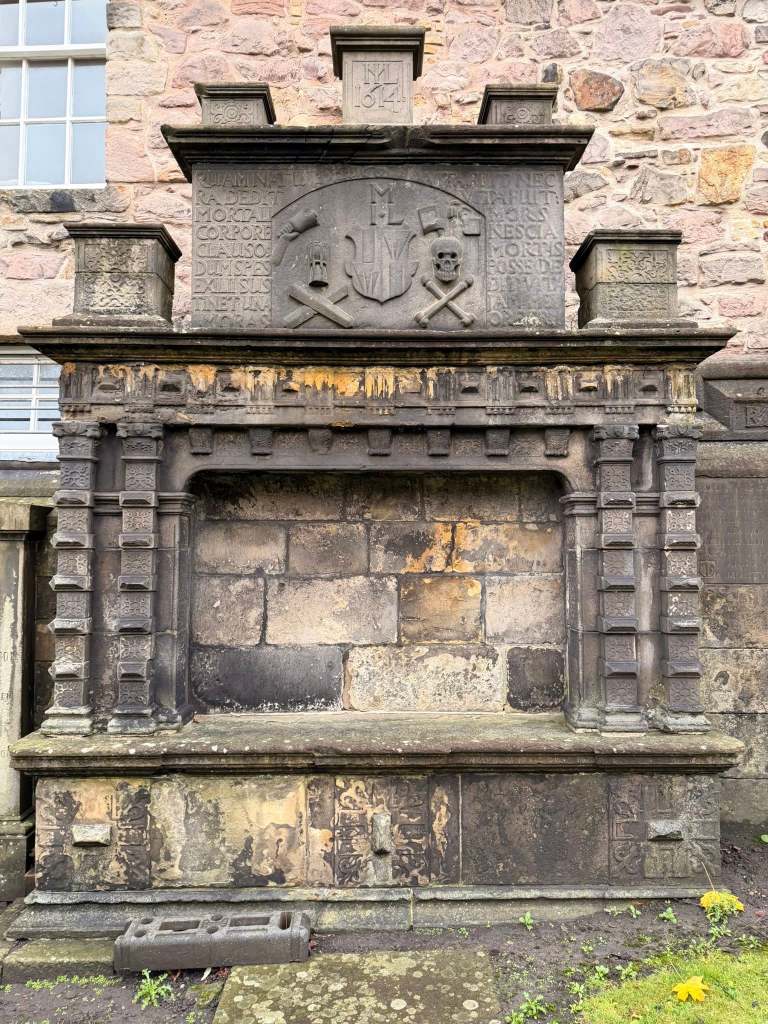
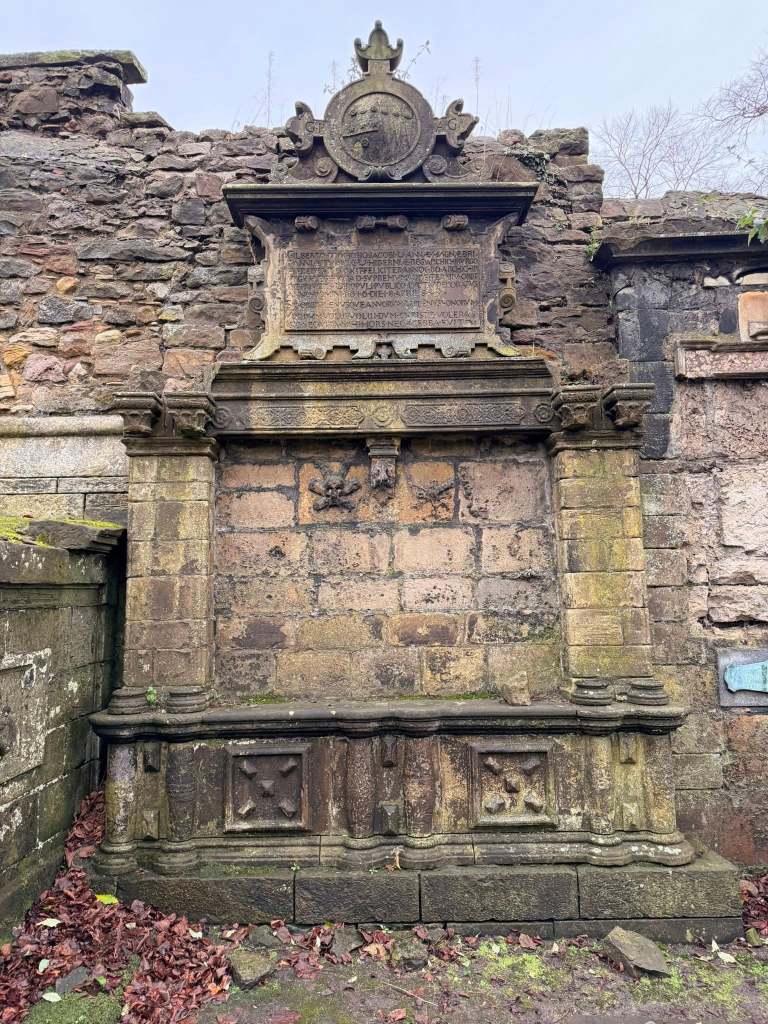
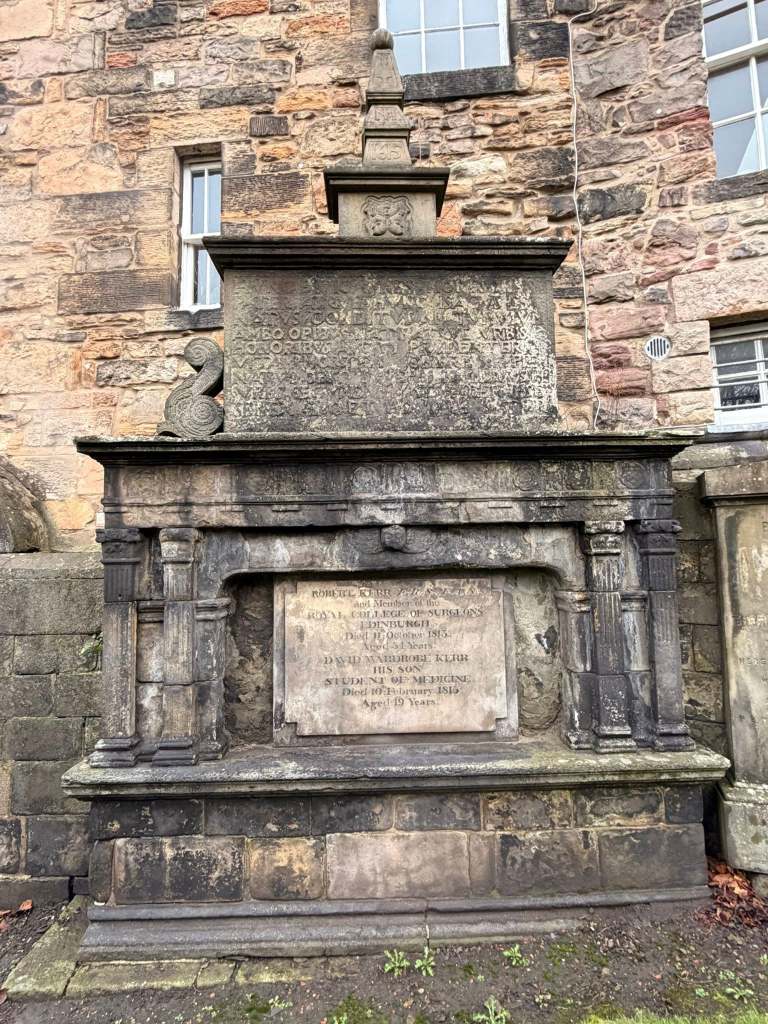
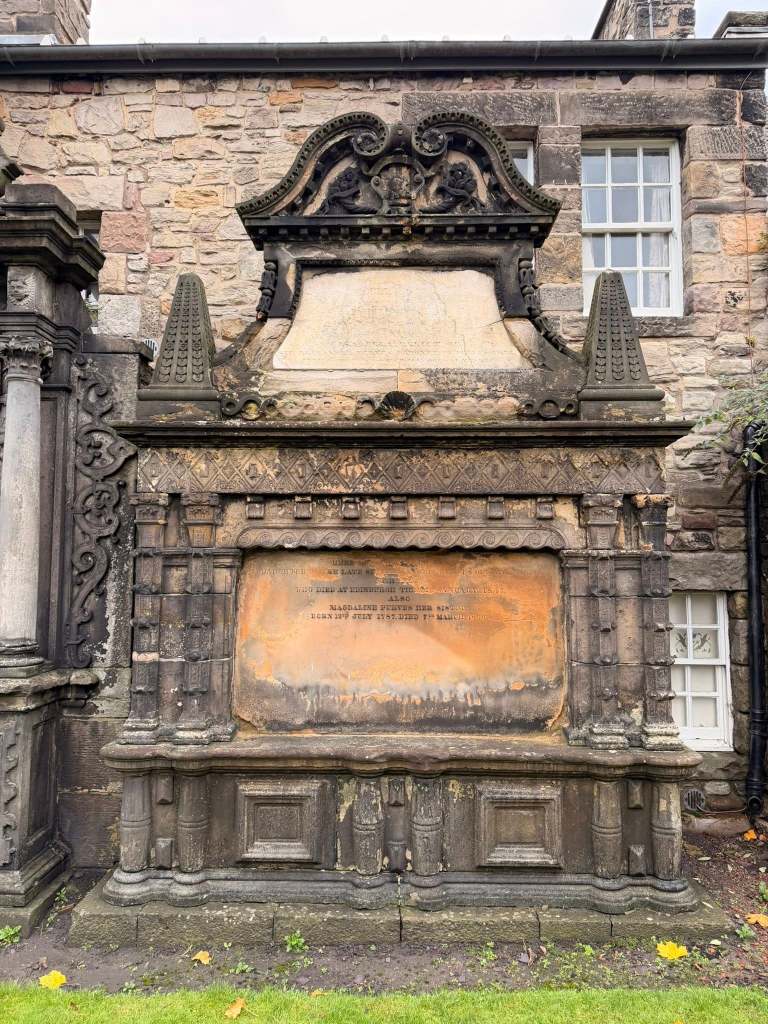
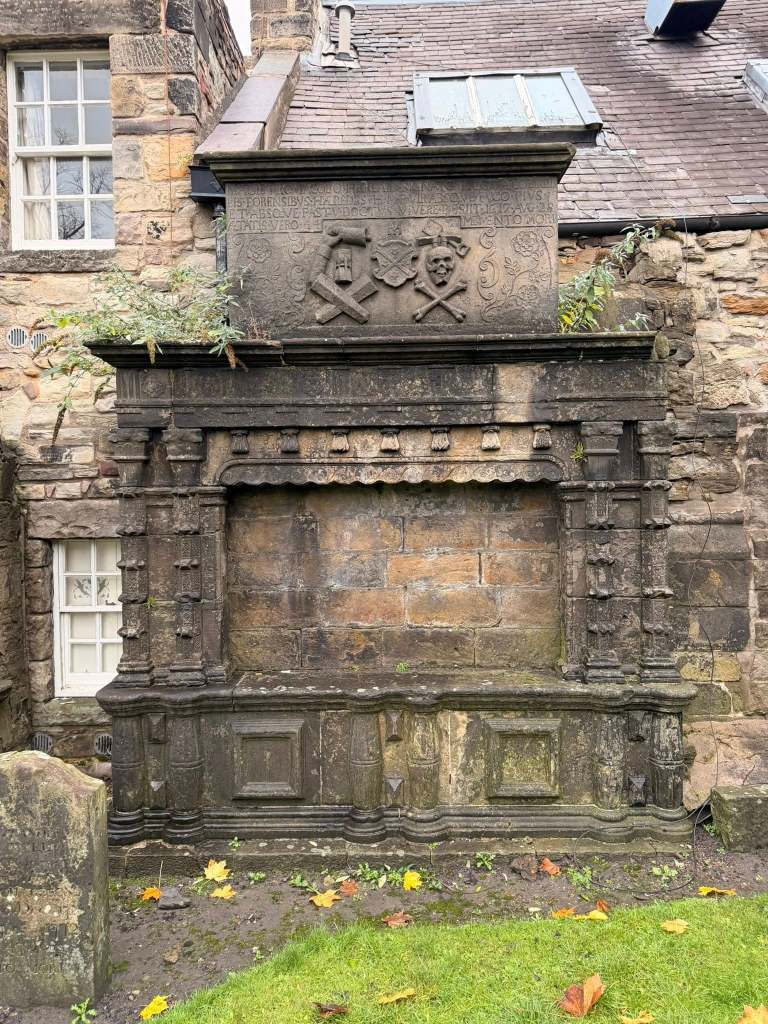
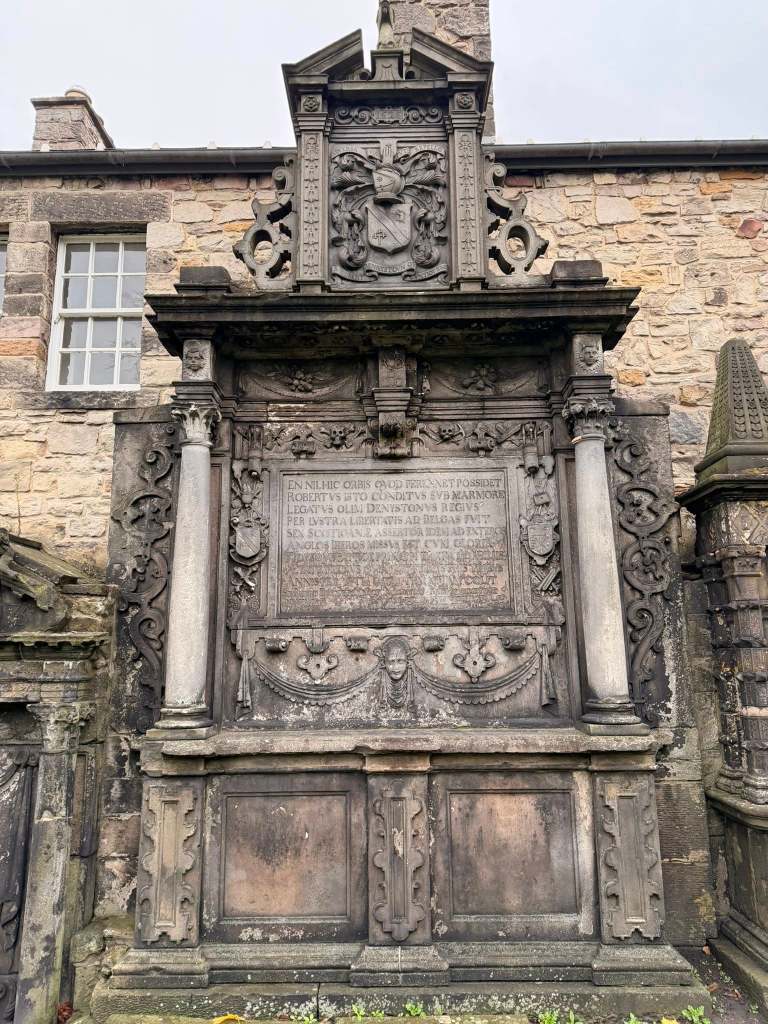
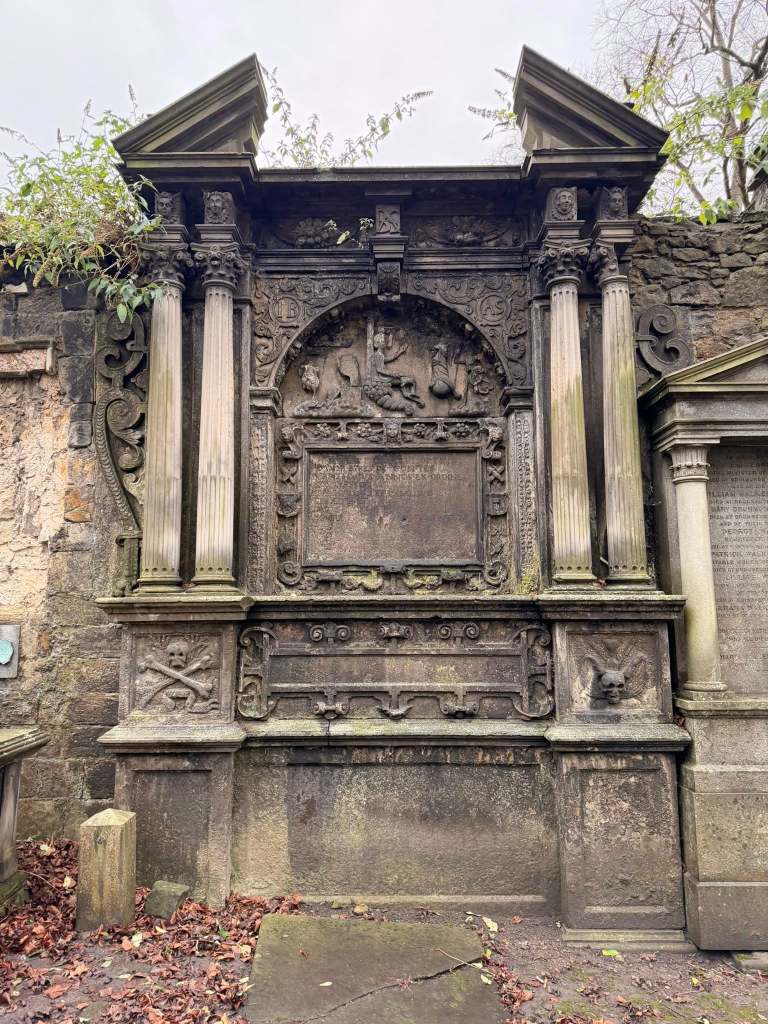
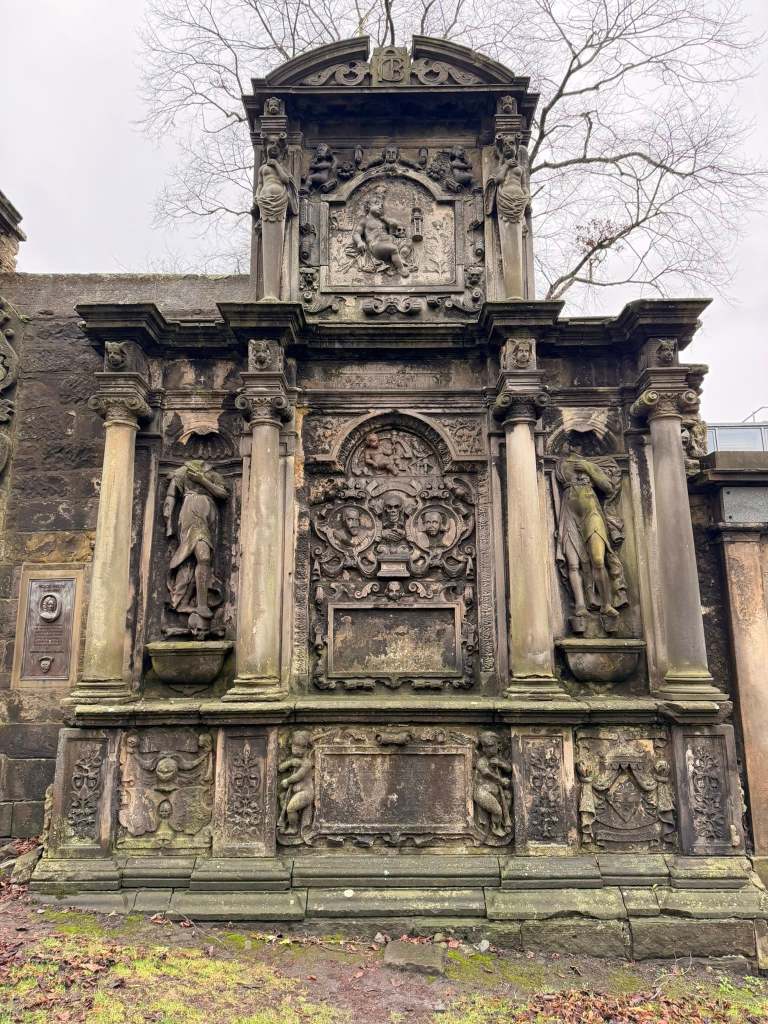
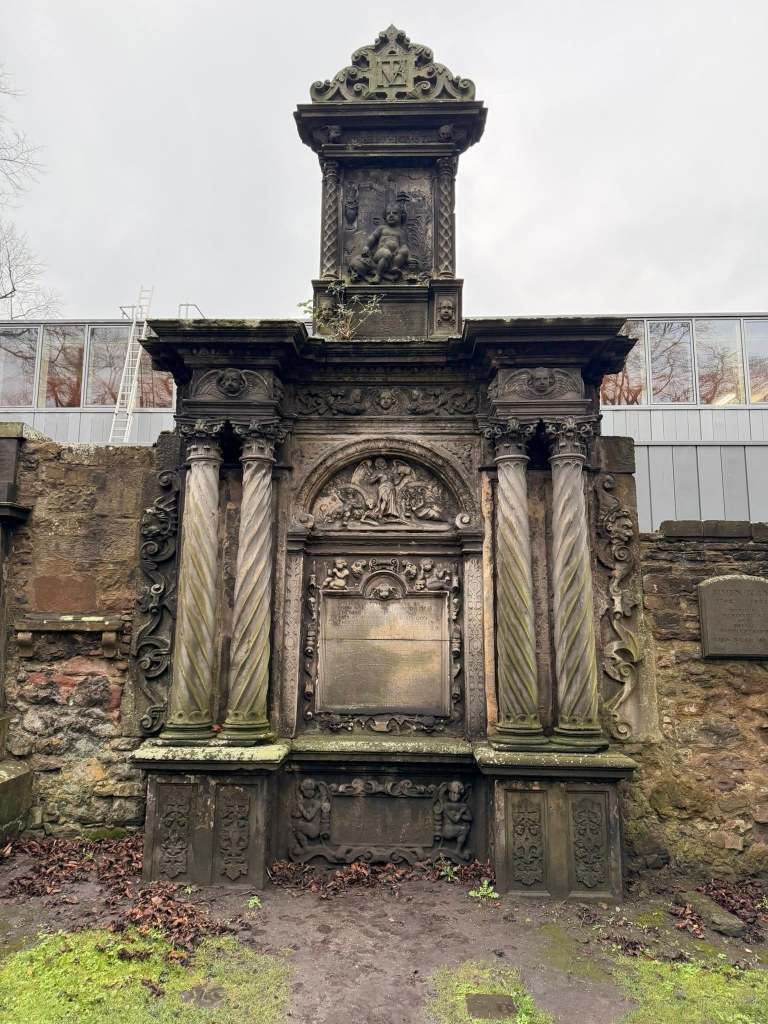
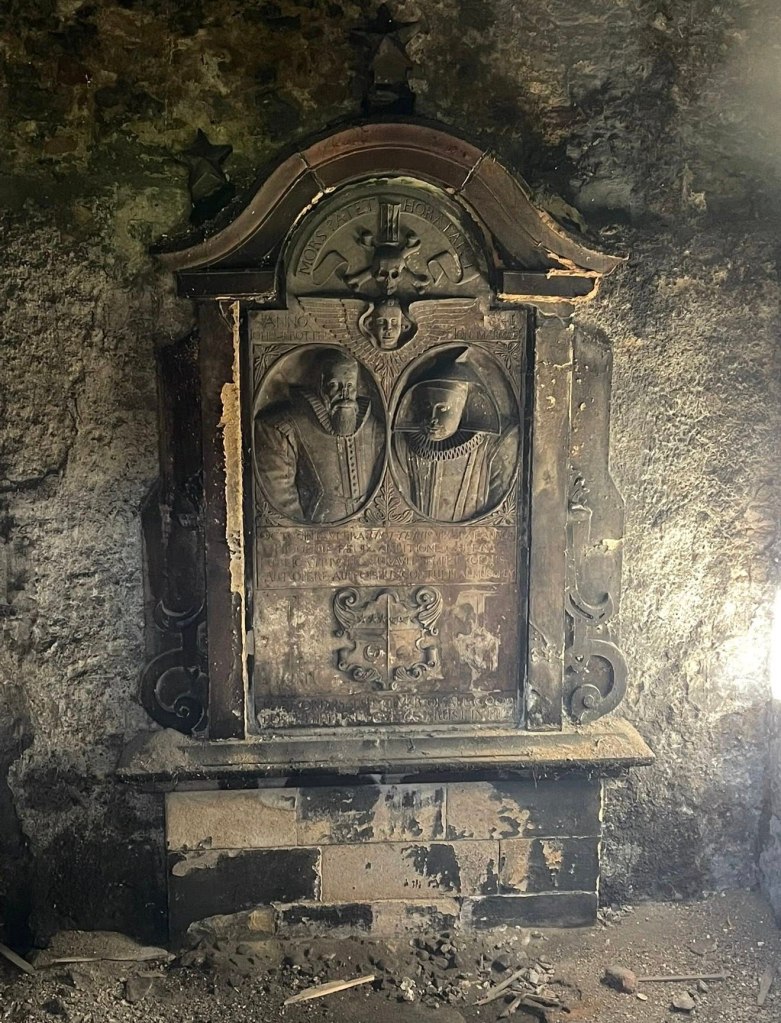
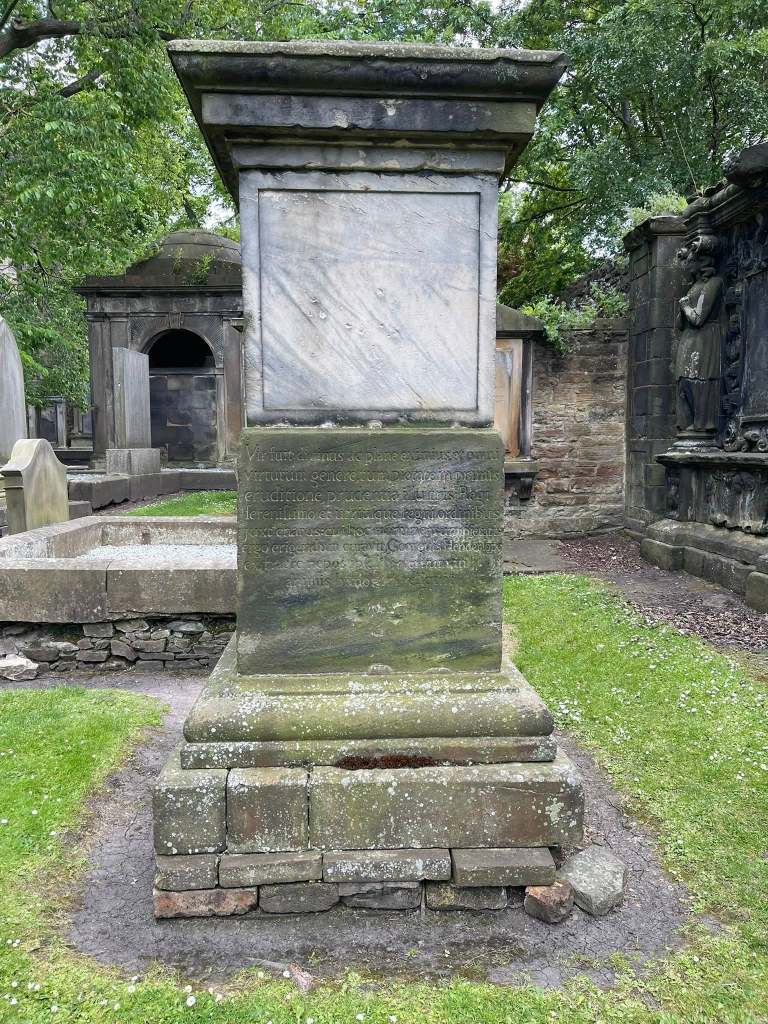
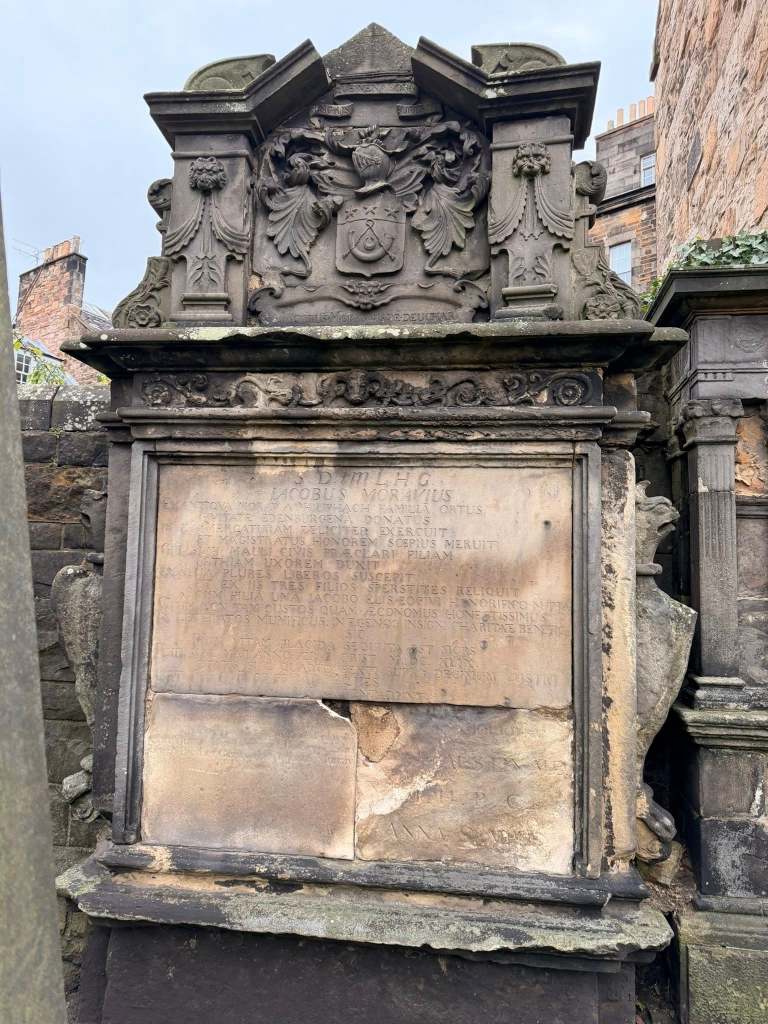
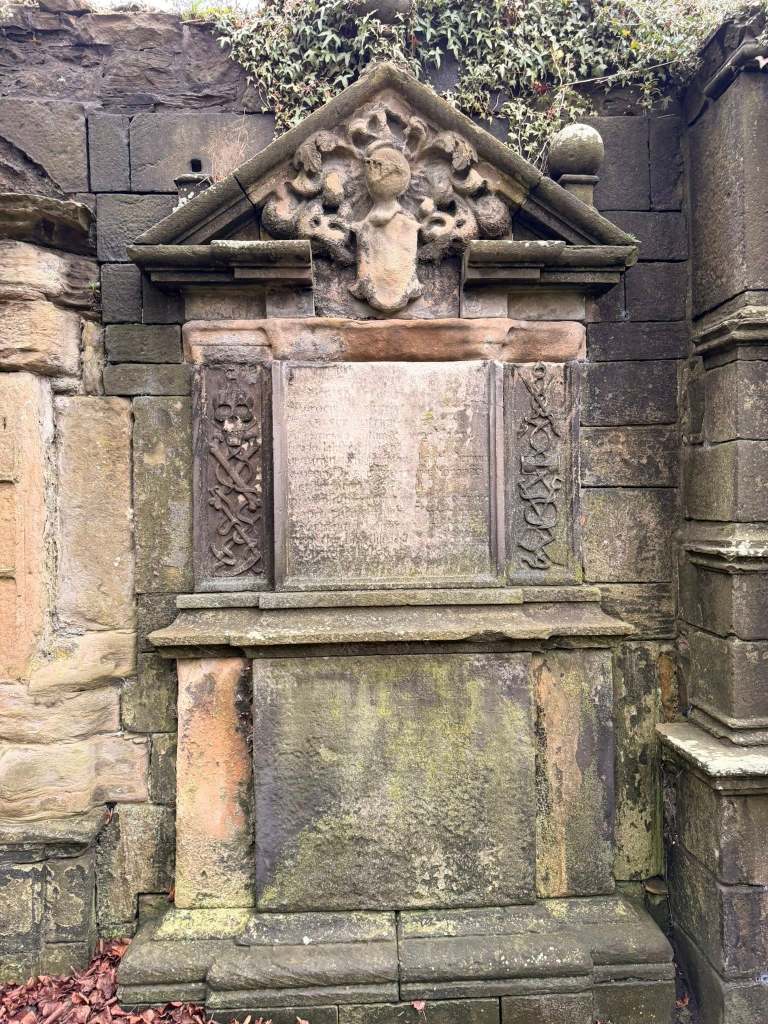
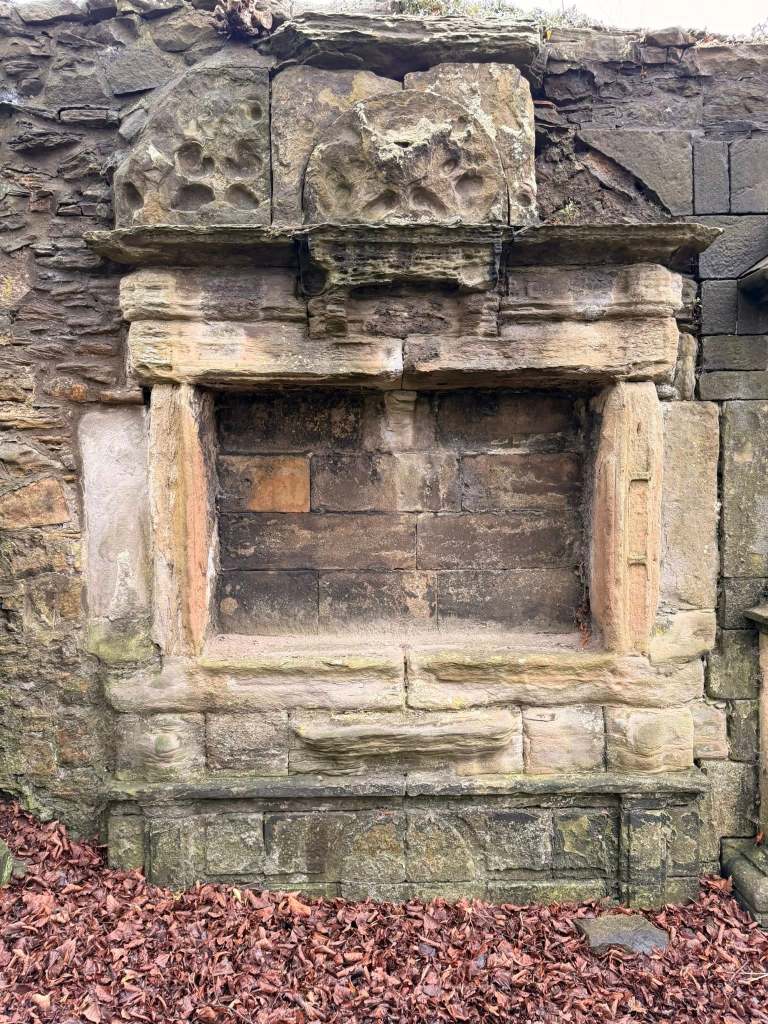
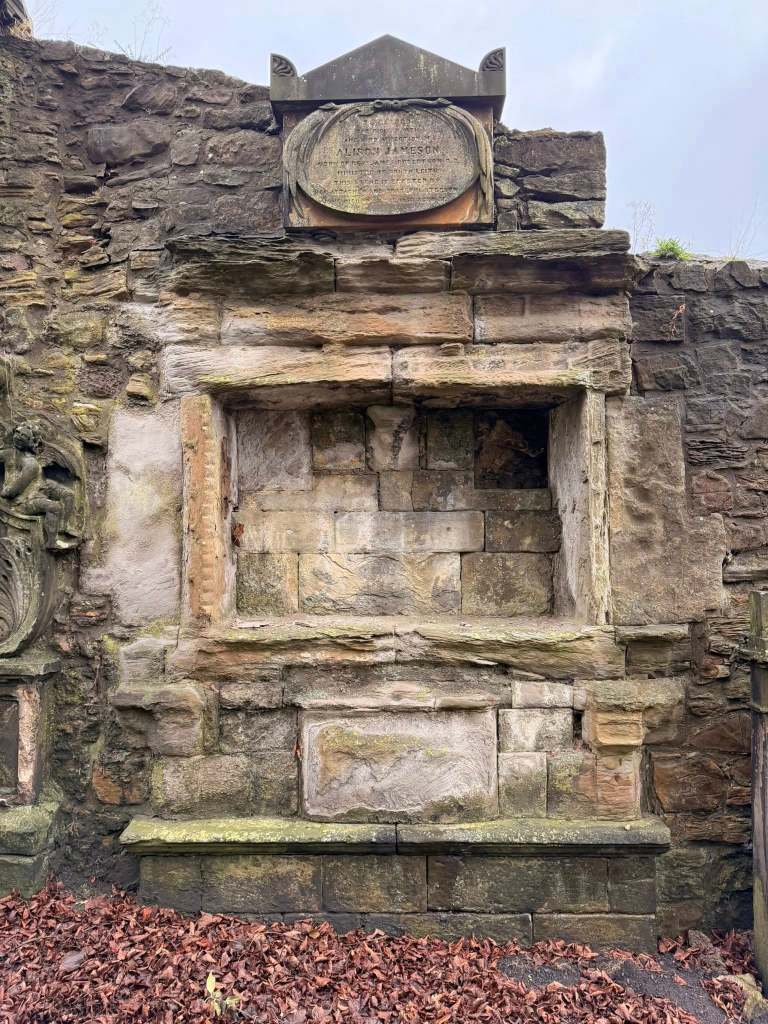
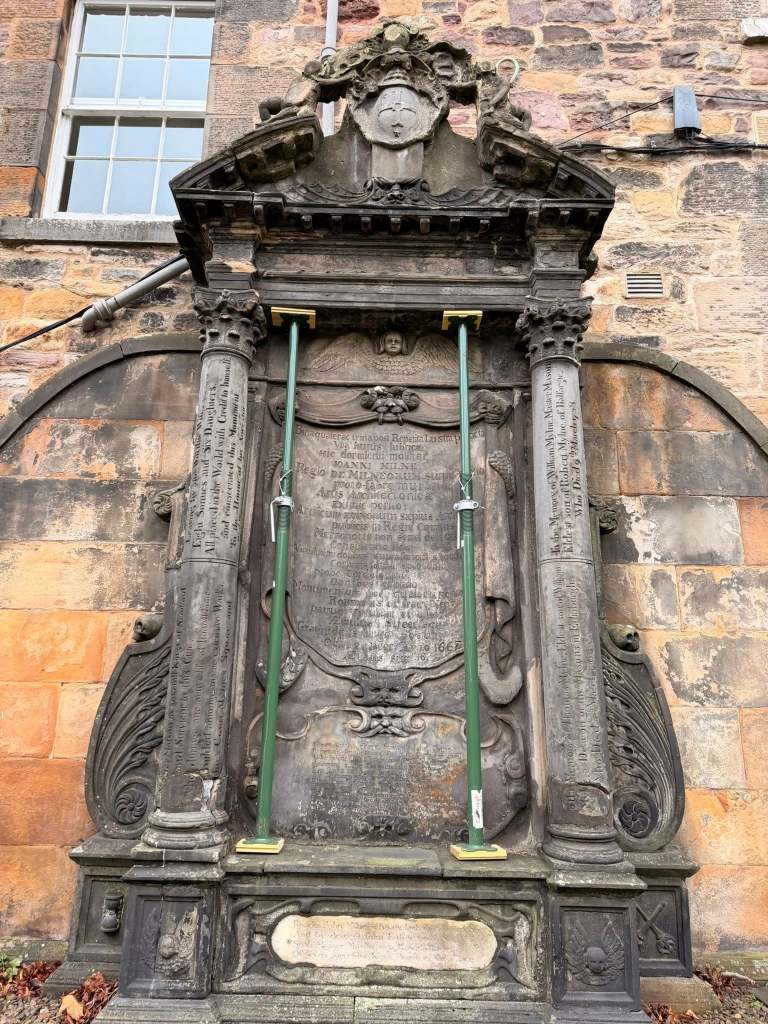
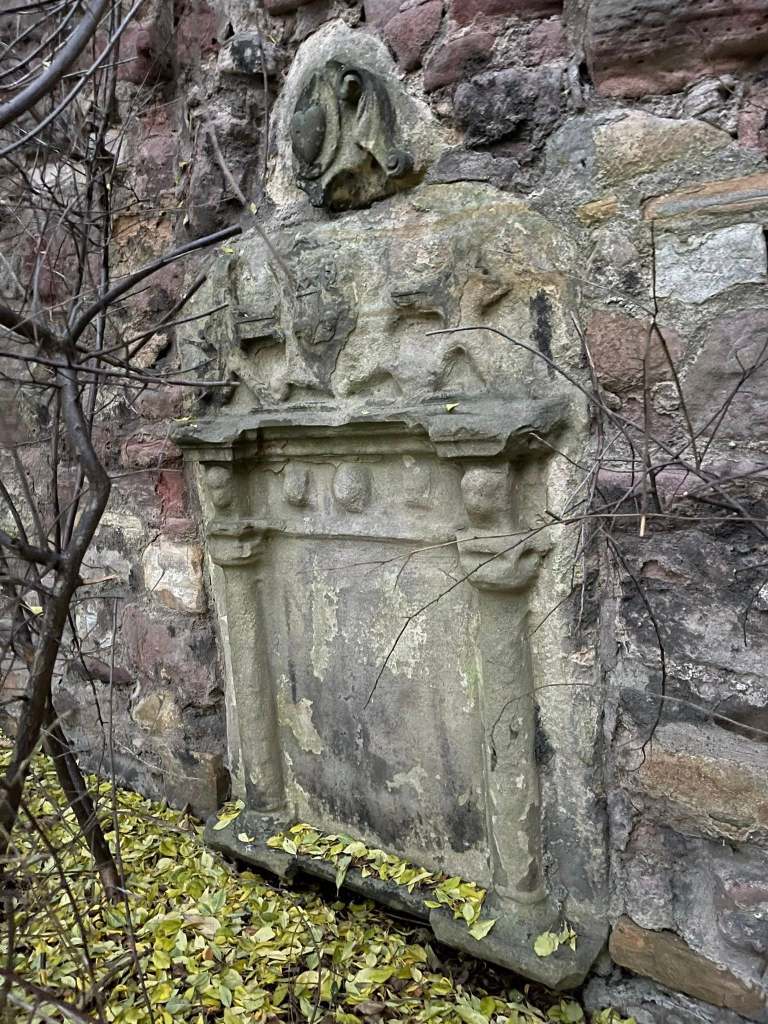
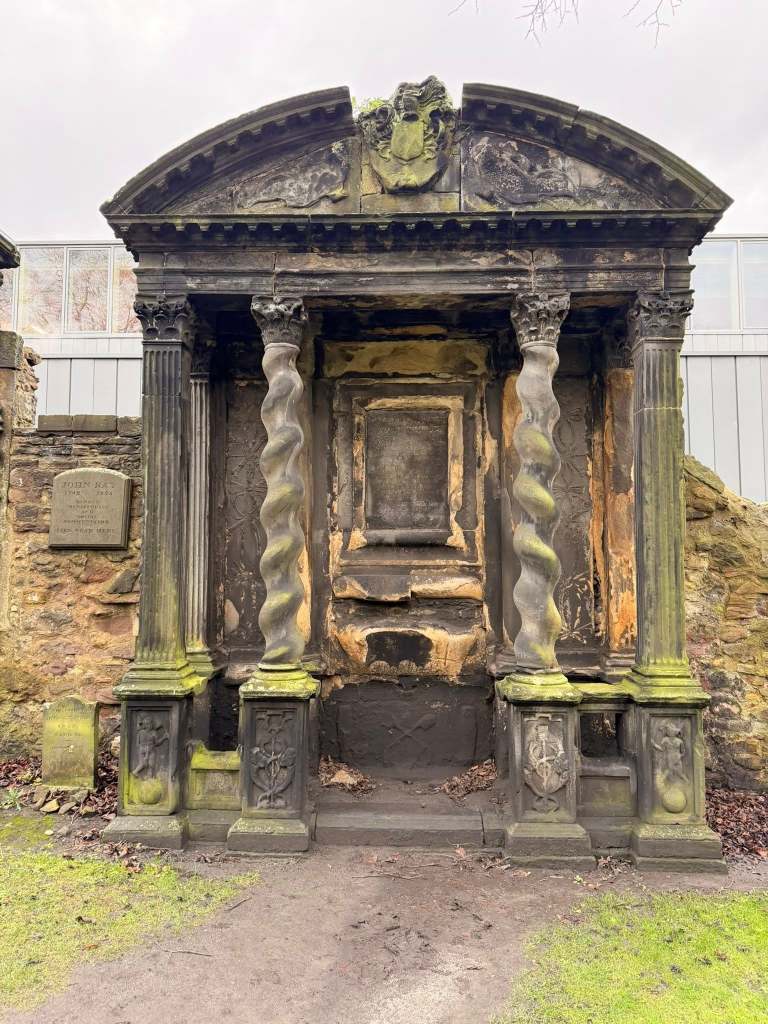
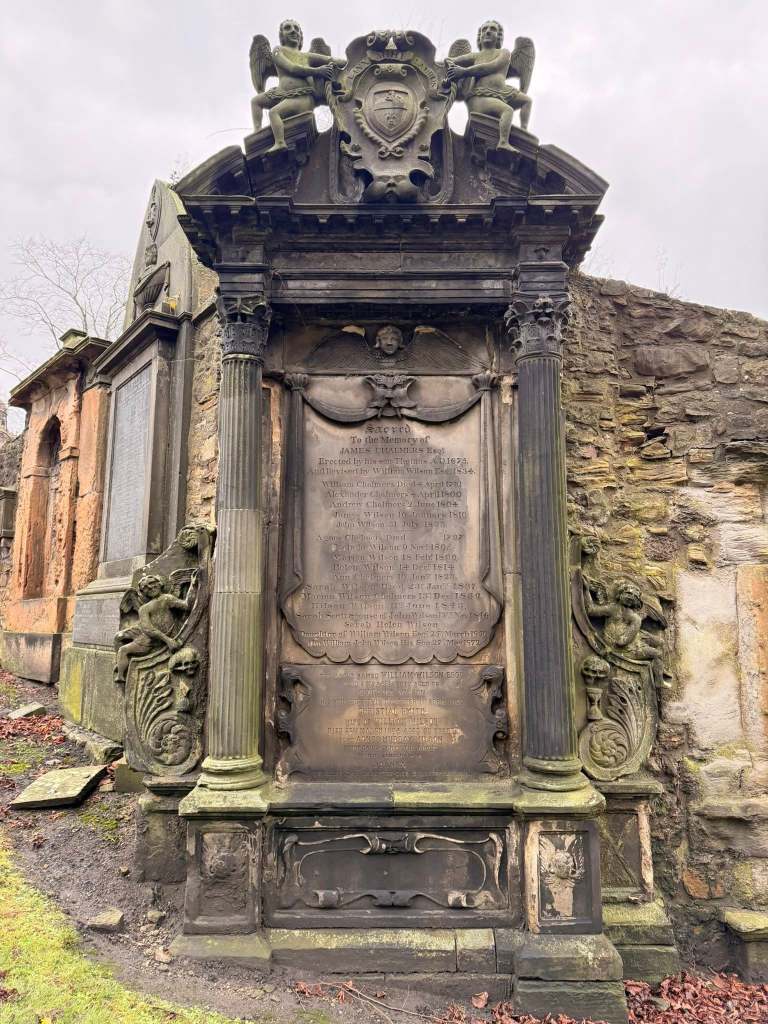
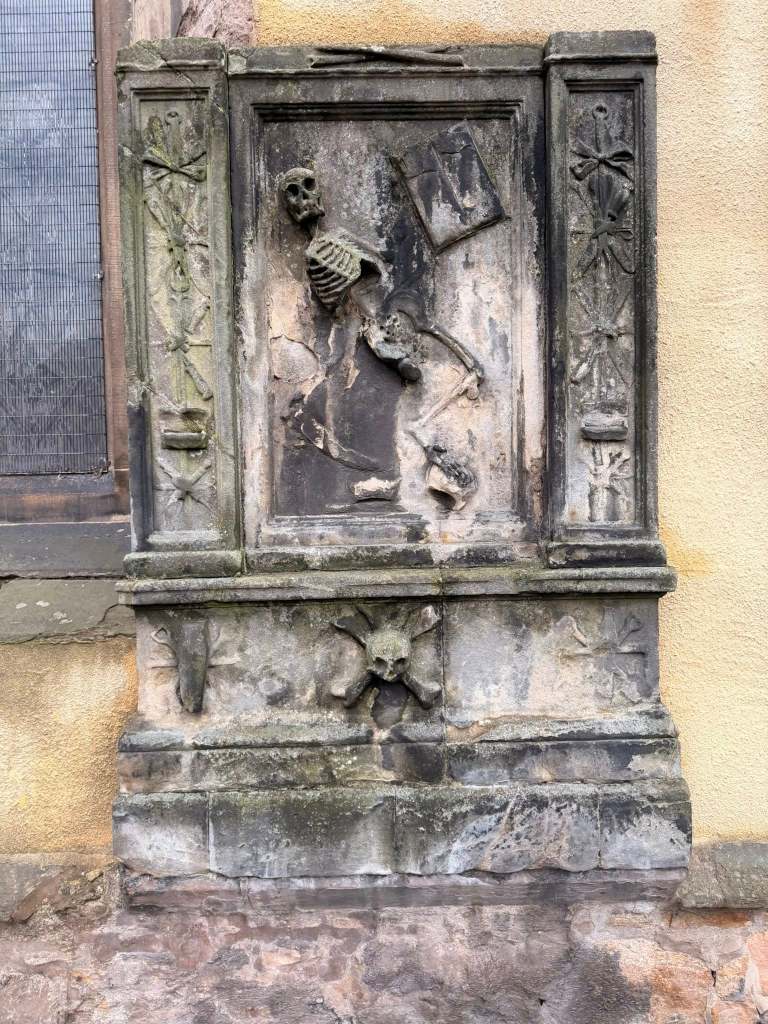
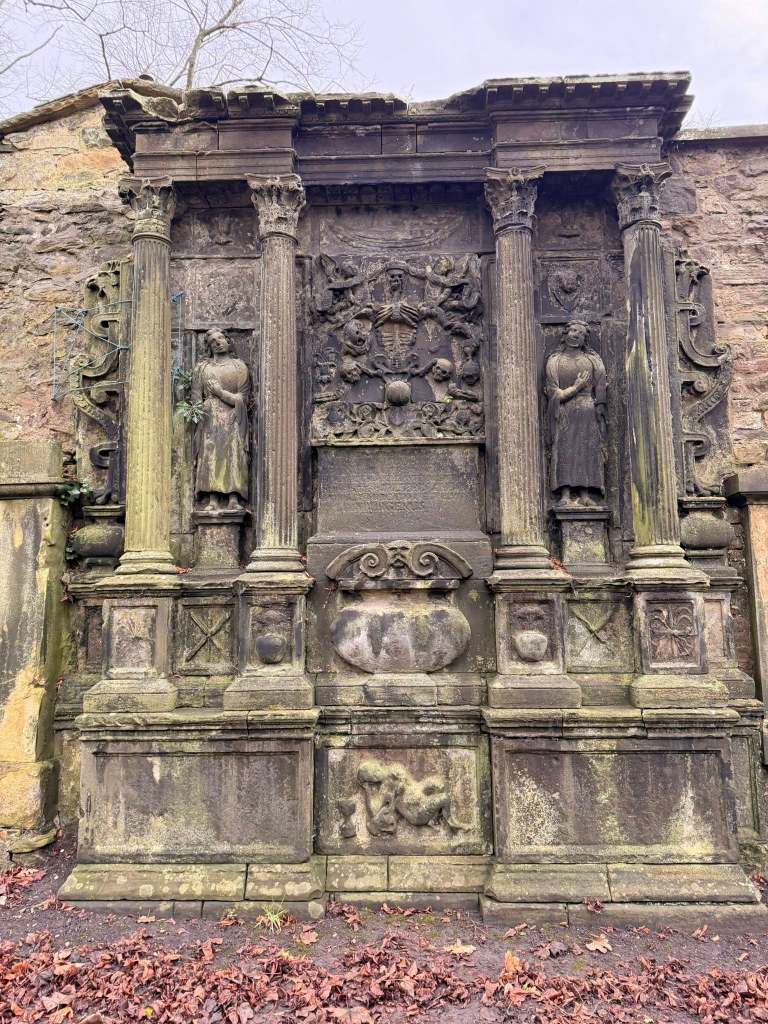
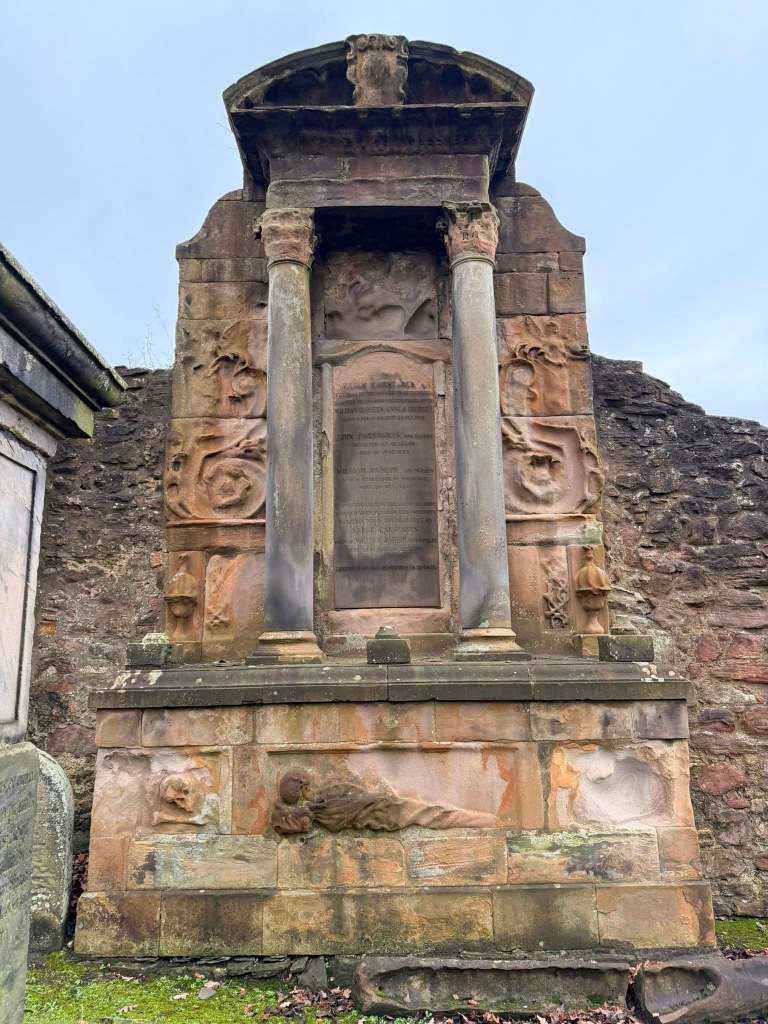
These images serve to illustrate the development of the memorials over time. It also shows the extravagance of the memorials raised in 1610’s to the 1630’s – no doubt due to the prosperity of that period, which is a marked contrast to the relative paucity of memorials raised between 1640 and 1667 – no doubt due to War, Plague, Occupation and Economic Depression in Edinburgh during those decades.
The date order is based mostly on the year of first death, except for Hope where the death was 150 years before the memorial and Little where the death was 100 years before the memorial.
1606: John Jackson1610: George Heriot1610: Rae1612: Dobie1614: Naysmith1614: Laing1615: Gilbert Primrose1615: Morrison1616: Miller1617: Harlay1619: Bishop Coupar1626: Dennistoun1629: Byres of Coates1633: Foulis1635: Bannatyne1636: Henryson1641: Trotter1644: Akinhead1646: Alexander Henderson1646: Sir Thomas Hope (although memorial dates to 1800’s)1649: Murray1656: Provist TodUnknownUnknown1667: Mylne1667: Douglas (Hatter)1672: Bethune1674: Kinloch1675: Chalmers1676: Borthwick1676: Cunninghame1679: Kincaid 1679: Chiesley1681: Bayne1681: Carstares (Oswald)1683: Little1686: Sharp1686: Robertson1688: McCulloch 1691: Mackenzie
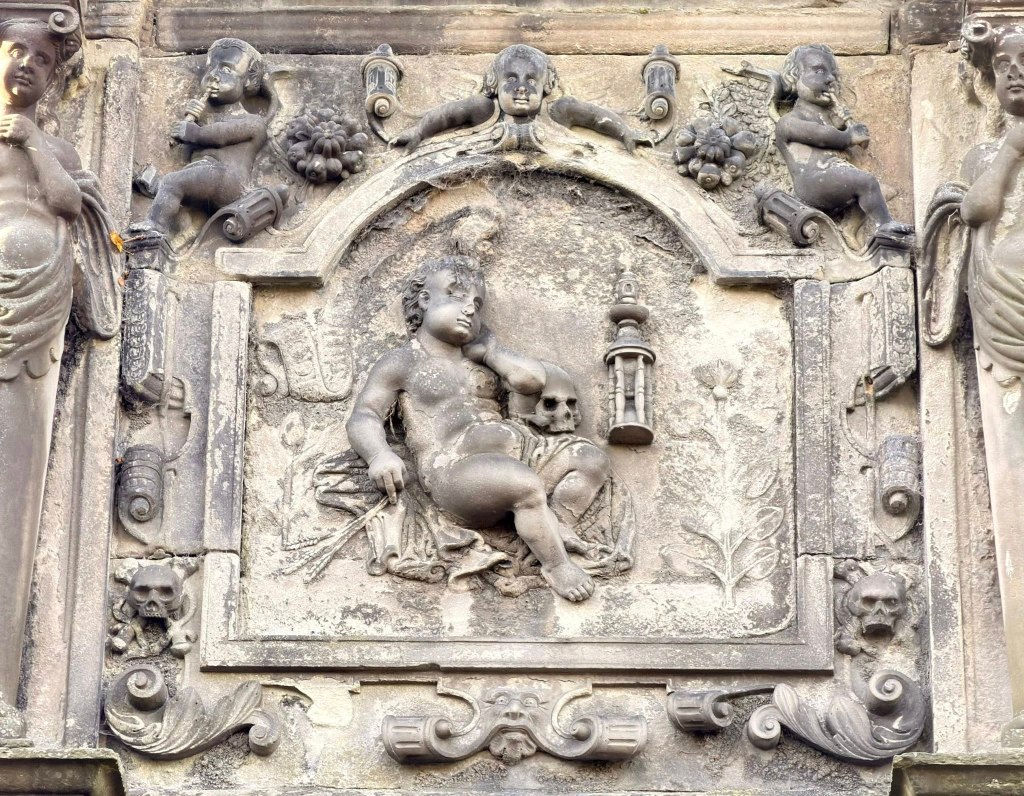
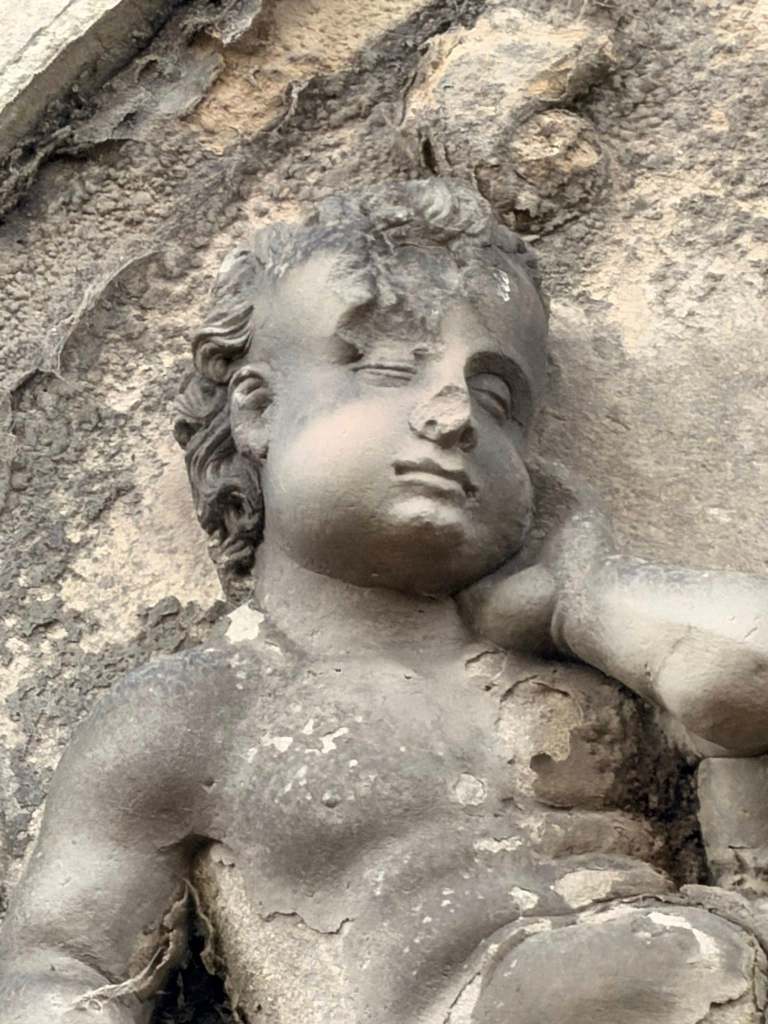
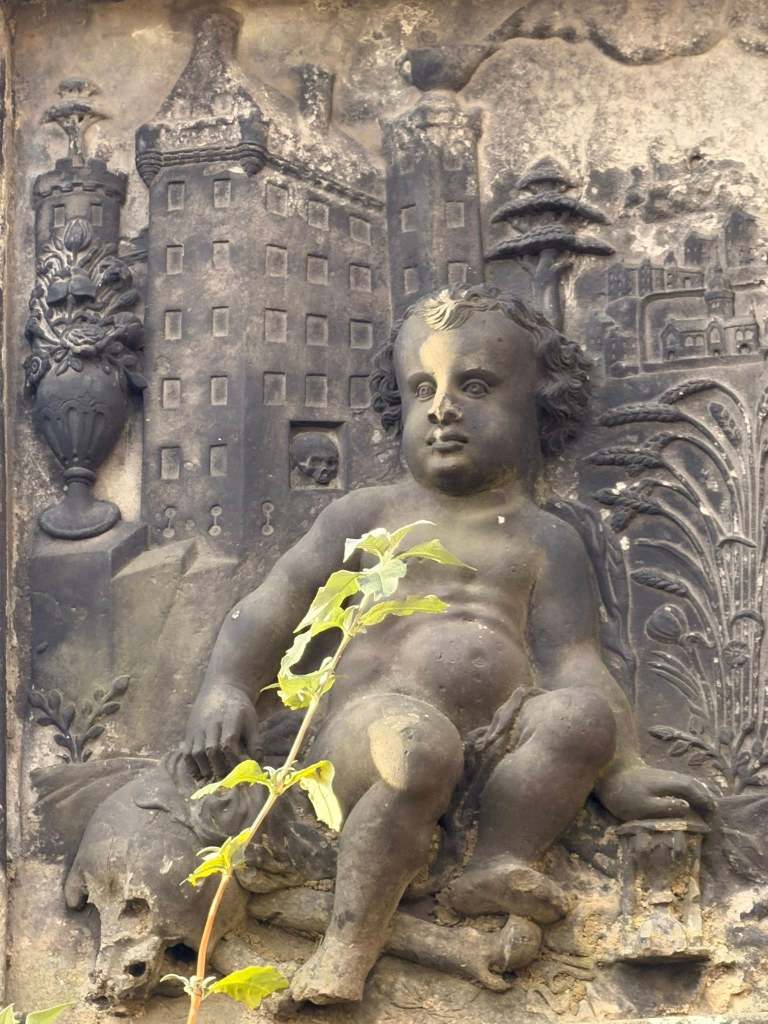
Have you ever noticed that the Cherub in the centre of the top panel on the Foulis Memorial has its eyes closed ? By contrast, the equivalent Cherub on the Bannatyne Memorial has its eyes wide open. Why ?
Whilst here, we should pause to consider just how much is going on on these panels. Being rather high up and difficult to see, it would be easy to miss just how much detail there is on these panels, rich in symbolism and its associated messages. I have added a description on each photo.
You are welcome to challenge or contradict my interpretation of the symbolism. It is a subject that deserves debate.
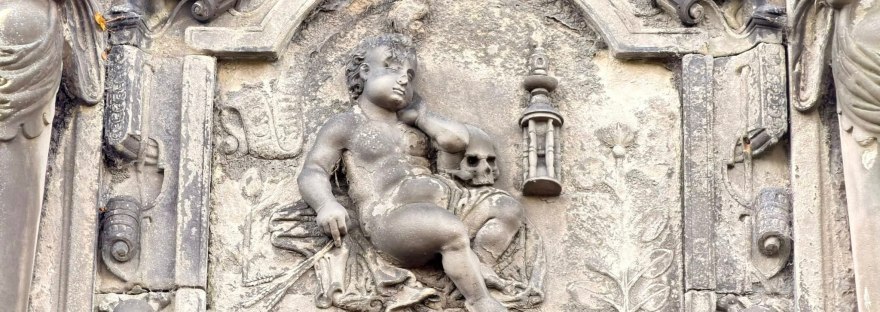
This scene is flanked by what appears to be pregnant caryatids, perhaps symbolising the promise of new life in heaven. The masked Greenman along the bottom also symbolises new life after death, as does the flowers, foliage, arrangements of fruits and stalks of wheat. The pair of small cherubs in each top corner are blowing trumpets, summoning the dead to arise. The hour glass symbolises that we need to be ready for our time to die, whilst the flaming lamp on top of the hourglass symbolises life going on. The small skull and cross bones, bound with ropes either side bottom corner symbolise what becomes of our mortal remains, which are affixed to the earth. The large Cherub leans rather casually on a skull, showing us to not be fearful of death, but we do need to be ready for it. Ready for it being having repented in time and having been faithful Christians, so deserving of resurrection to heaven. Perhaps the Cherub’s eyes are closed to show how relaxed they are, or how deep in contemplative thought ?
The Chubby Cherub symbolises a healthy new life.
The Cherub on the Bannatyne here has its eyes wide open and staring into the distance. It is surrounded by very similar symbolism to the Foulis, with several added extras. We have the skull and bones beneath the Cherub (we are not fearing death, we are beating it). We have the hourglass (be thee ready for when the time to die comes) and the foliage and wheat (new life). We have a vase full of flower to the left, then a Cityscape of buildings and towers. There is a skull peeking out of one of the windows. A tree grows out of the top of one of the towers (left) whilst the other has a huge lamp on top, from which emits a massive plume of smoke. Another large tree grows behind the Cherub. I suggest this distinctive style is showing us a Cedar of Lebanon, a tree which has held profound significance for millennia. The tree features in the Hebrew Bible, according to which the tree was used in the construction of the Jerusalem Temple by Solomon. To the right of the tree is a cluster of buildings, with what appears to be a large Church in the middle. This could be modelled on St Giles High Kirk in Edinburgh. The Bannatyne Memorial has a Vanitas theme, copying some Dutch artists of a few decades earlier. The symbolism here is clearly heavily influenced by that.
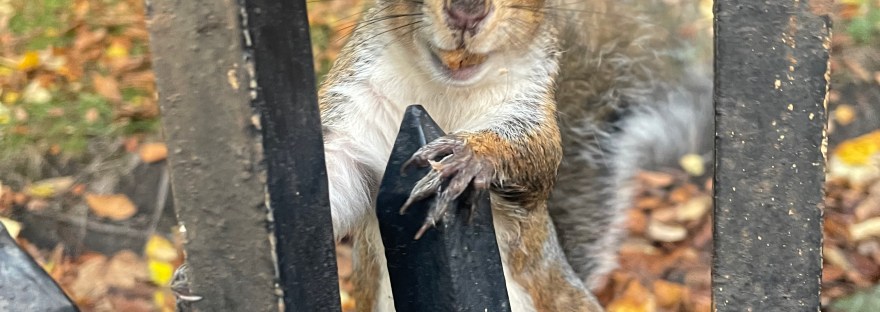
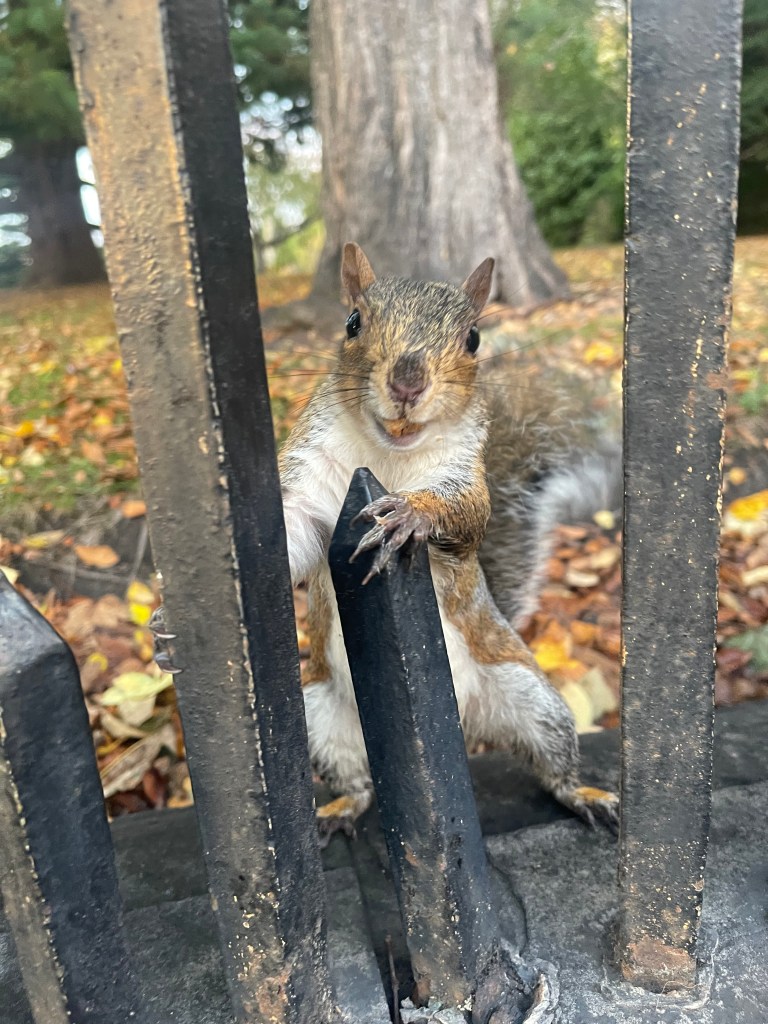
We have some lovely squirrels who visit the Kirkyard.
Here is Chappy, a squirrel that lives next to the Kirkyard. There is a thriving squirrel population in and around the Kirkyard, some of whom live behind the mural monuments. The many trees, substantial areas of grass and no dogs off leads seem to create the conditions that the squirrels enjoy. It’s just a pity they don’t eat buddleiha !
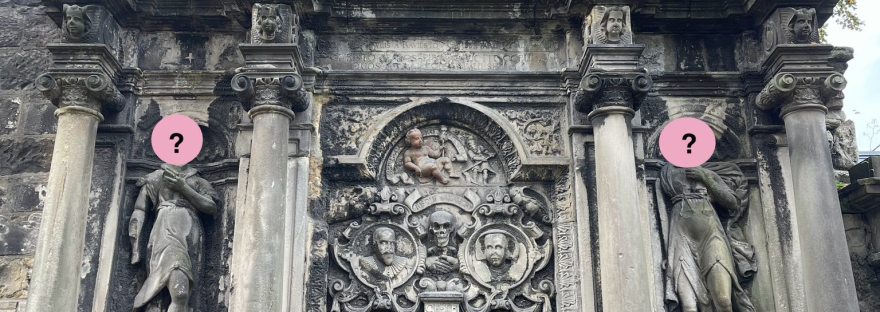
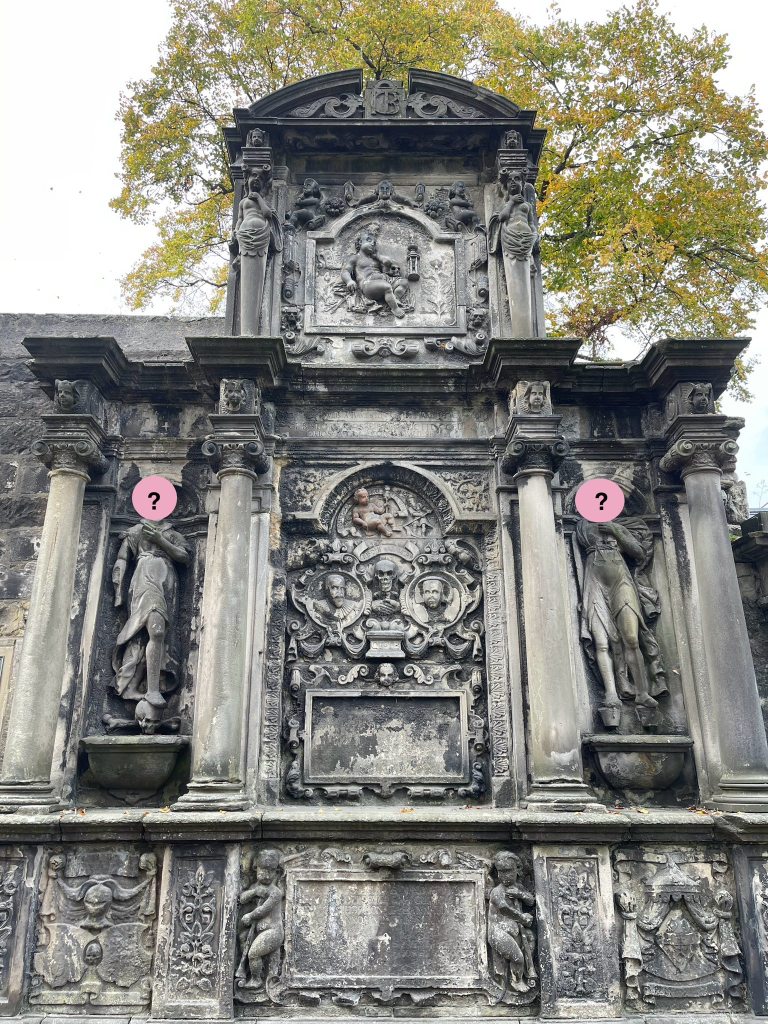
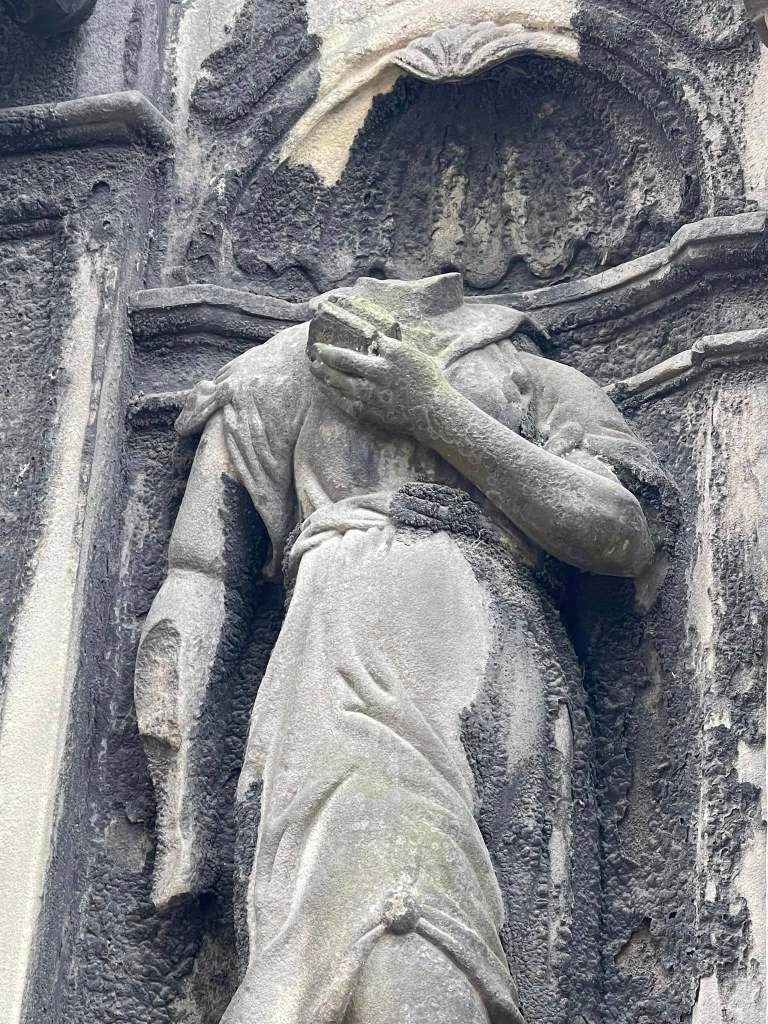
On the Foulis Mural Monument ….. did Justice & Faith ever have heads ?
So two possible answers. Maybe they were modelled on classical Greek or Roman sculptures which often don’t have heads. So maybe they never had heads when first created.
Or, they did originally have heads but these were knocked off at some stage in the past…..possibly during the time Oliver Cromwell troops garrisoned Greyfriars Kirk.
How will we ever know the answer to this question ? It is a question I often get asked and would love to be able to give a definitive answer.
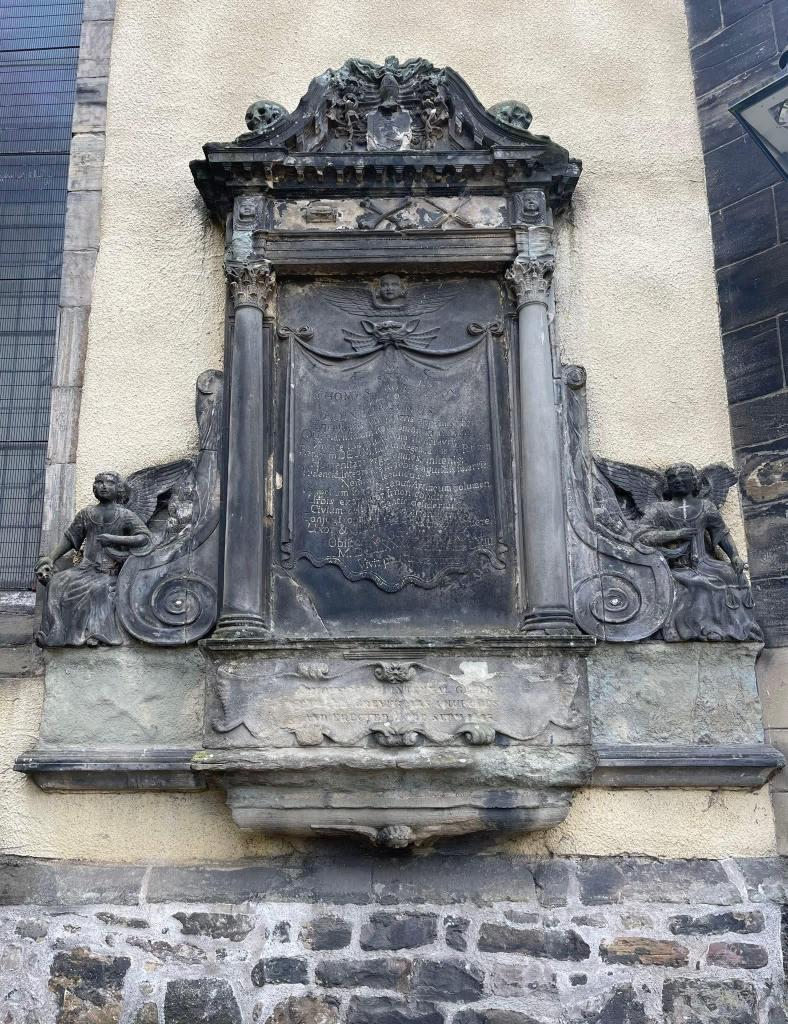
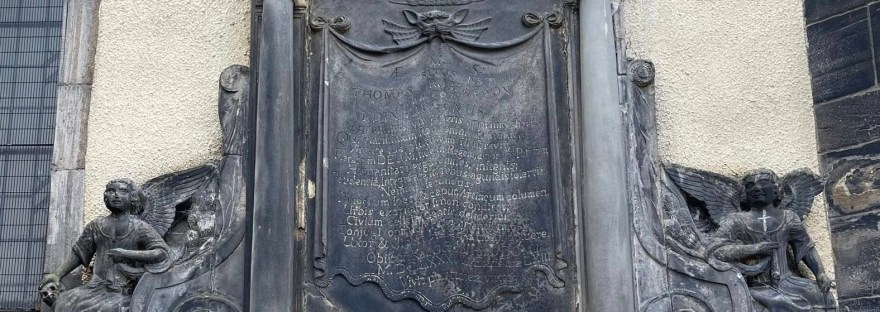
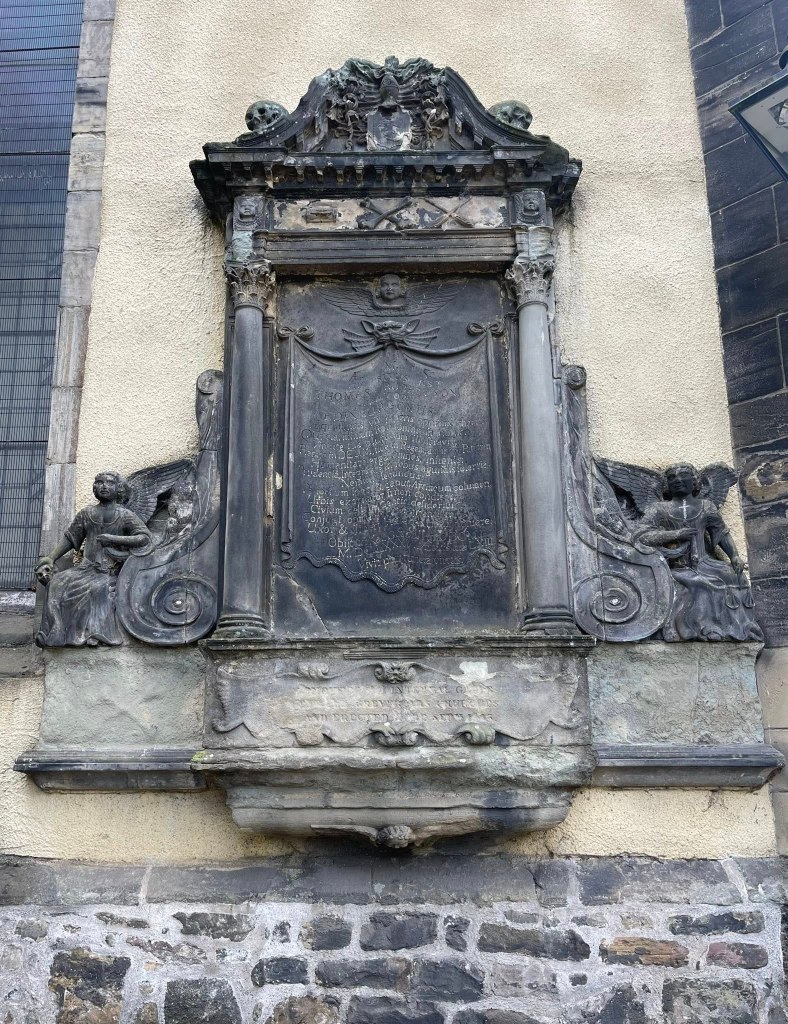
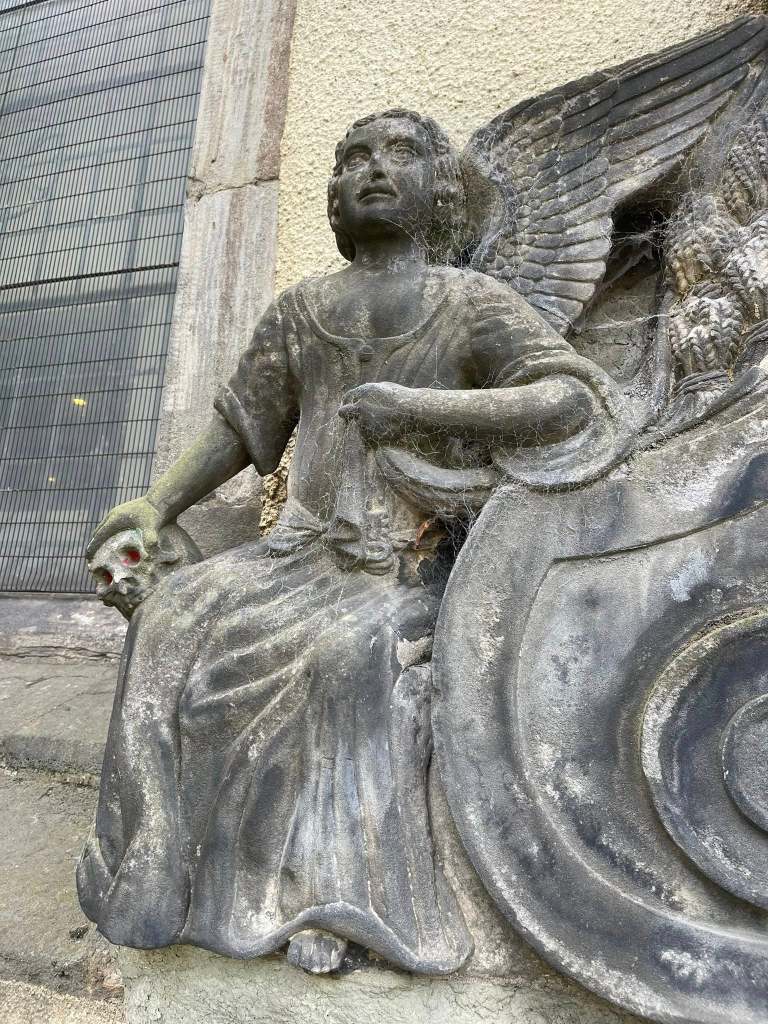
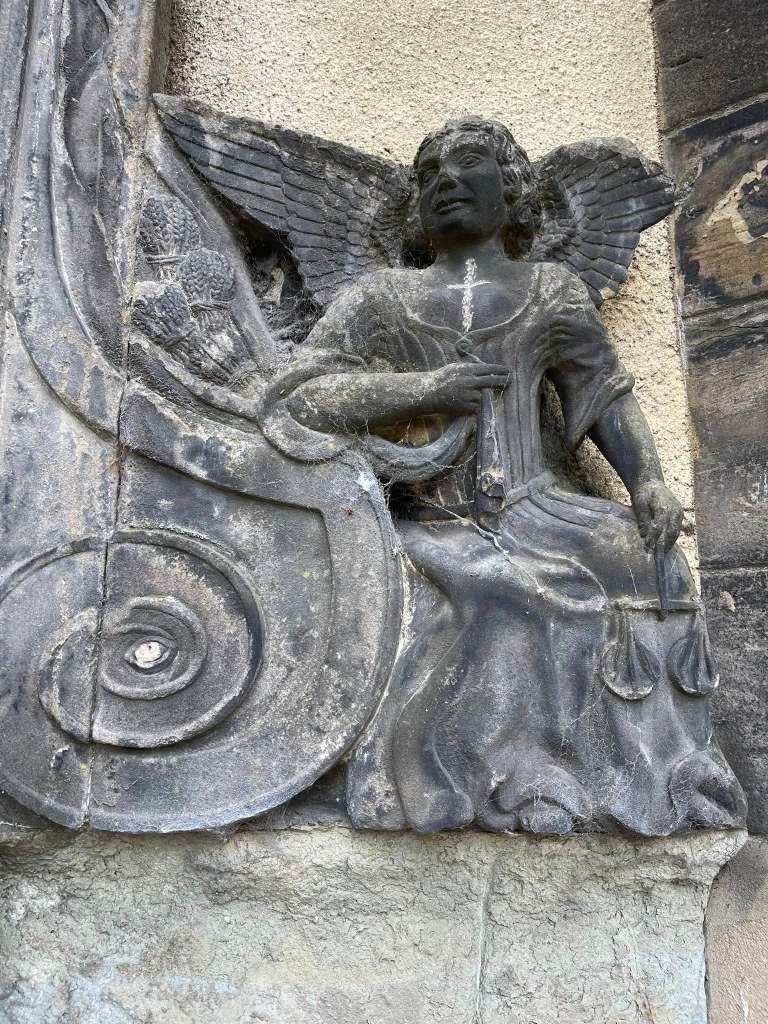
Today this memorial is mounted on the north wall of the Kirk, but it wasn’t originally in this position. When Thomas Robertson died in 1686 “his most mournful wife and children erected this monument”. The memorial was created by Robert Mylne, the most famed & skill Master Mason to the Crown. They had it affixed to the West Wall of the original (Old) Greyfriars Kirk, in a prominent position for all to admire. When the New Greyfriars Kirk was added to the west end of the old Kirk, this memorial found itself hidden from view in the internal space between the old and new structures. This space was subsequently used as the coal cellar, meaning this marvellous memorial suffered the indignity of being hidden and covered in coal dust. When the dividing walls between the Old & New Kirk were finally removed in the 20th century, this monument was liberated and mounted in its current position where everyone can see it again. The inscription ends with the motto “Virtue survives the Grave”. Perhaps a footnote might be added saying “This Monument survived the Coal Cellar”.
A classic Robert Mylne design in which the central panel is made up of drapes, held up in the mouth of a beast.This small foliate face (aka Green Man) is on the monument.A winged spirit underneathFlanking the left side of the monument is a large Angel holding a skull on their knee (Angels have no gender).On the right side the flanking Angel holds the scales of judgement. Note the all seeing eye of god depicted in the centre of the swirl to the left.
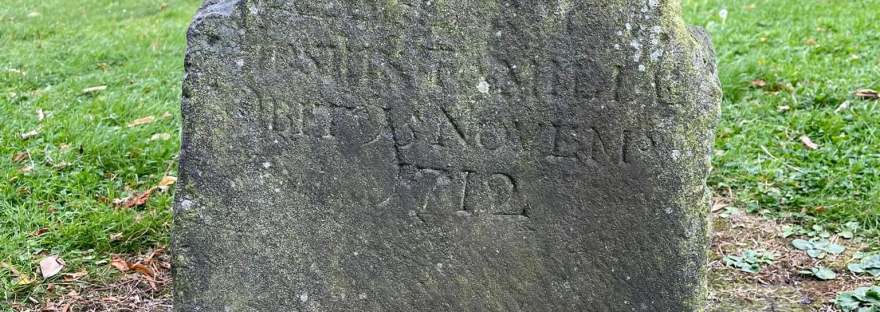
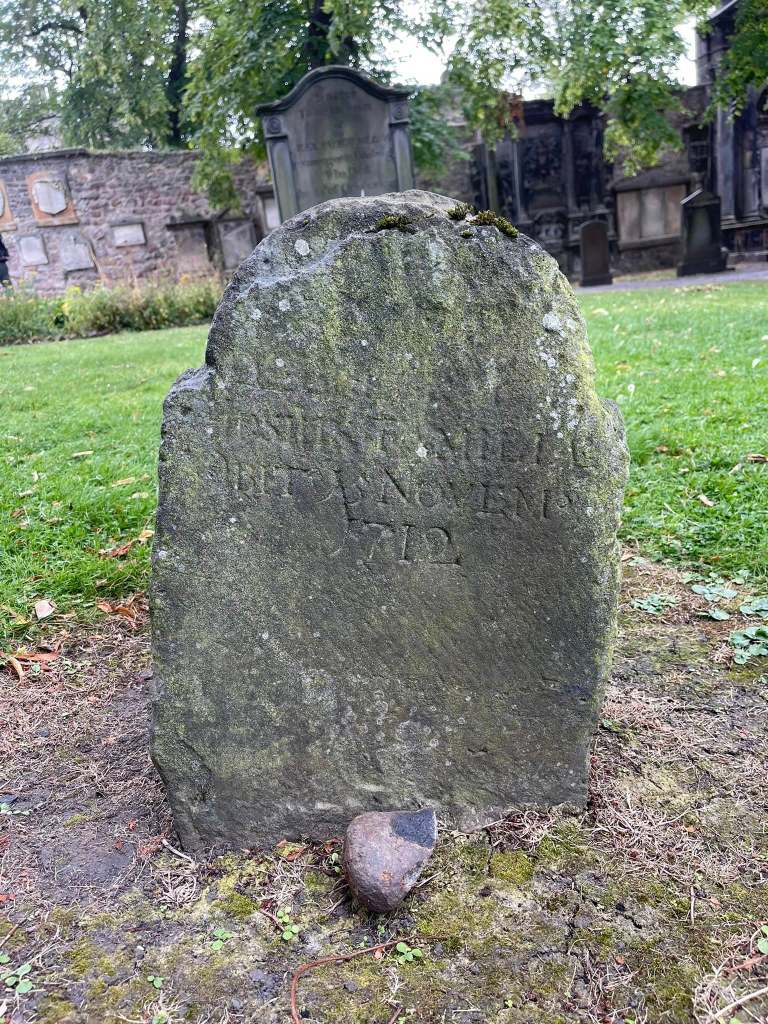
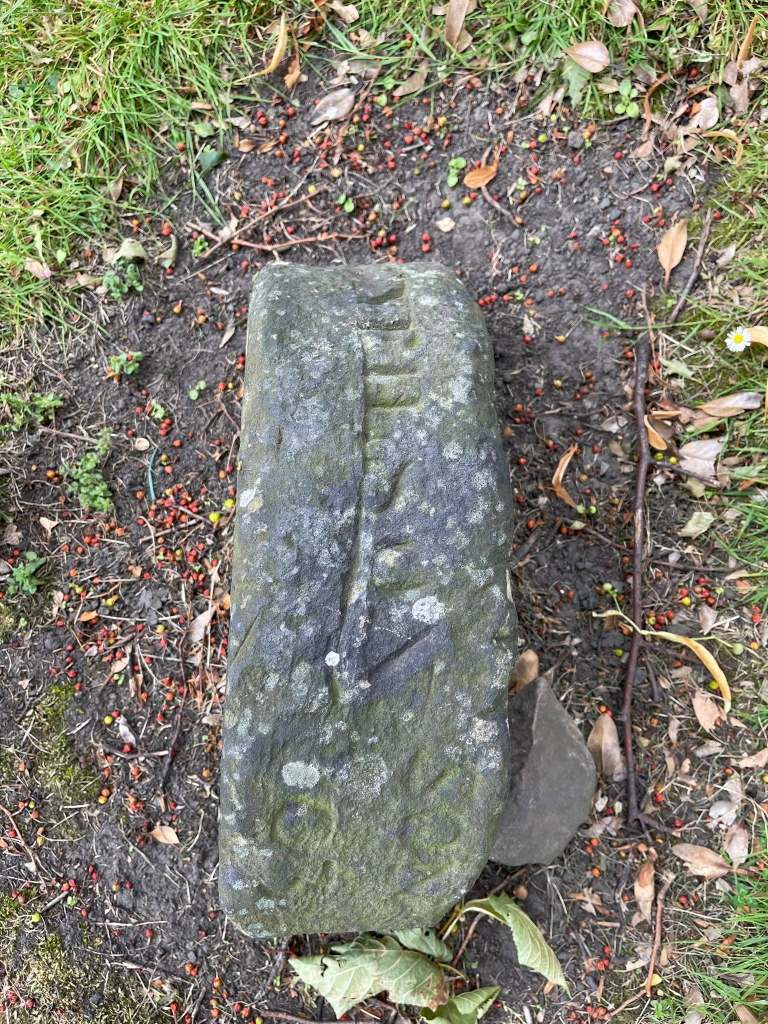
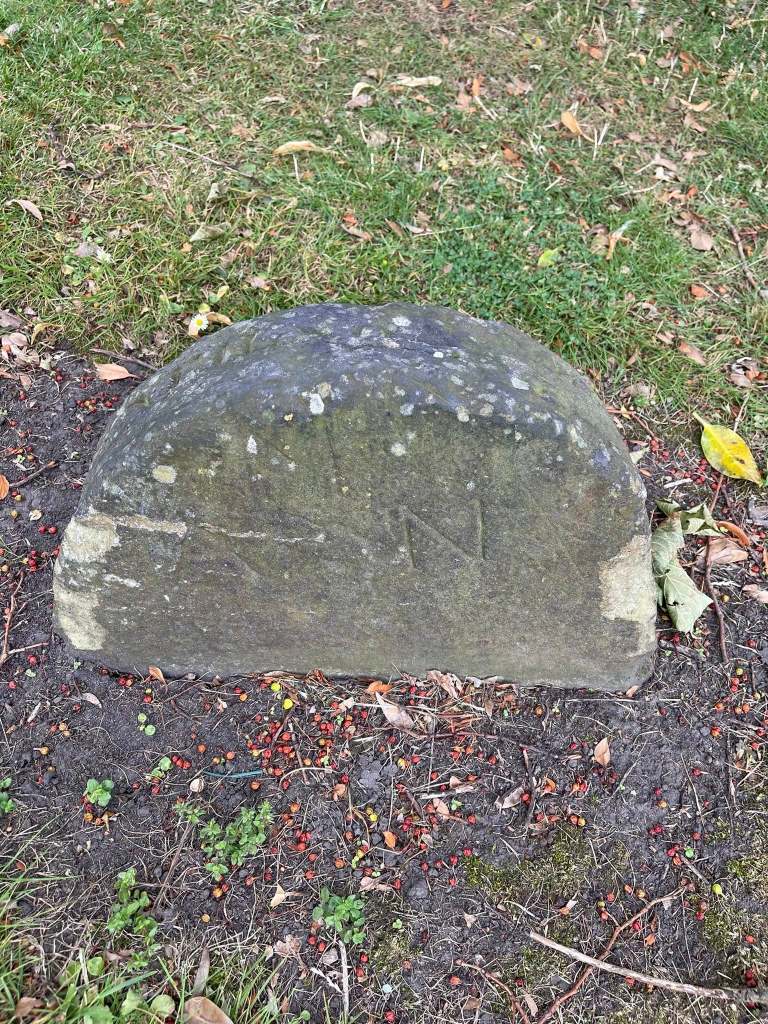
There are no surviving gravestones at Greyfriars dated pre 1606. There is one fragment that may bear a date of 1596, but we can’t be sure of its age. We do know there were some grave markers erected between the 1560’s and the early 1600’s but these were cleared away by order of the City Council at various times in that period. It appears the Council were concerned that headstones erected on the grass area of the Kirkyard would limit the capacity of the Kirkyard to accommodate vast numbers of burials. It was also consistent with the policy of the new reformed church that everyone should be buried in secret (meaning without grave markers). However, from 1606 onwards the council allowed wealthy families to buy the right to erect mural monuments against the walls of the Kirkyard. This raised valuable funds for building the Kirk without significantly reducing the capacity of the grass area. But move on to the 1700’s and a few very small headstones start to be allowed on the grass. These photos show the oldest two that I have spotted. One is very clearly dated 1712. The other appears to be dated 1703. Such small headstones may have been considered acceptable as they don’t take up much space. By contrast, other burial grounds in and around Edinburgh in the 1700’s allowed far larger & more elaborate stone memorials on the grass, but at Greyfriars in the 1700’s large memorials were still limited to the walls. On the grass only quite basic, small, solid, simple stones appear at Greyfriars. However, by the very end of the 1700’s the council started allowing larger and more plentiful headstones in some open grassed areas of the Kirkyard, perhaps because the volume of new burials were starting to reduce as Edinburgh began opening new large cemeteries in other areas of the City. Another reason for the small & simple stones on the grass in the 1700’s may be that in that period Greyfriars’ main grassed areas were regarded as a poor man’s burial place with the wealthy folk only wanting the best wall side plots or those in the newly opened Covenanter Prison extension.
1712 GraveGrave in lawnGrave in lawn1775 grave with Masonic set square & compass
Only one of the small headstones dating to the 1700’s has any symbolism on it. This one dated 1775 has a set square & compass, which are Masonic symbols and the tools of a Mason.
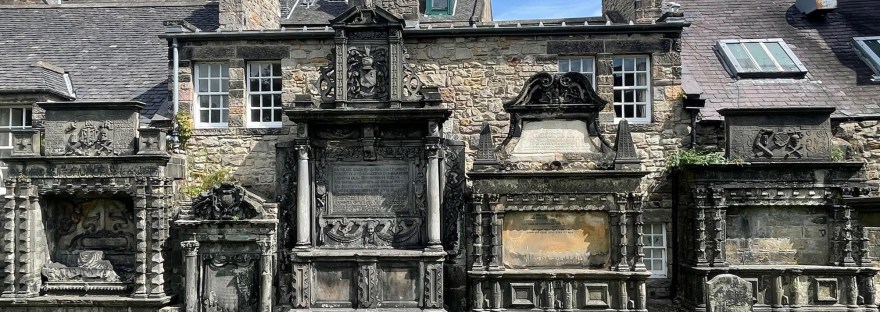
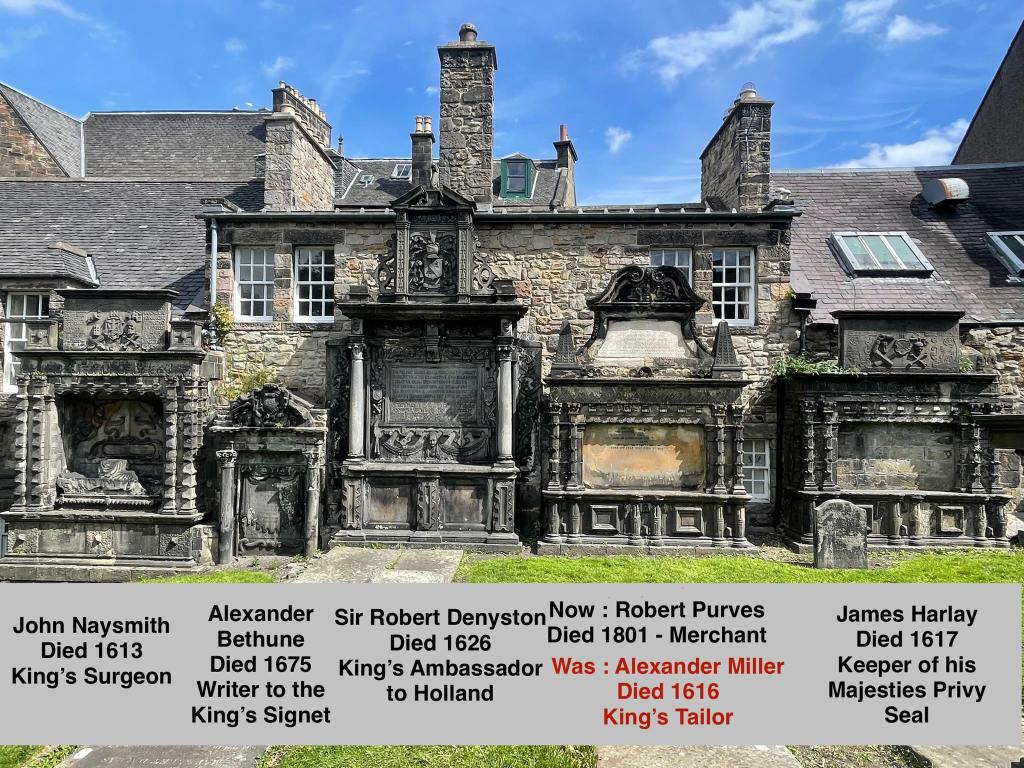
The East Wall of Greyfriars Kirkyard (that backs on to Candlemaker Row) has a line of 17th century monuments. This annotated photograph shows my suggestion that the monument second from the right was originally raised for Alexander Miller, the Tailor to James VI, who died in 1616. Now conventional wisdom says that the Alexander Miller memorial was originally near where the main gate into the Kirkyard now is from Candlemaker Row and that when that gateway and the Recorders Office (now Bobby’s Bothy used by City of the Dead Tours) was built Alexander Miller’s memorial was removed, never to be seen again. But I suggest either Alexander Miller’s memorial was simply moved 75 yards or so to the North and re erected here, or possibly that it was always here and the suggestion that it was originally where the gate now is was incorrect. The Theatre of Mortality book written by Robert Monteith in 1704 places Alexander Miller’s memorial between Dennistoun & Harlay (or at least that is the order he lists their inscriptions). It was James Brown in 1897 who wrote that Miller’s memorial had been taken away when the gateway and the Recorders Office was built. James Brown gives the details of this memorial (2nd from the right) as being that for Robert Purves, who was around in the 19th century. Obviously the monument itself is a 17th century work, but Purves probably bought it to use as his family memorial, thereby removing any reference to Alexander Miller. This was the fate of a number of other memorials along the East Wall. What do you think ?
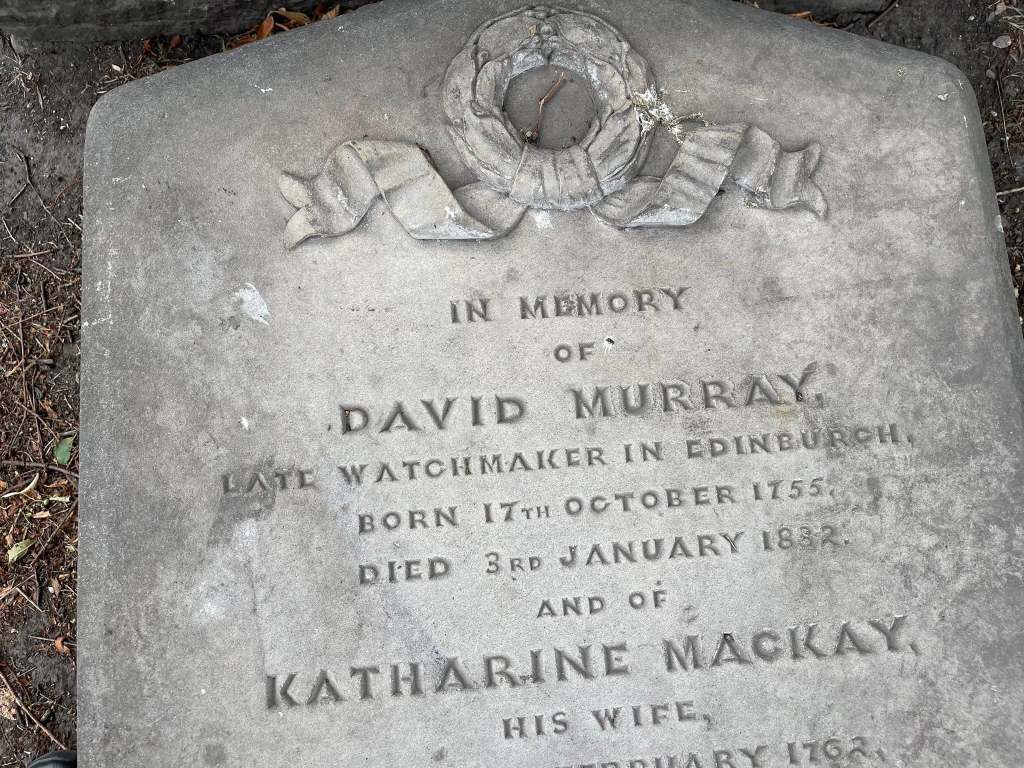
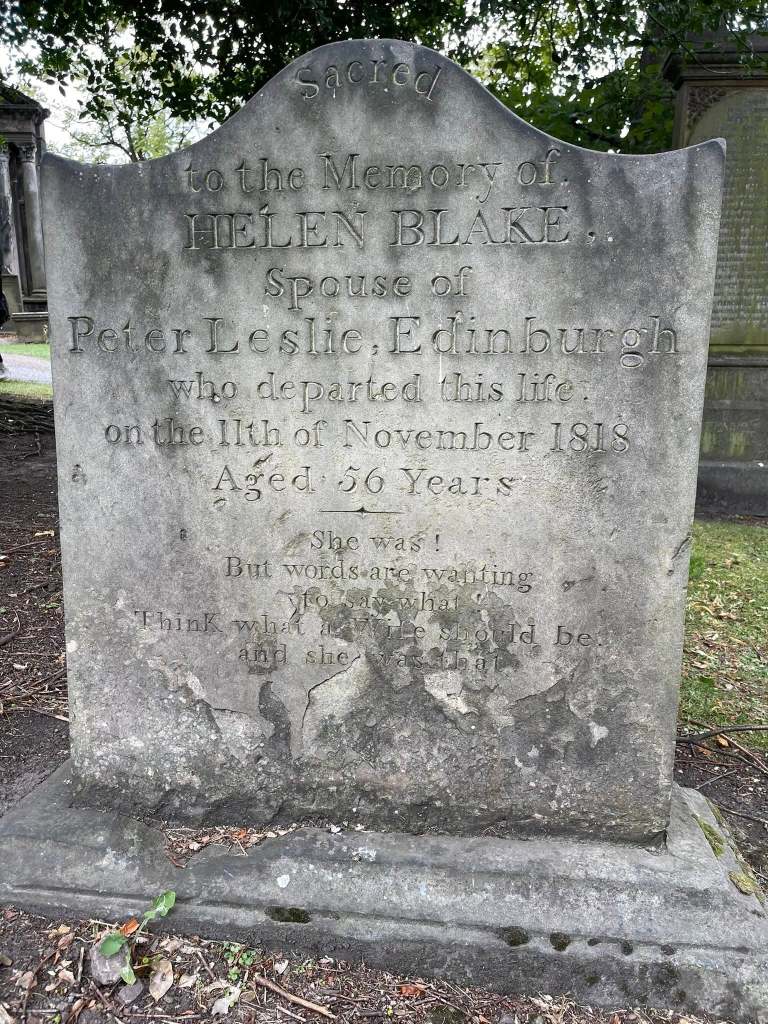
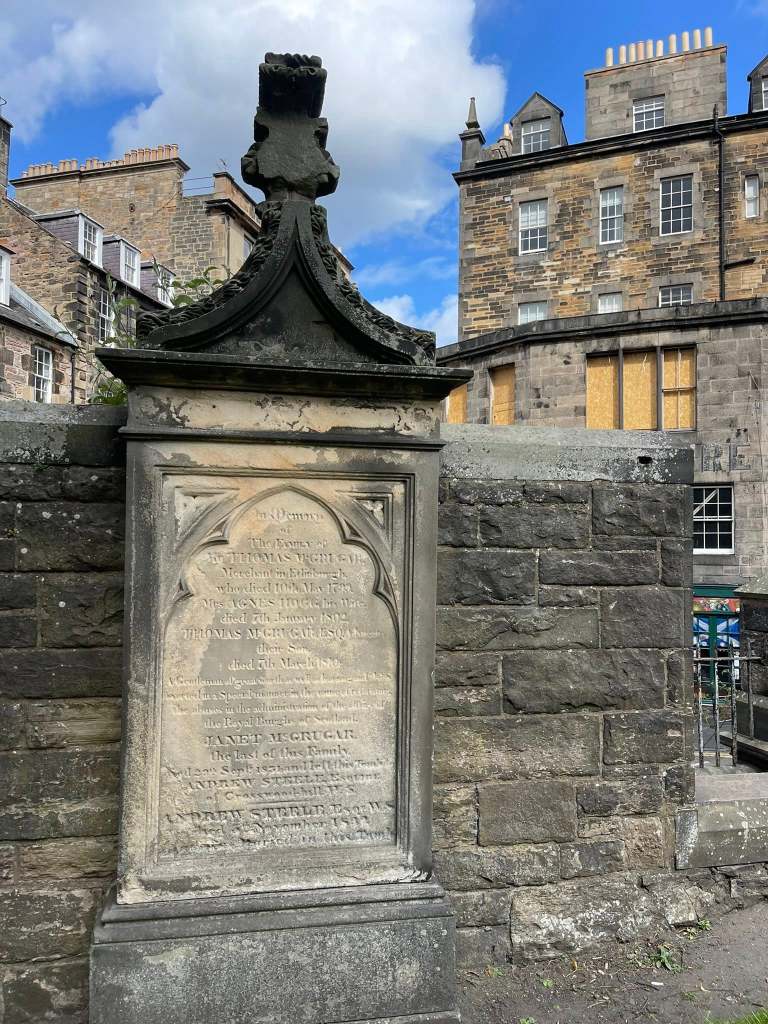
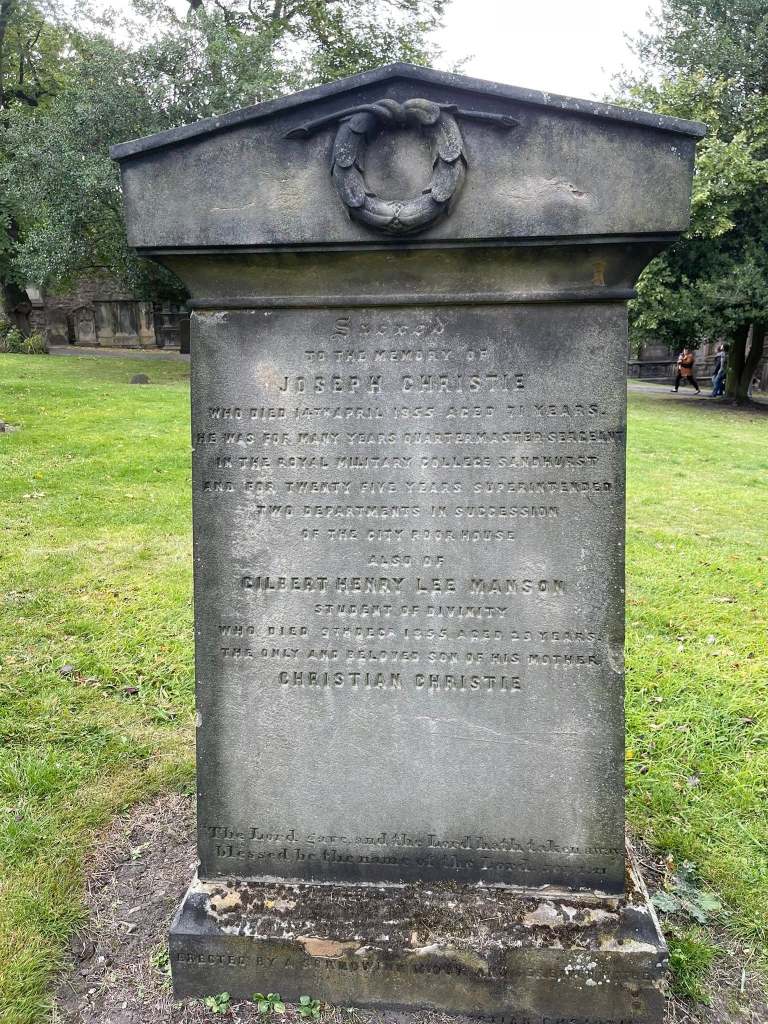
Every gravestone tells a story & gives us a glimpse of lives past. How people lived, how they made their living, the society they lived in & how they died. Maybe some clues as to their personality, their hopes & fears, their beliefs & values. These are 5 quite random gravestones that caught my eye in Greyfriars today. Non have the eye catching symbolism, scale or sophistication of the large mural monuments. They are all 19th century examples, by which time headstones were simpler, narrative heavy, symbolism light designs. So why did each of these catch my eye and cause me to pause for thought ? The answers are on the caption of each of the images.
David Murray 1755 – 1832
Ok, so obviously Watchmakers can’t live forever. But maybe not ideal to describe one as a “Late Watchmaker”, as that made me think he may not have been that good at making reliable time keeping instruments ;o)
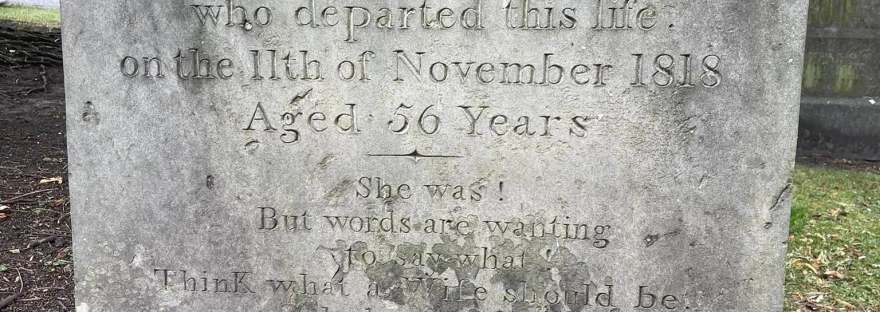
Helen Blake 1818
The epitaph here caught my attention. I am well used to reading long winded, gushing epitaphs that take great pains to describe the extraordinary virtues of the deceased. But here the epitaph for Helen Blake, written by her Husband, Peter Leslie, has been reduced to the following : SHE WAS ! BUT WORDS ARE WANTING TO SAY WHAT THINK WHAT A WIFE SHOULD BE AND SHE WAS THAT
Thomas McGrugar
The boarded up windows in the background are the back rooms of The Elephant House cafe where JK Rowling sat writing Harry Potter. If she did visit the Kirkyard looking for suitable names for her characters, maybe she should have spotted and used this one. McGrugar surely would have made a good name for a Professor of Magic ;o)
Joseph Christie
Joseph Christie started his career as Quartermaster Sergeant at the Royal Military College at Sandhurst. He then spent 25 years as the superintendent of the City Poor House, which was adjacent to Greyfriars.
William Coulter
William Coulter was a Soldier who served two campaigns in Portugal, “gaining the esteem of his equals and the confidence of his superiors”. Sadly he fell at the Battle of Albuera in 1811 aged only 21, “bequeathing to his afflicted parents the sweet consolation that he was worthy of his Country”. The Battle of Albuera took place on May 16, 1811, near the Spanish village of Albuera, not in Portugal. It was a major clash during the Peninsular War, involving British, Spanish and Portuguese forces standing together against the French. The battle was known for its fierce fighting and high casualties, particularly among the ranks of the British infantry.
What do each of these words describe & which of them do we have at Greyfriars ? Well, here is my attempt to pick through the individual meaning of these terms. I welcome any corrections of my homework, or improvements to sharpen up my definitions or alternative interpretations of these terms or additional terms that should be in this group.
A Monument is anything designed to commemorate a person or an event. As such a wide range of different types of structures could be labelled as a Monument, many not involving burials or graveyards. Usually the term is used to describe something that is a large, impressive structure, hence the term “Monumental” often used to describe something that is big and or important.
A Memorial is similar to a Monument and the terms are often used interchangeably. But whilst a Memorial is a type of Monument, not all Monuments are Memorials. Memorials are inherently involved in remembrance of the dead, while Monuments have a wider scope, including remembering events. A Memorial can be anything raised to serve to memorialise a person or persons passed, so in practice it can take many different forms ranging from the very simple & humble to the very grand & ornate. A Memorial does not necessarily mark the place where the person (or persons) being remembered is buried. And memorials can be raised anywhere, not just in burial grounds. For example, most communities have a war memorial listing the names of local people who died during or as a result of war. So whilst all gravemarkers are memorials, not all memorials are grave markers. Even in a burial ground the memorials may seem to be marking a grave but the inscription could describe a person whose remains lie elsewhere.
A Tomb is a general term for a place in which a body is interred (laid to rest) . It usually refers to something more than a simple hole dug in the ground (to which the term “grave” better applies), implying a structure of some kind designed to enclose or hold the burial. This structure may be below ground or above ground. A Tombstone originally referred to the stone slab that seals that burial place, but the term is now also used to refer to a stone that marks the burial.
A Mausoleum is a term used to describe an above ground tomb which has a grand scale and design. Often used for multiple interments, typically of members of the same family. The term originates from a King of Caria (part of Turkey) called Mausolus who in 353BC was interred in a large elaborate tomb.
A Lair is a burial plot, so a piece of land set aside for a burial. The Lair may be enclosed or unenclosed, marked or unmarked. The term refers to a place of rest, hence wild animals sleep in their lair (a place where they lie).
A Vault is any room or storage space built beneath an above ground structure, typically with an arched roof to support the structure above it. A vault may be used to hold bodies, but the term describes a space used for any number of purposes.
A Crypt is a type of vault, usually concealed & constructed underneath a Church, which is intended to be used for interment. The term is sometimes used to refer to a below ground burial vault, under a building or structure other than a Church.
A Sepulchre refers to a burial place, usually dug out of or made of stone. It is an old term, little used today. The Holy Sepulchre refers to the place Christ’s body was interred, which was a small cave, probably carved out of a rock face.
A Marker is anything that marks a place of burial or the Lair, possibly raised before the first burial but indicates who owns the lair.
A Gravestone is a stone erected to mark a grave.
A Headstone is an upright gravestone raised at the head end of the burial or Lair. A Footstone is a gravestone raised at the foot end of a burial, usually smaller than the headstone.
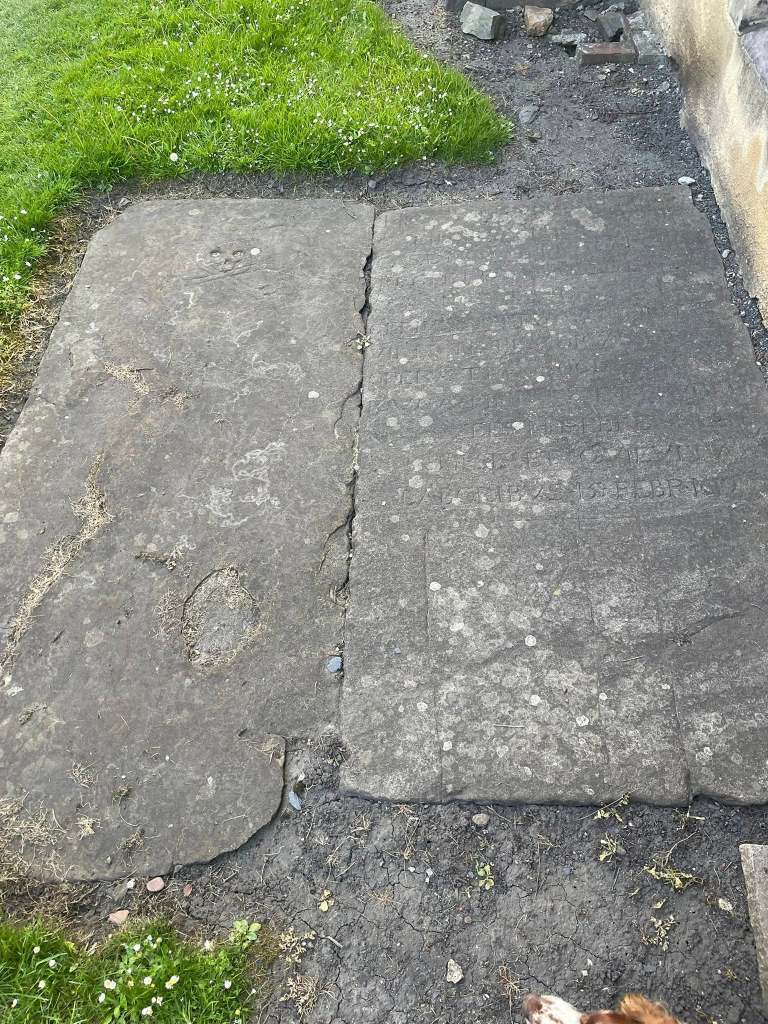
A Ledger is a flat stone slab laid over the burial. As such it both marks and protects the burial. Usually covering over the whole burial and often, but not always, inscribed with words or symbols to commemorate the dead.
So many of these terms are interchangeable and in some cases their original narrow definition has broadened over time.
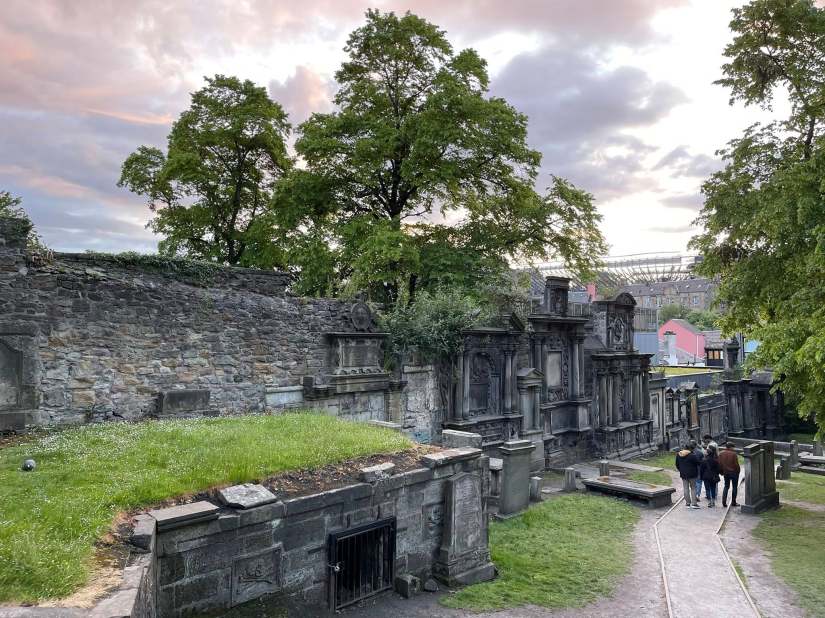
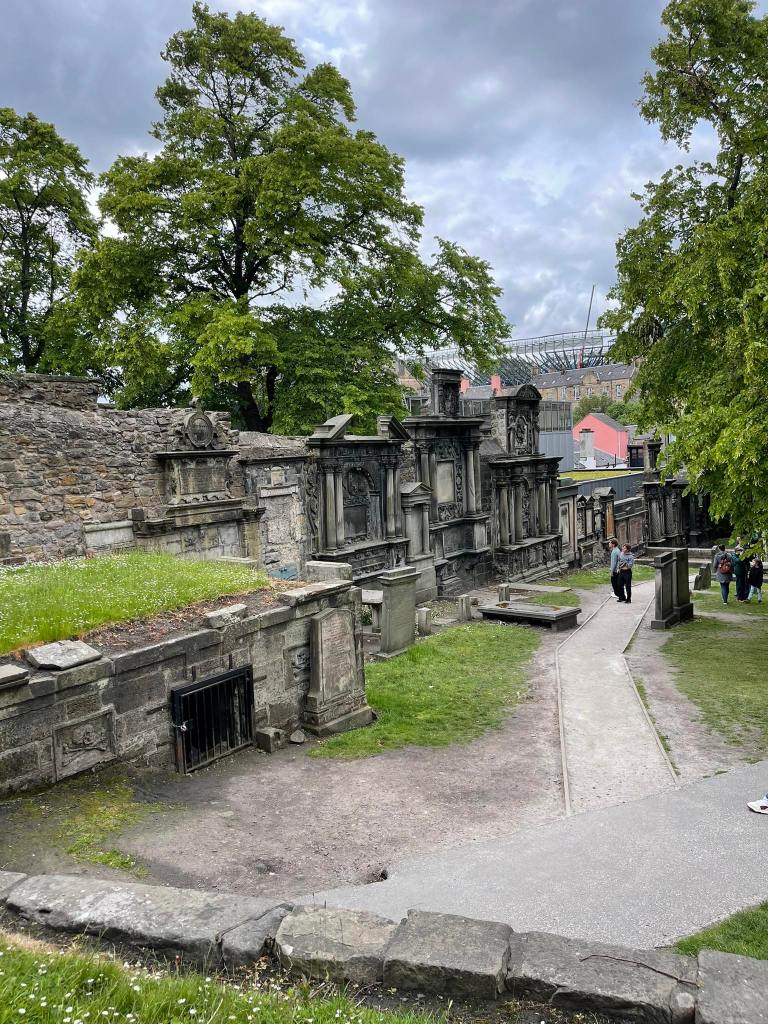
Let’s take a couple of examples at Greyfriars to see if we can decide which term applies to which. The first photo looks along the west wall and captures a sense of the wide range of different types of stones we have here. But deciding what is the appropriate term to describe each type is not entirely straightforward or clear cut. The structure that forms a burial place in the bottom left in this image may best be described as a Vault, the large wall mounted stones may best be described as Mural Monuments, the stones lying flat in front of the mural monuments may best be described as Ledger Stones. One of these is slightly raised up with a space beneath, so may qualify as a table stone whilst the upright stones on the right may best be described as Headstones.
West wall
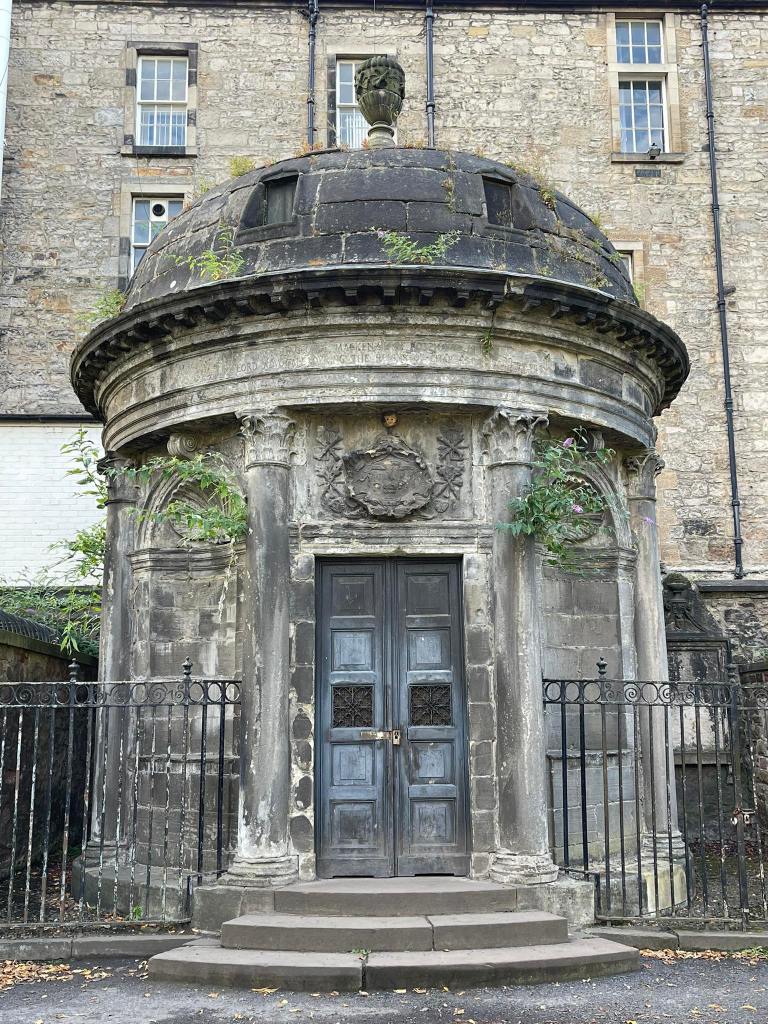
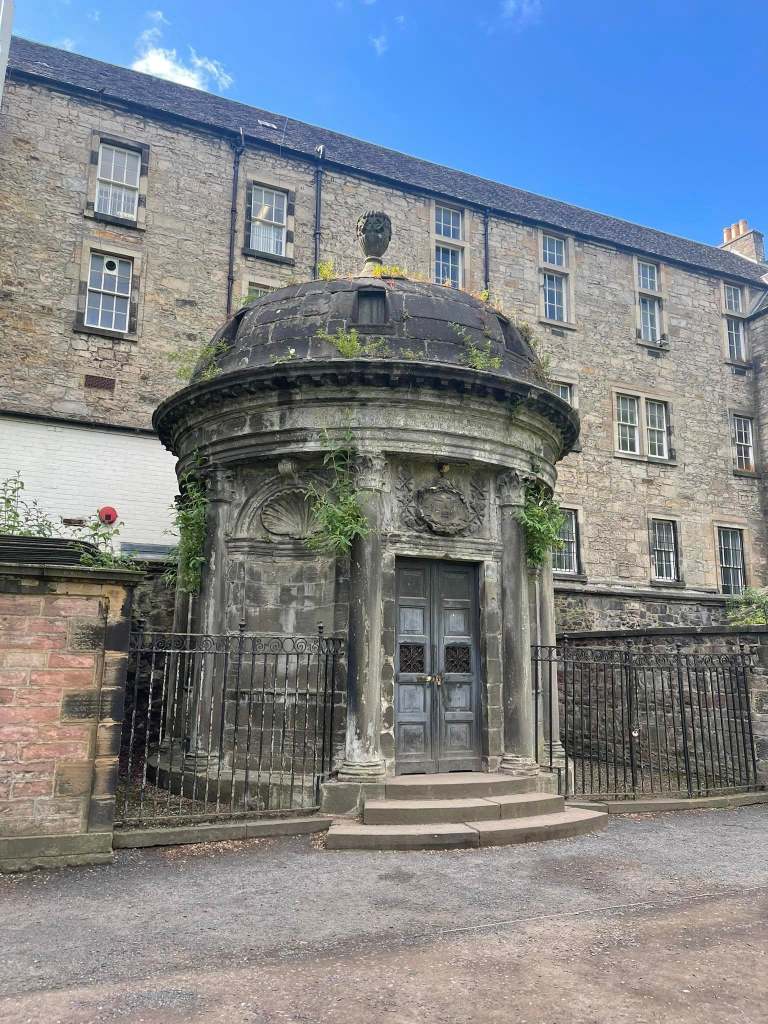
The second image is the burial place of Mackenzie which may best be described as a Mausoleum but this is complicated by the fact that the coffins in here are stored below ground level.
The Mackenzie Mausoleum?
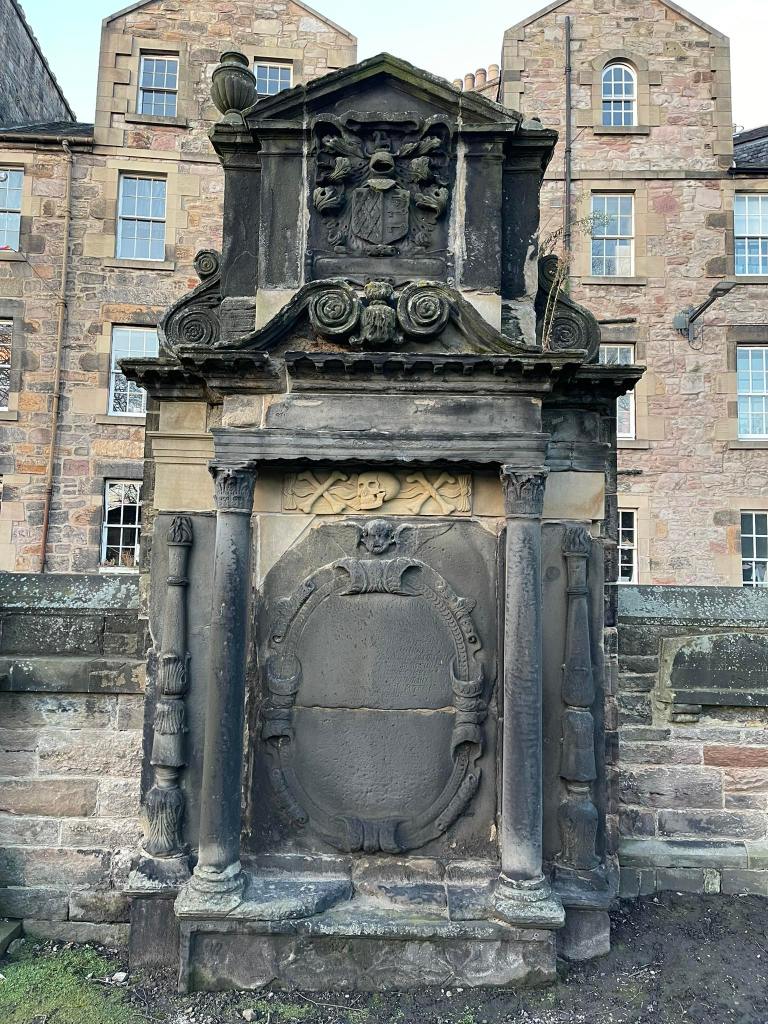
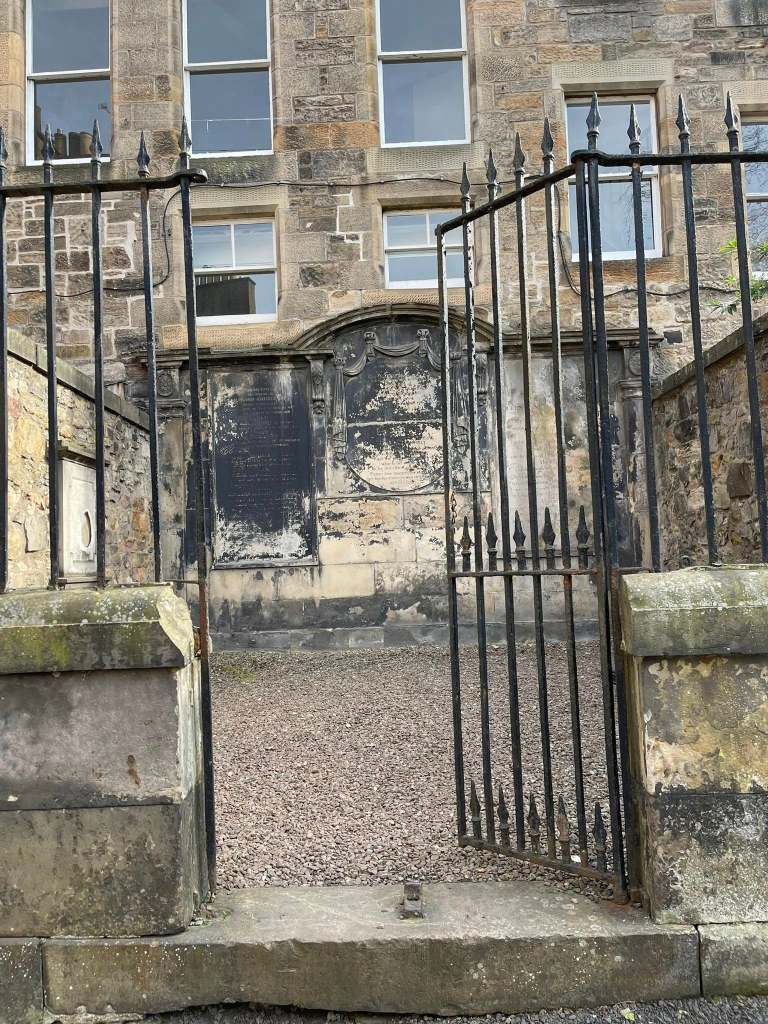
The third image is an enclosed Lair, in which the burials are made underground.
Enclosed Lair
The Foulis Mural Monument may be described as “A Monumental Memorial, that acts like an enormous Headstone, to Mark the Foulis family Lair”.
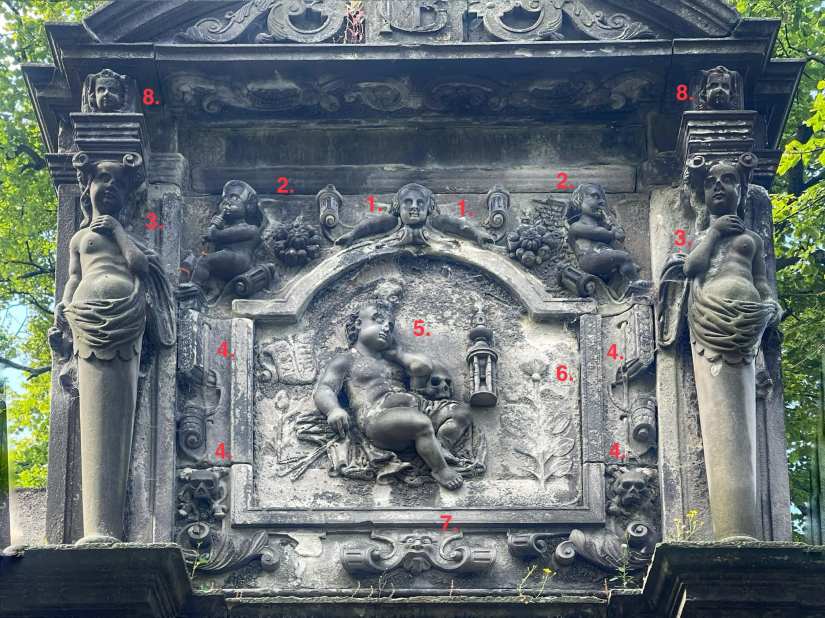
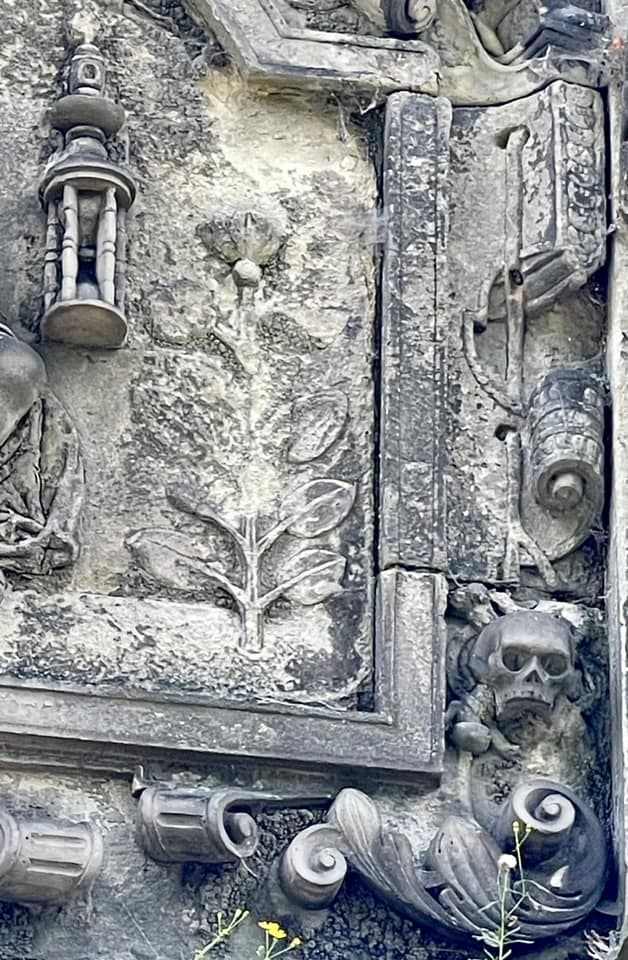
The upper section of the Foulis Memorial is so high above ground level that it is difficult to fully see and appreciate the intricate artistry and symbolism that resides here. A few unusual elements that must have been a stern test of the stonemasons’ skills include :
The cherub’s arms & hands are holding the frame of the scene below.
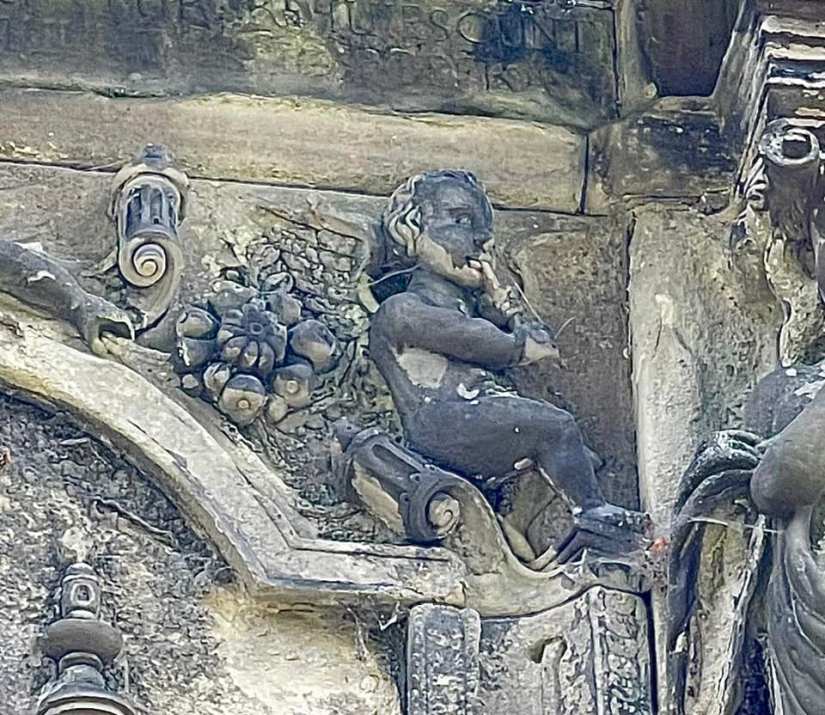
A pair of winged cherubs are blowing trumpets of resurrection. They symbolise that the dead will arise.
Pregnant female figures (in the form of caryatids) stand either side, naked from the waist up. They symbolise that the dead will be reborn.
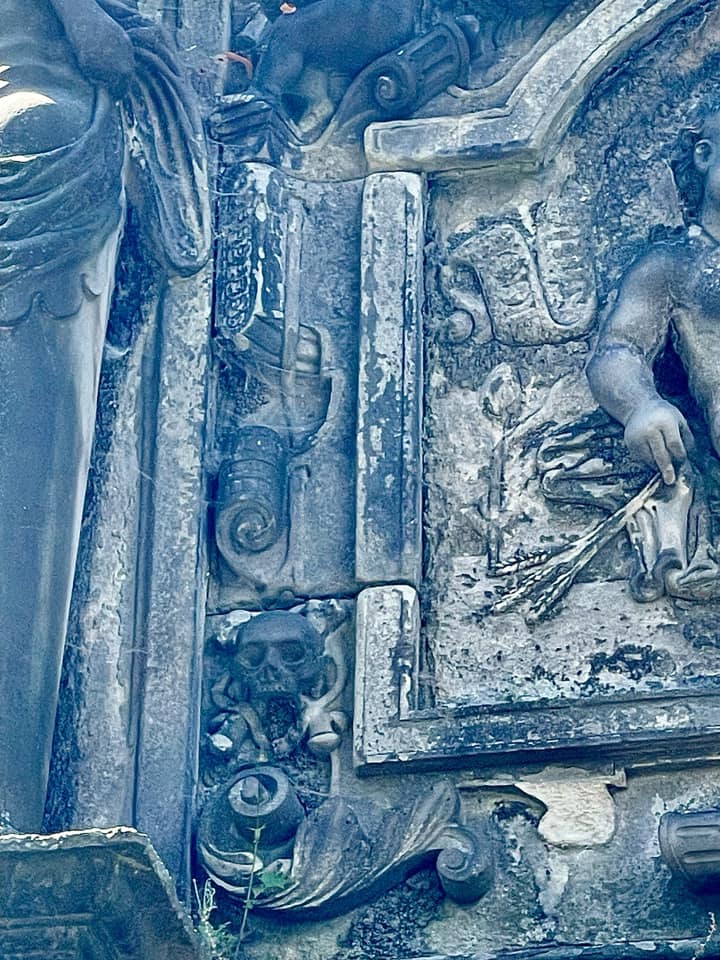
The skull & cross bones are tethered by ornate ropes which are threaded through the frame. This must have been exceedingly difficult to carve. These symbolise that we all will die and our mortal remains and possessions will remain on earth whilst our soul ascends to heaven.
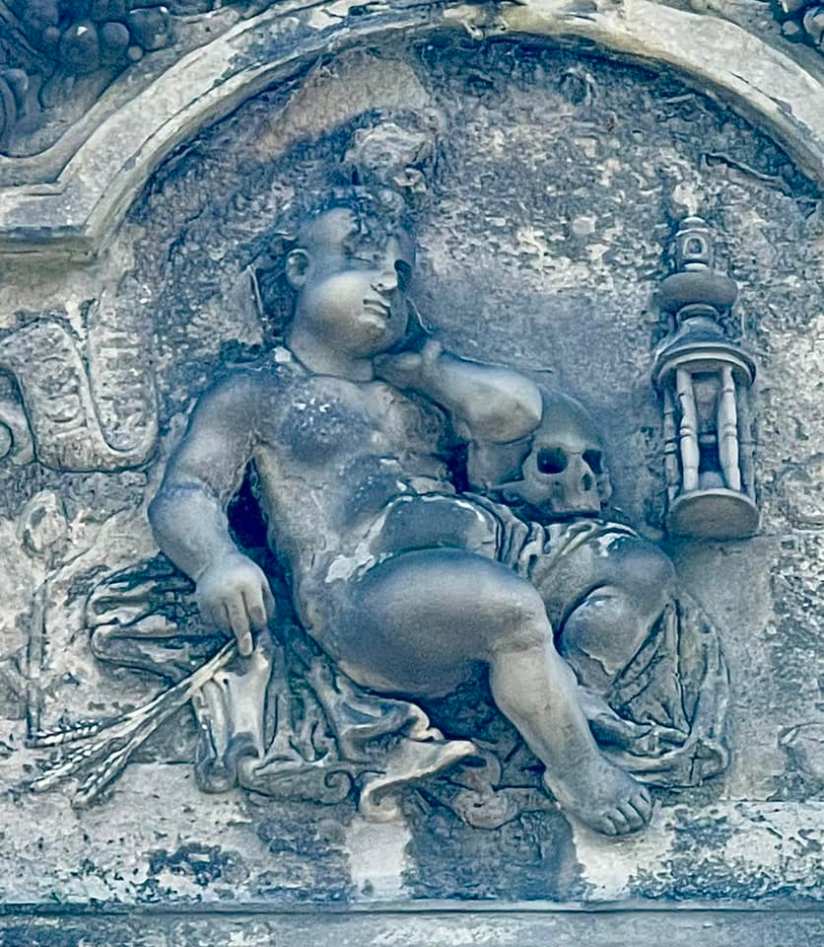
The large central cherub is shown in a relaxed contemplative pose, surrounded by symbols of death (skull & hour glass) and resurrection (flowers, foliage & crops)
The large flower symbolises the beauty and vulnerability of life, as well as the power to be reborn after death.
A “green man” hides in plain sight on the lower border. The face is covered in foliage, symbolising new life growing after and out of death.
The winged heads symbolise the soul of the deceased ascending to heaven. The whole Foulis memorial is a tour de force of the art of the stonemasons. No expense has been spared, no corners cut and no technical challenge was regarded as too great. The Foulis family did not achieve fame by playing an enduring role in the big social, political, military, religious, economic or scientific events of their day. They simply earned a fortune, mostly from money lending. Yet this memorial has earned them an enduring fame as we still discuss them today. The cost of this memorial must surely make it one of the most expensive of any we find in burial grounds in the whole of Scotland dating to the 17th or 18th centuries. But we can confidently conclude that the Foulis family received good value for money as by spending big, their name lives on, which is what a memorial seeks to achieve. George Heriot, another major money lender of the same period and a relative of the Foulis family, achieved the same result. But not by financing a big memorial above his burial place (which is at St Martin-in-the-Fields in London) but by leaving much of his fortune to establish Heriots School and Heriot Watt University. Those endowments amounted to over £25,000 (equivalent to £25 million today). The Foulis family will have spent a fraction of that amount on this memorial, but I estimate it will have cost up to £500 (or £500,000 in today’s terms).
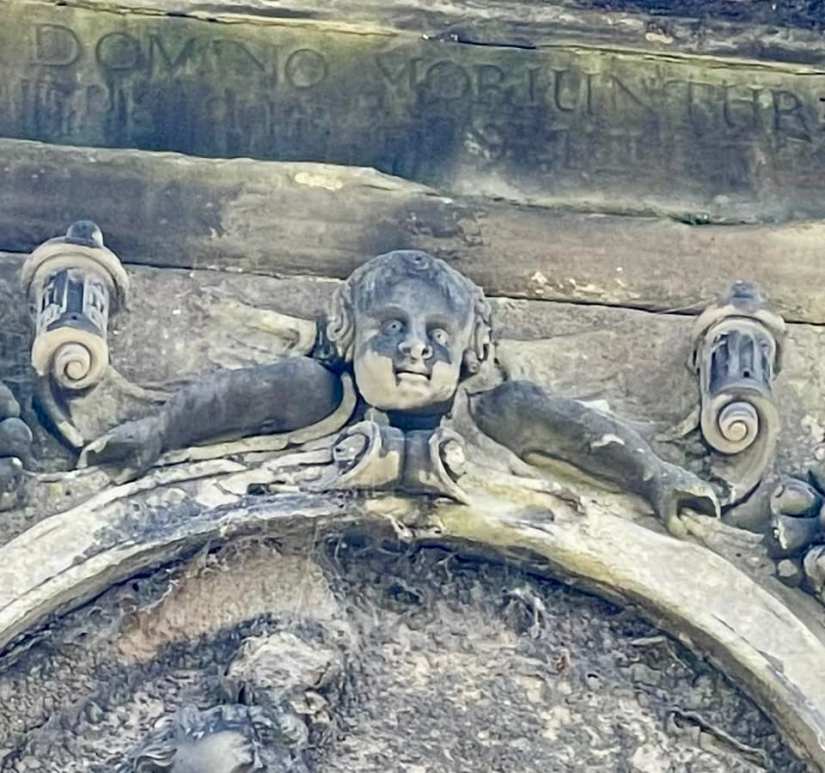
1 Winged cherub framing scene
This is the winged cherub whose arms appear to be holding the whole upper central scene. It is a most unusual pose, that must have been difficult to carve and could easily be overlooked. But once you see it, it is a detail that adds interest and impresses us further. The facial features are brilliantly carved giving the figure a personality & warm quality.
Winged cherub framing scene
2 Winged cherubs with trumpets
This is one of the pair of winged cherubs (angels) blowing trumpets of resurrection, pointing down towards the ground in which the dead are buried. They, like all of the Cherubs on this monument, have a very life like appearance, with a particularly well carved mouth, nose & eyes. They seem to display a deliberately warm & friendly character. The floral, fruity display behind them is further reinforcing the resurrection/ new life after death message.
Winged cherubs with trumpets
3 Caryatids
The pregnant & naked female figures forming the columns either side of this upper panel. These are Caryatids, a classical architectural device found on Ancient Greek buildings. This is a deliberate effort to evoke classical art, demonstrating the sophistication and education of the family. The figures are here to symbolise the power to bring forward new life. They are supporting their heads by holding their necks.
Caryatids
4 Skull & crossbones
The skull & cross bones is the most prevalent mortality symbol, serving to remind viewers to prepare for their inevitable death by living a good Christian lifestyle. The message is often reinforced by tethering the symbol with a rope or ribbon, symbolising that earthly assets and matters are of no value to us after death. A big effort has been made here to show the tether which is shown threaded through the structure to emphasis how securely bound it is. At the ends of the tether are decorative tassels that add weight.
Skull & crossbones
5 Central cherub
The central Cherub is shown, eyes closed to empathise its contemplative nature. It rests casually on a large skull, beside a brilliantly carved hourglass which has a flaming torch on top. The message is to contemplate death, the time of which will inevitably arrive, without any suggestion that these people fear death. This is designed to tell us that they are fully confident of their resurrection and admission to heaven so death holds no concerns, indeed death is the gateway to a new blissful life in heaven.
Central cherub
6 Flower
The large flower with leafy stem symbolises the frail, temporary beauty of life and the ability for life to go on after death (like flowers can die back in the autumn but grow up again in the spring). The carving of this element is less pronounced than the rest of the scene so sadly it has faded somewhat, compared to the still vibrant carvings that surround it.


















 Friends of Greyfriars Kirkyard