
Monument, Memorial, Mausoleum, Marker, Tomb, Lair, Ledger, Headstone, Gravestone, Vault, Crypt, Sepulchre…….
What do each of these words describe & which of them do we have at Greyfriars ? Well, here is my attempt to pick through the individual meaning of these terms. I welcome any corrections of my homework, or improvements to sharpen up my definitions or alternative interpretations of these terms or additional terms that should be in this group.
A Monument is anything designed to commemorate a person or an event. As such a wide range of different types of structures could be labelled as a Monument, many not involving burials or graveyards. Usually the term is used to describe something that is a large, impressive structure, hence the term “Monumental” often used to describe something that is big and or important.
A Memorial is similar to a Monument and the terms are often used interchangeably. But whilst a Memorial is a type of Monument, not all Monuments are Memorials. Memorials are inherently involved in remembrance of the dead, while Monuments have a wider scope, including remembering events. A Memorial can be anything raised to serve to memorialise a person or persons passed, so in practice it can take many different forms ranging from the very simple & humble to the very grand & ornate. A Memorial does not necessarily mark the place where the person (or persons) being remembered is buried. And memorials can be raised anywhere, not just in burial grounds. For example, most communities have a war memorial listing the names of local people who died during or as a result of war. So whilst all gravemarkers are memorials, not all memorials are grave markers. Even in a burial ground the memorials may seem to be marking a grave but the inscription could describe a person whose remains lie elsewhere.
A Tomb is a general term for a place in which a body is interred (laid to rest) . It usually refers to something more than a simple hole dug in the ground (to which the term “grave” better applies), implying a structure of some kind designed to enclose or hold the burial. This structure may be below ground or above ground. A Tombstone originally referred to the stone slab that seals that burial place, but the term is now also used to refer to a stone that marks the burial.
A Mausoleum is a term used to describe an above ground tomb which has a grand scale and design. Often used for multiple interments, typically of members of the same family. The term originates from a King of Caria (part of Turkey) called Mausolus who in 353BC was interred in a large elaborate tomb.
A Lair is a burial plot, so a piece of land set aside for a burial. The Lair may be enclosed or unenclosed, marked or unmarked. The term refers to a place of rest, hence wild animals sleep in their lair (a place where they lie).
A Vault is any room or storage space built beneath an above ground structure, typically with an arched roof to support the structure above it. A vault may be used to hold bodies, but the term describes a space used for any number of purposes.
A Crypt is a type of vault, usually concealed & constructed underneath a Church, which is intended to be used for interment. The term is sometimes used to refer to a below ground burial vault, under a building or structure other than a Church.
A Sepulchre refers to a burial place, usually dug out of or made of stone. It is an old term, little used today. The Holy Sepulchre refers to the place Christ’s body was interred, which was a small cave, probably carved out of a rock face.
A Marker is anything that marks a place of burial or the Lair, possibly raised before the first burial but indicates who owns the lair.
A Gravestone is a stone erected to mark a grave.
A Headstone is an upright gravestone raised at the head end of the burial or Lair. A Footstone is a gravestone raised at the foot end of a burial, usually smaller than the headstone.
A Ledger is a flat stone slab laid over the burial. As such it both marks and protects the burial. Usually covering over the whole burial and often, but not always, inscribed with words or symbols to commemorate the dead.
So many of these terms are interchangeable and in some cases their original narrow definition has broadened over time.
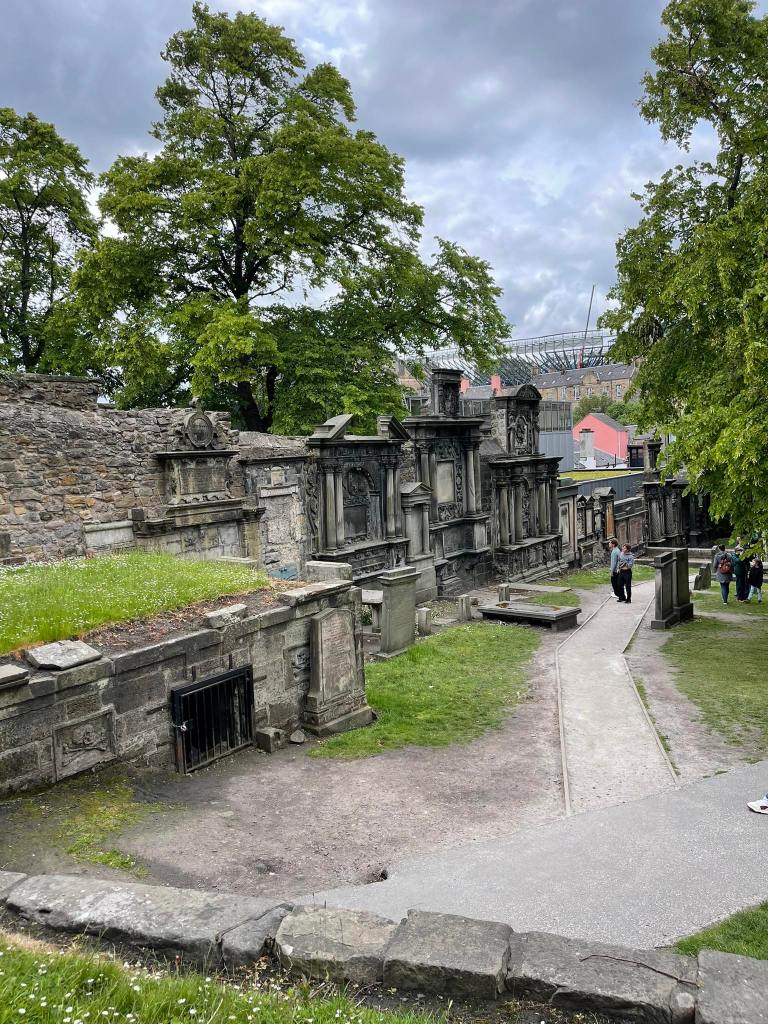
Let’s take a couple of examples at Greyfriars to see if we can decide which term applies to which. The first photo looks along the west wall and captures a sense of the wide range of different types of stones we have here. But deciding what is the appropriate term to describe each type is not entirely straightforward or clear cut. The structure that forms a burial place in the bottom left in this image may best be described as a Vault, the large wall mounted stones may best be described as Mural Monuments, the stones lying flat in front of the mural monuments may best be described as Ledger Stones. One of these is slightly raised up with a space beneath, so may qualify as a table stone whilst the upright stones on the right may best be described as Headstones.
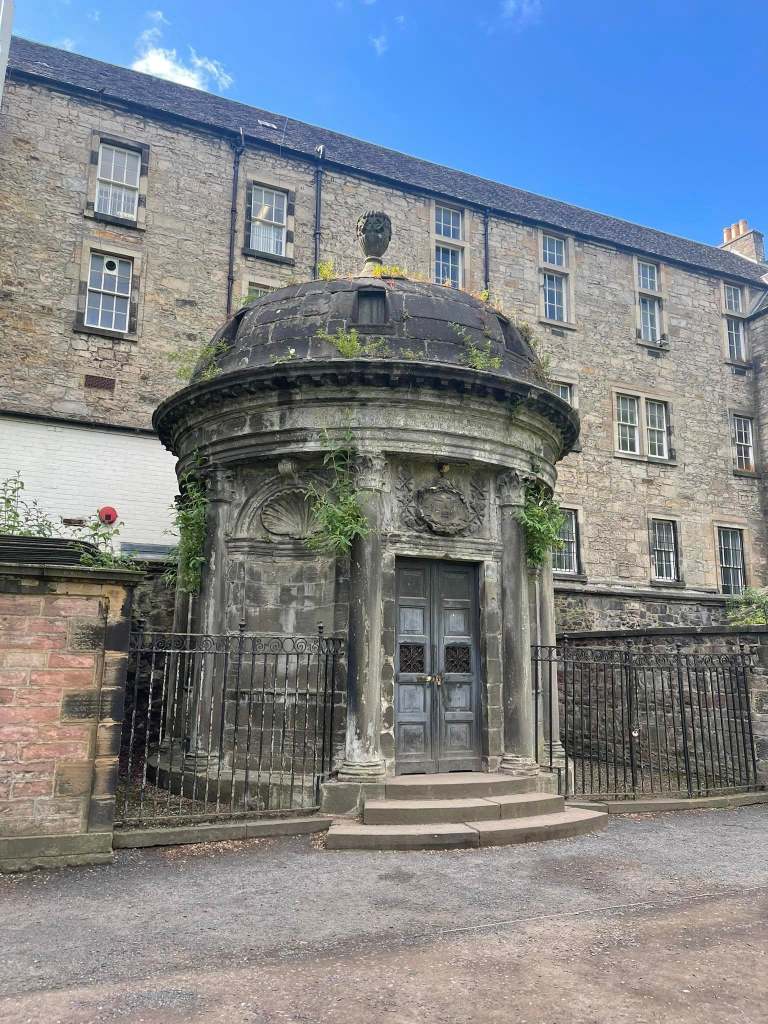
The second image is the burial place of Mackenzie which may best be described as a Mausoleum but this is complicated by the fact that the coffins in here are stored below ground level.
The third image is an enclosed Lair, in which the burials are made underground.
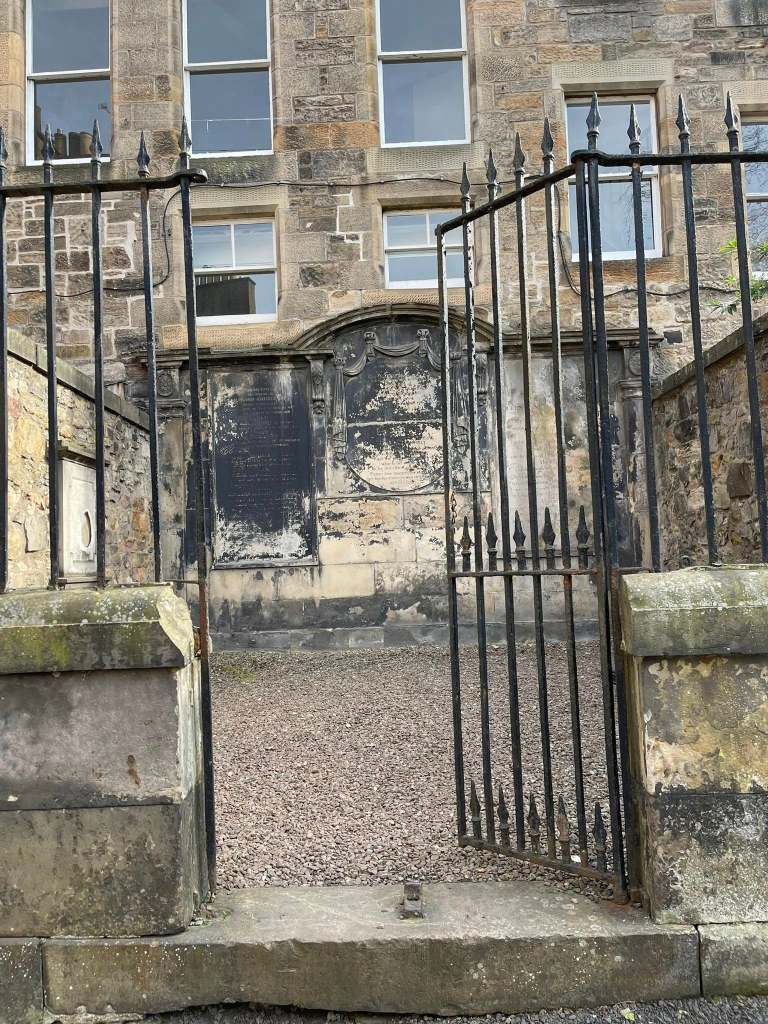
The Foulis Mural Monument may be described as “A Monumental Memorial, that acts like an enormous Headstone, to Mark the Foulis family Lair”.
 Friends of Greyfriars Kirkyard